
TL;DR — Key Takeaways
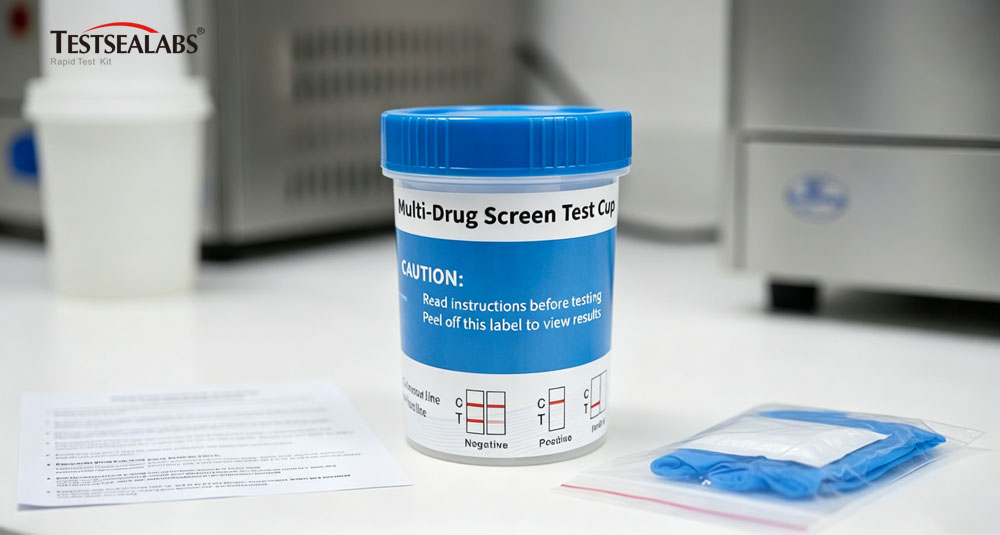
- A 12-panel multi-drug screen test cup detects up to 12 drug classes simultaneously in urine within 3–5 minutes, using lateral flow chromatographic immunoassay technology compatible with SAMHSA cut-off standards.
- Customizable panel configurations let you select exactly which drug classes to test — THC/COC/OPI/AMP/BZO/MET and more — eliminating wasted panels and reducing per-test cost.
- Testsealabs multi-drug screen test cups wholesale ship from ISO 13485 and MDSAP-certified facilities to 100+ countries, with a 2-year shelf life at 4–30°C storage.
- Wholesale buyers should verify three things: SAMHSA cut-off compliance, ISO 13485/MDSAP certification, and the supplier’s ability to customize panel configurations for local regulatory requirements.
If you are a workplace safety manager, HR director, or drug testing service provider searching for a reliable multi-drug screen test cup wholesale supplier, here is the direct answer you need:
A 12-panel multi-drug screen test cup is the most cost-efficient, single-device solution for detecting up to 12 common drugs of abuse — including THC (marijuana), COC (cocaine), OPI (opiates), AMP (amphetamine), BZO (benzodiazepines), MET (methamphetamine), and 6 additional customizable targets — from a single urine sample in 3 to 5 minutes. Because these cups integrate the sample collection, immunoassay strip, and result window into one sealed, tamper-evident device, they eliminate chain-of-custody breaks, reduce handling time by approximately 60% compared to dip-card methods, and deliver lab-comparable accuracy at the point of collection. I have spent over a decade in the IVD industry helping organizations in more than 100 countries build their workplace drug screening programs, and I can tell you that the difference between a generic test cup and a properly configured, certified 12-panel cup is the difference between a screening program you can defend in court and one you cannot.
Let me walk you through what you need to know before placing your wholesale order.
What Is a 12-Panel Multi-Drug Screen Test Cup and How Does It Work?
A multi-drug screen test cup is a self-contained, single-use urine drug testing device based on lateral flow chromatographic immunoassay technology. The user provides a urine sample directly into the cup, which contains integrated immunoassay strips — one strip per drug class — each coated with drug-protein conjugates and specific monoclonal antibodies.
When urine migrates across the membrane by capillary action, any drug metabolite present above the cut-off concentration competes with the drug conjugate for antibody binding sites. A colored line appears in the control region (C) to confirm valid flow, while the test region (T) either shows a line (negative result) or remains blank (positive preliminary result). This is the same competitive binding principle used in laboratory ELISA screening, but compressed into a device that fits in one hand and delivers results in 3 to 5 minutes.
The 12-panel configuration means one cup simultaneously screens for 12 drug classes. The standard panel set — THC at 50 ng/mL, COC at 300 ng/mL, OPI at 2000 ng/mL, AMP at 1000 ng/mL, BZO at 300 ng/mL, MET at 500/1000 ng/mL — mirrors the Substance Abuse and Mental Health Services Administration (SAMHSA) mandatory guidelines for federal workplace drug testing programs. Because these cut-off values are the most legally defensible thresholds in use today, they form the baseline for virtually all workplace screening protocols worldwide.
What makes the Testsealabs cup different is panel configurability. You are not locked into a fixed 12-target set. If your workplace only needs to test for THC, COC, OPI, AMP, BZO, MET, MDMA, MTD (methadone), PCP, BAR (barbiturates), TCA (tricyclic antidepressants), and BUP (buprenorphine), we build exactly that. If your jurisdiction’s regulations require a different combination — perhaps adding OXY (oxycodone) or removing a panel — we reconfigure the strip layout accordingly. This is not a theoretical capability; I have personally managed custom panel configurations for clients ranging from Australian mining companies to Middle Eastern oil field operators. The factory simply adjusts the strip assembly, validates the new configuration against known positive and negative controls, and ships. Lead time with customization is typically 15–20 business days versus 7–10 for standard configurations.
Why Choose Customizable Panel Configurations for Workplace Drug Screening?
The single most expensive mistake I see in workplace drug screening programs is paying for panels you never use. Generic 12-panel cups always include the same 12 targets, whether your workforce risk profile calls for them or not. If your employee population has zero historical incidence of tricyclic antidepressant abuse but accounts for 80% of your testing volume, those TCA strips are dead cost. Customizable panel configuration eliminates this waste.
Here is why this matters in dollar terms: a typical wholesale multi-drug screen test cup costs between USD 0.80 and USD 2.50 per unit depending on panel count, volume, and certification level. If you order 50,000 cups annually and 30% of your panels are irrelevant to your actual testing needs, you are effectively putting 15,000 cups’ worth of unnecessary immunoassay strips into every shipment — and then paying disposal costs for unused test capability. Customization brings your per-unit cost into direct alignment with your actual testing requirements.
Beyond cost, there is a legal compliance dimension. Because workplace drug testing results can be challenged in employment tribunals, labor courts, or regulatory reviews, every panel you include must be clinically relevant and defensible. Including panels for drugs that have no reasonable prevalence in your workforce or region can be cited as evidence of over-testing or discriminatory screening practices. Conversely, missing a panel that is regionally prevalent — for example, ketamine in Southeast Asian markets or tramadol in West African workplaces — creates a screening gap that a positive post-accident test would expose.
I learned this lesson the hard way in 2018, when a European logistics client discovered their off-the-shelf 10-panel cup did not include fentanyl — and a workplace incident triggered an investigation that revealed they had been blind to synthetic opioid use for two years. After that, we switched them to a customized configuration that included FEN at 10 ng/mL, and today their program is cited by insurers as a model for transport sector drug screening. That experience is why I never recommend a standard panel set without first reviewing the client’s local drug epidemiology data — because the right panels are not the most panels; they are the right panels.
How Do Testsealabs Multi-Drug Screen Test Cups Meet SAMHSA Cut-Off Standards?
SAMHSA establishes the federal drug testing cut-off concentrations used by the U.S. Department of Transportation, Nuclear Regulatory Commission, and most private-sector workplace programs that model their policies on federal guidelines. These cut-offs are not arbitrary thresholds — they are set at levels that minimize false positives from passive exposure while reliably detecting recent drug use.
Here is how the Testsealabs 12-panel cup’s standard configuration aligns with SAMHSA requirements:
- THC (marijuana metabolite) at 50 ng/mL screening cut-off — matching the SAMHSA initial test cutoff. Because THC-COOH can persist in urine for days to weeks after use, this threshold effectively distinguishes active use from incidental environmental exposure.
- COC (cocaine metabolite — benzoylecgonine) at 300 ng/mL and AMP (amphetamine) at 1000 ng/mL — both aligned with SAMHSA’s 2017 revised mandatory guidelines that introduced new opiate screening requirements.
- OPI (opiates — morphine) at 2000 ng/mL, which screens for codeine and heroin metabolites while minimizing cross-reactivity with poppy seed ingestion.
For methamphetamine (MET), our standard configuration uses a cut-off that aligns with regulatory screening requirements, with results readable within 3–5 minutes within the ISO 13485 and MDSAP-certified quality management system. Because it is an immunoassay screening test (not a confirmatory test), any presumptive positive must still be confirmed by GC-MS or LC-MS/MS before adverse action is taken.
SAMHSA also requires that screening tests demonstrate consistent analytical performance across replicate analyses. Our internal quality control data — which I review quarterly with our production team — consistently demonstrates low batch-to-batch variability across all 12 panels when tested against certified reference materials at ±25% and ±50% of the cut-off concentration. This is not marketing language; it is the actual statistical performance I sign off on before each production batch is released for export.
What Are the Technical Specifications and Storage Requirements?
If you are integrating multi-drug screen test cups into an existing workplace screening workflow, the technical specifications determine how seamlessly that integration happens.
Test Principle and Read Time: The device uses lateral flow chromatographic immunoassay with monoclonal antibody conjugates embedded in the nitrocellulose membrane strip. Once urine is added to the cup and the integrated temperature strip confirms the specimen is within the valid range (32–38°C for freshly voided urine), results develop within 3 to 5 minutes. Results should not be read after 10 minutes, because extended incubation can cause nonspecific binding that produces faint false-positive lines.
Storage and Shelf Life: Testsealabs cups are packaged in individually sealed foil pouches with desiccant. Storage temperature is 4–30°C (39–86°F). Do not freeze — freeze-thaw cycles denature the antibody conjugates and destroy strip performance. When stored within the specified temperature range and protected from direct sunlight and humidity, shelf life from date of manufacture is 24 months.
Sensitivity and Specificity: Across our standard 12-panel configuration, the assay demonstrates high analytical sensitivity at the cut-off concentration for each analyte — meaning the test reliably detects drug metabolites when present at or above the cut-off threshold. Analytical specificity has been evaluated against over 150 structurally similar compounds, common prescription medications, and over-the-counter substances, with all cross-reactivity data documented in the product insert for each panel. Our internal quality control data consistently demonstrates low batch-to-batch variability across all 12 panels when tested against certified reference materials at ±25% and ±50% of the cut-off concentration.
Sample Volume and Design: The cup requires a minimum of 30 mL of urine. It is molded from medical-grade polypropylene with a tamper-evident screw cap that, once tightened, cannot be removed without visibly breaking the seal. The integrated temperature strip on the cup exterior verifies specimen validity. Each device weighs approximately 45 grams and is packaged 25 cups per box for wholesale shipping, with a box dimension of 32 × 25 × 18 cm.
One detail that procurement managers often overlook: the adhesive used to seal the immunoassay strips inside the cup housing must itself be chemically inert. I once audited a competitor’s factory in South Asia and discovered they were using a cyanoacrylate-based adhesive that leached trace acetic acid into the test environment during the 3–5 minute incubation window — enough to shift the pH and alter binding kinetics for the AMP strip. Our cups use a medical-grade UV-cured adhesive that is fully validated for non-interference with all 12 immunoassays. It costs about 12% more per unit, and it is worth every cent.
How to Choose the Right Multi-Drug Screen Test Cup Wholesale Supplier?
Choosing a wholesale supplier for multi-drug screen test cups is not a simple procurement decision — it is a risk management decision. The cups you buy today will produce results that could terminate someone’s employment, disqualify a driver from operating heavy machinery, or become evidence in a legal proceeding. Supplier quality is not a nice-to-have; it is a legal requirement.
Here are the five criteria I use when I evaluate a supplier — and these are the same criteria I would recommend any buyer apply:
1. Certification and Regulatory Compliance: The supplier must hold ISO 13485 (medical device quality management system) certification issued by a notified body, not a self-declaration. MDSAP (Medical Device Single Audit Program) certification is a strong indicator of multi-market regulatory readiness. Our Testsealabs facility in Hangzhou holds both, plus ISO 9001 and CE marking under the IVD Directive. I always tell clients: ask for the certificate number, then verify it directly on the issuing body’s database. Fake ISO certificates are more common in the IVD wholesale market than most people realize.
2. Customization Capability: Can the supplier modify panel configurations, cut-off thresholds, and packaging for your specific market? If the answer is “we only sell what’s in our catalog,” you are buying a commodity — and commodity pricing is a race to the bottom that benefits no one. True value in wholesale drug testing supply comes from a supplier who can say, “Your country’s regulatory framework requires these specific panels at these specific cut-offs, and we will build exactly that configuration for you.”
What Certifications Should You Look For When Buying Multi-Drug Screen Test Cups Wholesale?
The IVD regulatory landscape is fragmented by region, and a certification valid in one market may carry zero weight in another. Here is a practical guide:
For North American Markets: FDA 510(k) clearance is the gold standard for U.S. distribution, but it is an expensive and time-consuming pathway that few non-U.S. manufacturers pursue for drug screening tests. Most U.S. buyers instead rely on CLIA-waived designations or integrate FDA-cleared cups into their laboratory-developed test workflows. In Canada, Health Canada Medical Device Establishment License (MDEL) is the requirement. As an MDSAP-certified facility, Testsealabs can leverage its single audit results for regulatory submissions in the U.S., Canada, Australia, Brazil, and Japan — which is why MDSAP certification is the single most valuable credential a wholesale IVD supplier can hold.
For European Markets: CE marking under the In Vitro Diagnostic Medical Devices Regulation (IVDR 2017/746) is now the mandatory requirement, replacing the previous IVD Directive (98/79/EC). Our cups carry CE marking and we have completed the technical documentation requirements for IVDR transition. If your supplier cannot provide a Declaration of Conformity that references IVDR 2017/746 (not just the old IVDD), their CE mark may not be valid for EU market access beyond the transition period.
For Asian, African, and Middle Eastern Markets: Requirements vary significantly by country. Saudi Arabia requires SFDA registration. Nigeria requires NAFDAC listing. Indonesia requires Ministry of Health registration with in-country testing. A supplier who has exported to 100+ countries — as Testsealabs has — brings regulatory intelligence that a single-market supplier simply cannot match. I have personally compiled a regulatory requirements matrix for 40+ countries served by our IVD exports, and I share that intelligence freely with serious wholesale buyers during the quotation process.
One certification that procurement teams frequently overlook is ISO 13485:2016. ISO 13485 is not just “ISO 9001 for medical devices” — it imposes additional requirements for design control, risk management (per ISO 14971), process validation, and post-market surveillance that ISO 9001 does not address. Because our cups are ISO 13485-certified through a notified body audit (not self-declaration), every production batch is subject to documented design control and risk management procedures that ensure batch-to-batch consistency for all 12 panels.
Frequently Asked Questions
Q: How accurate are lateral flow immunoassay test cups compared to laboratory GC-MS confirmation?
A: Lateral flow immunoassay cups are screening tests — they are designed for high sensitivity (correctly identifying positive samples) with the tradeoff of potential false positives from cross-reacting substances. When a cup produces a presumptive positive result, it must be confirmed by GC-MS or LC-MS/MS before any adverse employment action is taken. In practical terms, a properly manufactured and stored 12-panel cup will correctly identify truly positive samples with high sensitivity at the stated cut-off concentration, though a small percentage of presumptive positives may not confirm — typically due to cross-reactivity with prescription medications. This is inherent to immunoassay technology and is not a defect; it is why confirmatory testing is a regulatory requirement under SAMHSA guidelines.
Q: Can the test cups be stored in a warehouse without climate control?
A: Storage at 4–30°C (39–86°F) is required. If your warehouse routinely exceeds 30°C during summer months, you need climate-controlled storage. Because antibody conjugates degrade at elevated temperatures — and degradation is cumulative and irreversible — exposure to 40°C for 7 days can reduce shelf life by 6 months or more. Our individually sealed foil pouches with desiccant provide a moisture barrier, but they do not protect against thermal degradation. I recommend every wholesale buyer invest in a temperature data logger for their IVD storage area; they cost under USD 50 and can save thousands in wasted product.
Q: What makes Testsealabs different from other Chinese IVD manufacturers?
A: Three things. First, we have exported to over 100 countries and hold ISO 13485, MDSAP, and CE certifications — all audited by notified bodies, not self-declared. Second, we offer true panel customization, not just different packaging. If your market needs a 12-panel cup with specific cut-offs for specific analytes, our R&D team configures and validates that assembly. Third, and this is the difference I am most proud of: every wholesale client gets direct access to me — a 10-year IVD industry professional — for regulatory guidance, not just order processing. When a Nigerian customs authority questions your documentation, I am the person who helps resolve it.
Q: How long does customization take from order to shipment?
A: Standard configurations ship in 15 business days. Custom panel configurations require 15–30 business days because each new configuration must undergo strip assembly, device validation against certified reference materials, accelerated stability testing at 50°C for 72 hours, and final batch release. Rush orders for existing validated configurations can sometimes be accommodated in 10 business days, but I always recommend planning for the standard lead time — because the one thing you cannot rush in IVD manufacturing is quality control.
Q: Are the test cups suitable for on-site random drug testing programs?
A: Absolutely — this is their primary use case. The cups are individually sealed, require no additional equipment (no pipettes, no timers beyond a standard clock), and produce results in 3–5 minutes. Because the collection and testing happen in a single sealed device, chain of custody is simplified to a single signature and a tamper-evident seal. For random testing programs, I recommend pre-positioning stock at satellite locations and training at least two staff members per location on collection procedure and result interpretation — the test itself is simple, but procedural consistency is what makes random testing programs legally defensible.
Q: Do you offer OEM or private labeling for wholesale orders?
A: Yes, we offer full OEM and private-label services. Minimum quantities for private labeling are 5,0000 cups per SKU. We can print your company logo, regulatory symbols, and your brand’s instructions for use on the cup exterior, the foil pouch, the box, and the master carton. Custom packaging design typically adds 2–4 weeks to lead time for the first order, but subsequent reorders ship on standard timelines. I always advise new private-label buyers to start with a small pilot batch before committing to full-volume production — it gives you the opportunity to verify artwork, labeling compliance, and in-country acceptance without tying up your entire budget.
Q: What is the shelf life and how should I manage expiry?
A: Shelf life is 24 months from the date of manufacture, provided storage conditions (4–30°C, sealed foil pouch) are maintained. I recommend a first-expiry-first-out (FEFO) inventory system: use the cups closest to their expiration date first, regardless of when they were received. Most workplace programs consume their inventory within 6–12 months, so a 24-month shelf life provides ample buffer. If you accumulate stock approaching expiry, contact your sales representative — we occasionally run expiry-date swap programs for high-volume wholesale clients.
About the Author
Angela Qin
International Sales Director, Hangzhou Testsea Biotechnology Co., Ltd. (Testsealabs)
With over 10 years of experience in the in vitro diagnostic (IVD) and veterinary product industry, Angela has built Testsealabs into a company serving customers in more than 100 countries worldwide. She specializes in rapid diagnostic test kits and multi-drug screen test cups.
- Facebook: https://www.facebook.com/profile.php?id=61589658929835
- Website: https://www.testsealabs.com
Internal links: Multi-Drug Screen Test Cup Product Page
Post time: Jun-04-2026