
African Swine Fever: Understanding the Global Challenge and the Importance of Early Detection
Rapid Diagnostic Solutions to Support Improved Animal Health Monitoring and Disease Management
Introduction
African swine fever (ASF) remains one of the most significant challenges affecting the global pig industry. As a highly contagious viral disease affecting domestic pigs and wild boar, ASF can cause severe economic losses and poses major threats to livestock production, animal health management, and food security.
Since spreading beyond the African continent, ASF has become a truly global concern. The World Organisation for Animal Health (WOAH) describes ASF as one of the most devastating diseases of domestic pigs and wild boar worldwide. Between January 2022 and February 2025 alone, ASF led to the loss of more than 2 million animals globally, with Asia and Europe being the most severely affected regions. The disease has now been reported in five different regions of the world.
As biosecurity and disease surveillance become increasingly important, early identification and effective monitoring have become indispensable components of modern herd health management. Convenient and reliable diagnostic technologies play a critical role in supporting veterinarians, farmers, and animal health professionals in making informed decisions and strengthening disease prevention strategies.
What is African Swine Fever (ASF)?
African swine fever is a viral disease caused by the African swine fever virus (ASFV) , a large, stable double-stranded DNA virus belonging to the family Asfarviridae. ASF infects members of the family Suidae, including domestic pigs and wild boar.
The disease does not infect humans and is not considered a human health risk. According to existing research, the possibility of ASF mutating to infect humans is extremely low. However, it has a major impact on animal health, livestock production, and the global pork supply chain.
The Virus and Its Characteristics
Understanding the biological characteristics of ASFV helps explain why this disease is so difficult to control.
Environmental resistance
ASFV is highly resistant in the environment. The virus can survive on clothing, boots, wheels, vehicles, and other objects, as well as in pork products. This environmental resistance means that without adequate biosecurity measures, the virus can easily spread across borders. Contaminated equipment, feed, and even footwear can serve as vehicles for virus introduction.
Transmission routes
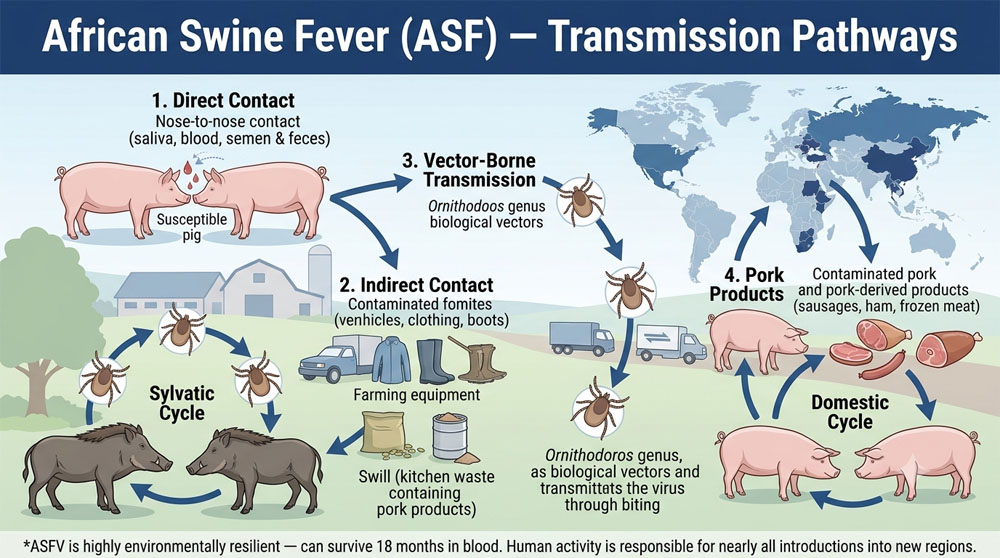
ASFV can be transmitted through multiple routes:
- • Direct contact between infected pigs and susceptible animals
- • Indirect contact through contaminated fomites (equipment, vehicles, clothing)
- • Ingestion of contaminated swill or feed
- • Vector-borne transmission via soft ticks of the genus Ornithodoros
- • Human-mediated transmission through the movement of pigs, pork products, and contaminated materials
In the natural sylvatic cycle in Africa, ASFV is maintained by indigenous suids (such as warthogs and bushpigs) as natural reservoir hosts, together with tick vectors. These wild hosts usually do not show clinical signs. However, in domestic pigs and wild boar, the virus can cause devastating disease, with mortality rates reaching over 90%.
The challenge of multiple genotypes
ASFV exists in multiple genotypes, among which genotypes I and II are the most prevalent. The genetic diversity of the virus complicates surveillance and control efforts. Recent studies have documented the evolutionary patterns of circulating genotypes in different regions, emphasising the importance of ongoing genetic monitoring to track transmission dynamics and strengthen disease control strategies.
Global Challenge: Spread and Distribution
Historical spread
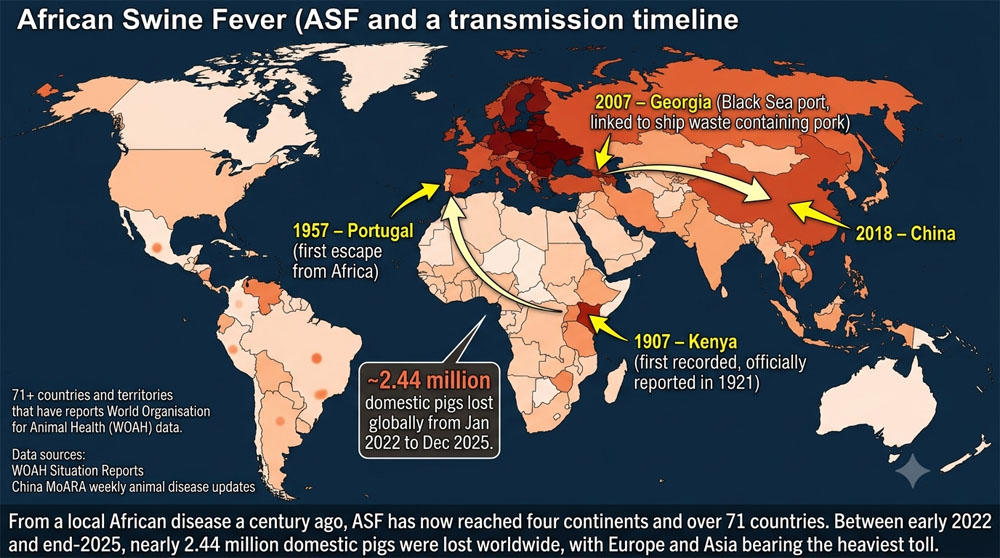
The first case of ASF is believed to have occurred in 1907 in Kenya, but it was not officially reported until 1921. The virus rapidly spread to other countries in eastern and southern Africa, and later to central and western Africa.
ASF was confined to Africa until it was detected in 1957 in Portugal. It subsequently spread to Spain and France, and was eradicated from the European continent only in the 1990s. The virus re-emerged in 2007 at the Black Sea port of Poti, Georgia—an outbreak linked to ship waste containing pork products. Genotyping traced the virus to outbreaks in Mozambique, Madagascar, and Zambia.
A truly global disease
Since the 2007 outbreak in Georgia, ASF has continued its relentless spread. By the end of 2007, the virus had spread within Georgia and reached neighbouring Armenia, Azerbaijan, Iran, Russia, and Belarus. In 2018, ASF entered China. Today, the disease has spread to four continents beyond Africa.
The latest WOAH data illustrate the ongoing global burden:
- • In July 2025 alone: 11 European countries, 3 Asian countries, and 1 African country reported outbreaks.
- • 83 new outbreaks were recorded in domestic pigs, causing the loss of 19,241 animals.
- • 193 outbreaks were recorded in wild boar populations.
- • Since January 2022, 67 countries and territories have reported the presence of the virus.
The fact that ASF can appear in a new country or region at any time, without warning, adds further complexity to the challenge.
Diversity of Clinical Presentations: Why Detection is Challenging
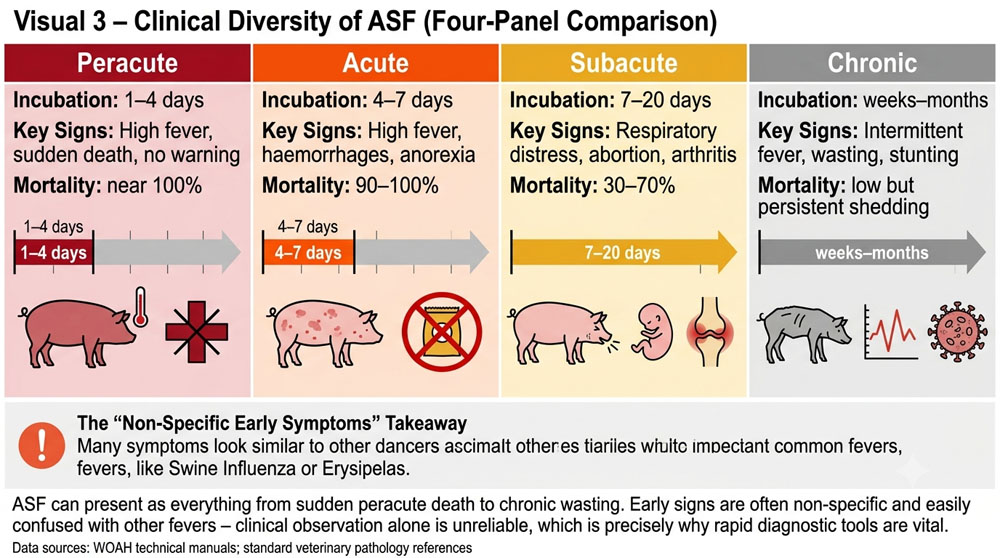
The clinical presentation of ASF varies depending on the virus strain, the animal’s condition, and the stage of infection. The disease can manifest in multiple forms:
Peracute, acute, subacute, and chronic
- • Peracute and acute forms: After a short incubation period, infection usually begins with severe but nonspecific systemic signs—high fever, depression, and anorexia. In the terminal phase, pigs may show hemorrhagic signs. Pigs infected with highly virulent ASFV strains can die before producing antibodies.
- • Subacute and chronic forms: Clinical signs are milder and more variable, and may include respiratory problems, abortion, arthritis, chronic skin ulcers, or necrosis. Chronically infected pigs may show intermittent low-grade fever, reduced appetite, depression, and may become emaciated, weak, or stunted.
The challenge of early detection
Because early signs are often non-specific and may resemble other pig diseases, visual observation alone is insufficient for reliable disease assessment. Clinical ASF cases are usually diagnosed through laboratory testing. In the field, the presence of one or several dead wild boars, a live wild boar showing signs, or an abnormal carcass on postmortem examination may suggest ASF.
This wide spectrum of clinical presentations—from sudden death to chronic mild signs—makes timely and accurate detection particularly difficult, and further underscores the importance of convenient diagnostic tools for effective surveillance and early response.
Economic and Food Security Impacts
Devastating losses for farmers and communities
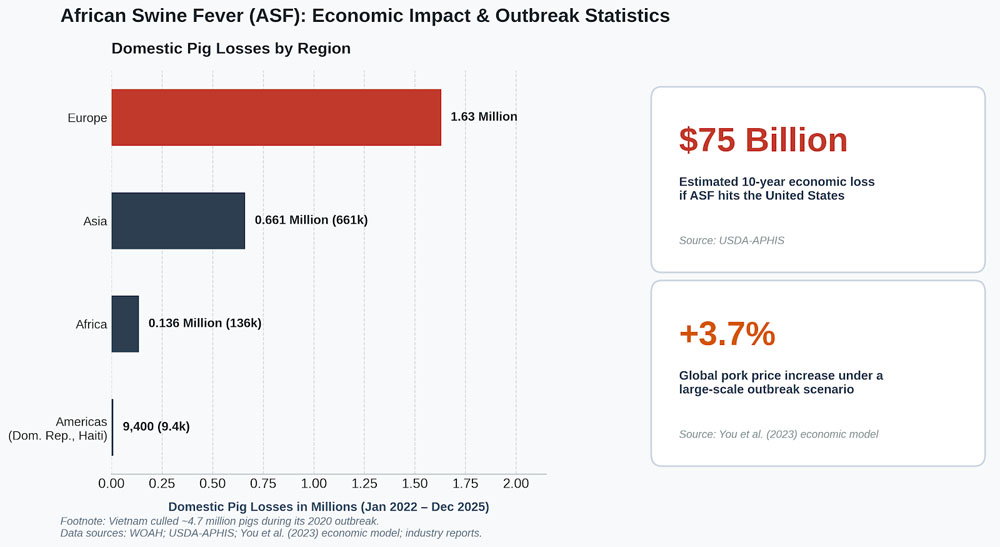
WOAH notes that ASF “has become a major crisis for the pig meat sector in recent years.” Its impact goes far beyond the animals themselves.
In many countries, pigs are a primary source of income for family-run farms. When ASF strikes, entire livelihoods can disappear overnight. In Nigeria, for example, ASF poses a major challenge to the pig industry, with the estimated annual disease burden due to pig mortality reaching US$6.2 million.
Global economic consequences
The economic consequences of ASF can be severe:
- • Reduced farmer incomes due to herd losses and decreased pork production
- • Higher consumer prices due to supply contraction
- • Reduced revenue across the pork industry
- • Market instability and disrupted trade flows
In the United States (currently ASF‑free), the estimated economic loss from a potential outbreak would exceed US$50 billion and eliminate more than 140,000 jobs. Other estimates suggest that a large-scale outbreak could cause serious welfare losses of up to US$11.4 billion in the US. For Brazil (one of the top five pork exporters globally), an outbreak would significantly reduce production, raise domestic pork prices, and push up global pork prices.
Threat to food security
If left unchecked, ASF can “put food security at risk.” Pork accounts for 31% of global protein intake. When pig populations plummet, the supply of this critical protein source is disrupted, affecting global nutrition and food availability.
Real-world impact
The real-world losses are staggering. In Vietnam (the world’s sixth largest pork producer), approximately 4.7 million pigs were culled as ASF spread to all 63 provinces. In Europe, ASF continues to pressure wild boar populations and domestic pig farms. In the first half of 2026 alone, Serbia recorded 132 outbreaks, Romania 109, and Croatia 24. Even as global outbreaks have declined by some measures, the disease remains a persistent threat—especially in European wild boar populations.
Control Challenges: No Widely Available Commercial Vaccine
Controlling ASF has historically been difficult due to the lack of commercial vaccines or effective treatments.
Vaccine development: progress and challenges
In recent years, the research community has made considerable progress in ASF vaccine development—some vaccines have received approval for field use in a few countries. Live attenuated vaccines are currently considered the most promising approach, with certain variants showing significant protective efficacy in pigs.
However, developing highly effective and safe vaccines remains a major challenge.
- • Inactivated vaccines have consistently shown poor efficacy
- • The extensive genetic diversity and largely unknown antigenic diversity of the virus complicate vaccine design
- • Current ASF vaccines under development still face challenges in achieving absolute safety and reliable efficacy
WOAH vaccine standards
In May 2025, the WOAH adopted its first international standards for ASF vaccines. These standards aim to provide minimum requirements for safe and effective vaccines for members and manufacturers. They emphasise that vaccines must:
- • Effectively reduce disease severity and limit virus transmission
- • Provide immunity to animals
- • Be proven safe before use—i.e., they must not cause persistent or severe clinical signs
- • Match the ASF genotype circulating in the region where they are used
Use of substandard or non-compliant vaccines could threaten ASF control efforts—ineffective vaccines could allow disease spread or lead to recombination between vaccine virus and circulating ASF virus, generating new strains that are more transmissible and harder to detect.
Multi-layered control strategies
WOAH emphasises that vaccination alone is not a viable method to control ASF. Successful disease management requires a combination of biosecurity measures, import controls, and pig movement restrictions—with vaccines as a complementary tool. As WHO states, “strict biosecurity, import controls, and movement restrictions” remain fundamental. Until safe and effective vaccines are widely available, prevention, biosecurity, and early detection remain the key strategies for ASF control.
The Importance of Rapid Testing in ASF Management
Traditional laboratory diagnostic methods, though accurate, usually require specialised equipment, trained operators, and long turnaround times, making it difficult to meet the needs of on-site real-time decision-making. In actual farming and production processes, disease surveillance and early detection are often constrained by the accessibility and response speed of testing.
Therefore, there is a growing demand for convenient and rapid screening solutions to support:
- • Routine farm-level monitoring and proactive screening
- • Rapid veterinary field investigations and preliminary assessments
- • Regular operation of regional animal health surveillance programmes
- • Rapid response and decision-making in emergency situations
Rapid testing technologies offer significant advantages, such as ease of operation, no need for complex equipment, efficient workflows, and suitability for various field environments. They can bring testing capabilities to the front line of farming, helping veterinarians and farmers obtain critical information in the shortest possible time, thereby enabling the timely implementation of biosecurity measures such as isolation and disinfection to reduce the risk of disease spread.
By lowering the threshold for testing and increasing surveillance frequency, rapid test solutions can effectively compensate for the limitations of traditional testing in terms of timeliness and coverage, providing important sentinel support for the global ASF control system.
Supporting ASF Detection with Rapid Diagnostic Technology
As part of our commitment to advancing global animal health, we offer rapid diagnostic solutions designed to support ASF surveillance and veterinary applications.
Our African Swine Fever rapid test portfolio includes:
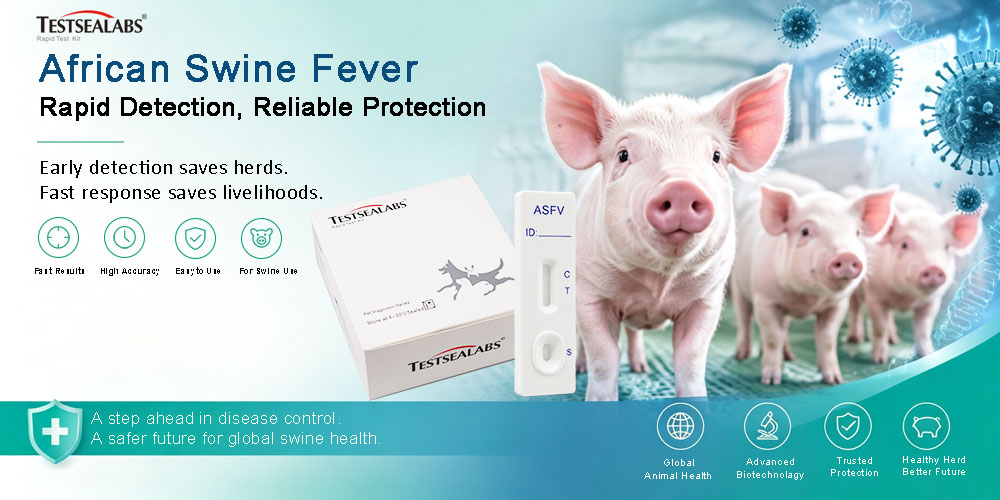
African Swine Fever Virus Antigen Rapid Test Cassette
Rapid screening solution for ASF virus detection
The African Swine Fever Virus Antigen Rapid Test Cassette is designed to support the detection of ASF virus-related antigens in animal samples.
This rapid test format provides a convenient testing method for veterinary professionals and animal health applications, suitable for scenarios requiring timely screening support.
Key features
- • Rapid antigen detection technology
- • User-friendly test cassette format
- • Simple testing procedure
- • Suitable for veterinary field applications
- • Supports ASF surveillance and screening programmes
Potential applications
- • Pig farms
- • Veterinary clinics
- • Animal disease surveillance programmes
- • Livestock health management
African Swine Fever Virus Antibody Rapid Test Cassette
Supporting ASF exposure monitoring and epidemiological investigation
The African Swine Fever Virus Antibody Rapid Test Cassette is designed to detect ASF virus antibodies, supporting activities related to the immune response and disease surveillance.
Antibody-based testing can provide valuable information for veterinary professionals to assess ASF exposure and conduct epidemiological investigations.
Key features
- • Antibody detection technology
- • Convenient rapid test format
- • Supports disease surveillance activities
- • Easy-to-operate testing procedure
- • Suitable for veterinary applications
Potential applications
- • Veterinary laboratories
- • Livestock surveillance programmes
- • Animal health research
- • ASF monitoring schemes
Building a Better Future for Global Animal Health
Managing African Swine Fever requires close collaboration among farmers, veterinarians, researchers, governments, and animal health technology providers.
While biosecurity remains the foundation of disease prevention, convenient diagnostic solutions can provide valuable support by enhancing surveillance capabilities and accelerating awareness of potential disease risks.
Through innovative in vitro diagnostic technologies, we are committed to supporting global animal health and providing reliable testing solutions for veterinary professionals around the world.
Partner with Us for Advanced Veterinary Diagnostic Solutions
Learn more about our African Swine Fever Virus Antigen and Antibody Rapid Test solutions and explore how rapid testing technology can support your animal health programmes.
Post time: Jul-21-2026