
TL;DR — Key Takeaways for Brazilian Healthcare Distributors
- Triple Arboviral Combo Tests (Dengue IgG/IgM/NS1 + Zika + Chikungunya) are replacing single-pathogen rapid tests in Brazilian point-of-care settings — because co-circulation of these three arboviruses makes differential diagnosis impossible without multiplex testing.
- Aceita armazenamento em temperatura ambiente (4–30°C) — Chinese-manufactured combo rapid tests from ISO 13485-certified facilities like Testsea are stable for 24 months when stored per labelled conditions, eliminating cold chain requirements for last-mile distribution in the Brazilian North and Northeast regions.
- Brazilian healthcare procurement through SUS and private clinic networks is driving sustained demand for cost-effective rapid diagnostic tests with regulatory compliance (ANVISA registration), and Chinese manufacturers with CE-IVDR and ISO 13485 credentials are well-positioned to meet this demand.
- The minimum order quantity for wholesale combo test procurement is 5,000 units for standard configurations, with OEM/custom specifications (packaging, insert language, branded cassette) available at 50,000-unit MOQ — economics that support competitive landed costs in Brazilian Reais.
The Brazilian Arboviral Challenge: Why Single-Pathogen Tests Are No Longer Enough
Brazil’s public health system has been fighting a losing battle against arboviral disease for over two decades. Dengue fever — transmitted by Aedes aegypti mosquitoes — has been endemic across most of Brazil’s states since the early 1980s. Zika virus arrived dramatically in 2015, associated with the microcephaly crisis in newborns. Chikungunya, while less headline-generating, has established persistent transmission in the Northeast and Amazon regions since 2014.
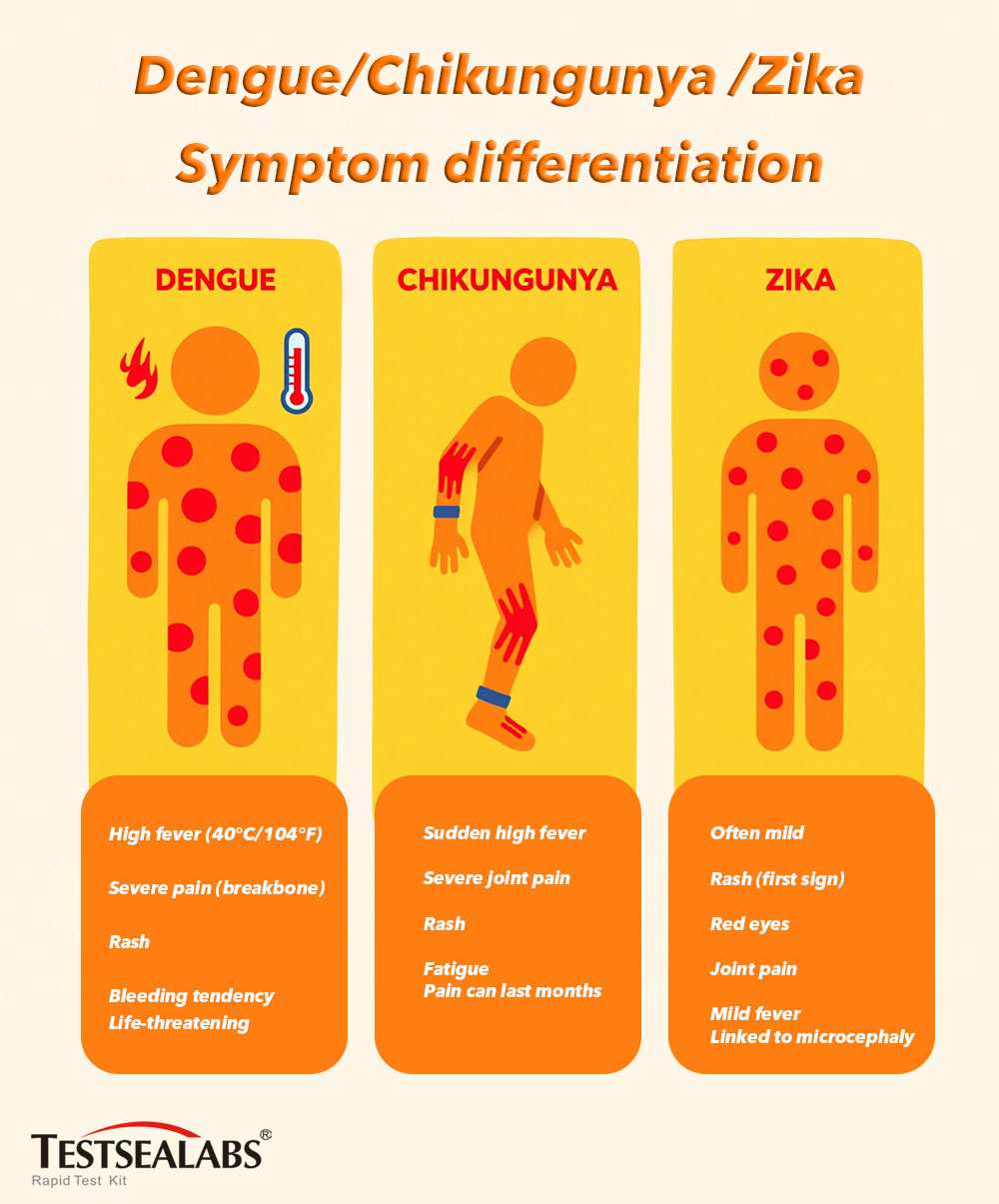
The clinical challenge that this creates is profound: all three diseases present with similar initial symptoms — fever, headache, muscle pain, rash — and the differential diagnosis cannot be made clinically. A patient presenting with 3 days of fever and joint pain could have any of the three, and the clinical management pathway is meaningfully different for each. Dengue requires fluid management to prevent hemorrhagic progression. Zika requires fetal monitoring in pregnancy. Chikungunya requires pain management for the chronic arthritis that can persist for months.
I’ve worked with public health diagnostic procurement specialists in Brazil who describe the situation bluntly: “Before combo tests, we were treating the wrong disease in approximately 25–30% of suspected arboviral cases during co-circulation periods, because we were guessing based on the most recent outbreak data rather than actual pathogen identification.” That clinical misallocation of treatment — with real consequences for patient outcomes — is the fundamental driver behind the adoption of multi-pathogen combo rapid tests in Brazilian primary care and hospital settings.
How Combo Rapid Tests Work: The Immunochromatography Principle
Understanding the technology behind Dengue/Zika/Chikungunya combo rapid tests helps Brazilian procurement officers evaluate product quality claims from different suppliers — and identify which specifications actually matter versus which are marketing language.
Lateral Flow Immunochromatography
Combo rapid tests for Dengue, Zika, and Chikungunya use lateral flow immunochromatography — a proven, well-understood technology that has been used in pregnancy tests and glucose monitoring for decades. The test device contains a nitrocellulose membrane with three test lines (one per pathogen marker) and a control line. When the patient sample (capillary blood, whole blood, serum, or plasma) is applied to the sample well, it flows along the membrane by capillary action.
If the patient has antibodies against a specific arbovirus: the antibody, if present in the sample, binds to a colored conjugate (typically colloidal gold) that is also moving along the membrane. This antibody-conjugate complex then continues to flow until it reaches the relevant test line — where it is captured by immobilized antigens specific to that pathogen, forming a visible colored line.
The NS1, IgG, and IgM markers: The Dengue component of a quality combo test detects three independent markers — NS1 (non-structural protein 1, present in early infection before antibodies develop), IgM (early antibody response, typically detectable from day 4–5 of illness), and IgG (later antibody response, detectable from day 7 onward and persisting for months). This triple-marker approach provides sensitivity across the entire clinical window, from the day a patient first presents to weeks after recovery.
Sample Type and Clinical Convenience
For Brazilian point-of-care settings — particularly in primary care clinics (UBS), emergency units (UPAs), and community health posts (ACS) in remote areas — the practical convenience of the sample type is as important as the analytical performance of the test.
Most combo rapid tests for Dengue/Zika/Chikungunya use one or more of the following sample types:
- Capillary whole blood (finger prick): the most convenient for point-of-care, requiring no venipuncture equipment or centrifuge, no cold storage of samples, and can be performed by a community health worker with minimal training
- Venous whole blood (EDTA tube): standard clinical sample, requires phlebotomy equipment but provides larger sample volume
- Serum or plasma: requires centrifugation, typically only available in hospital or clinic laboratory settings
The Testsea infectious disease rapid test range includes combo test configurations that use capillary whole blood as the primary sample type — which is the practical requirement for broad deployment across the Brazilian primary care network where laboratory infrastructure is limited.
Brazilian Regulatory Landscape for Rapid Diagnostic Tests
Any rapid diagnostic test product entering the Brazilian market must navigate ANVISA (Agência Nacional de Vigilância Sanitária) regulatory requirements — and understanding these requirements before engaging with Chinese manufacturers prevents costly regulatory rejection at the point of customs entry.
ANVISA Registration Requirements
Rapid diagnostic tests for infectious diseases in Brazil are regulated by ANVISA under RDC 36/2015 (in vitro diagnostic devices) and related technical notes. The registration process for a foreign-manufactured rapid test typically requires:
- Technical file including product description, intended use, Instructions for Use (IFU) in Portuguese, and manufacturing quality documentation
- Performance evaluation data from clinical studies — the specific study design and sample size requirements vary by product risk classification
- Quality management system certification (ISO 13485 is the baseline standard ANVISA recognizes as equivalent to Brazilian GMP requirements)
- ANVISA Good Manufacturing Practice (GMP) inspection or recognized equivalent certification
For Chinese manufacturers: ANVISA requires that foreign manufacturers have a Brazilian Legal Representative (Representante Legal) who is registered with ANVISA and assumes regulatory responsibility for the product in Brazil. Most Chinese rapid test manufacturers with established export experience to Latin America work with a Brazilian legal representative as part of their standard export package — but procurement officers should confirm this is in place before placing orders.
INMETRO Certification
Beyond ANVISA registration, some Brazilian public procurement frameworks require INMETRO certification for diagnostic devices — particularly for products purchased through government tenders (SUS procurement). INMETRO certification confirms that the product meets Brazilian technical standards for accuracy, safety, and labeling. Chinese manufacturers who have already obtained INMETRO certification for their rapid test products — or whose Brazilian legal representative can facilitate the certification process — significantly reduce the procurement risk for Brazilian institutional buyers.
Why Chinese Rapid Test Manufacturers Are Winning Brazilian Market Share
The global rapid diagnostic test market has undergone a significant structural shift over the past decade — and Brazilian healthcare procurement is at the leading edge of this transition. Chinese manufacturers have developed rapid test production capabilities that are competitive with — and in some dimensions superior to — traditional market leaders from the United States, Europe, and Japan.
Price competitiveness: Chinese-manufactured rapid diagnostic tests for Dengue/Zika/Chikungunya typically price at USD 1.80–3.50 per test at 10,000-unit MOQ, against USD 4.50–8.00 for equivalent European or American products. At the Brazilian public health procurement scale — where SUS purchases millions of arboviral tests annually during peak dengue season — this price differential translates directly into the number of patients who can be tested per budget Real.
Manufacturing scale: Chinese rapid test manufacturers like Testsea operate production lines that produce millions of tests per month — giving them the capacity to fulfill large-volume procurement orders without the supply constraints that sometimes limit delivery from smaller Western manufacturers. This production scale also supports the customization and OEM capabilities (custom packaging language, branded cassettes, adapted IFU inserts) that Brazilian distributors require for their market positioning.
Quality system advancement: The generation of Chinese rapid test manufacturers that emerged post-2015 — particularly those who developed and validated COVID-19 rapid tests during the pandemic under intense international scrutiny — have significantly upgraded their quality management systems. Testsea, as an ISO 13485 and MDSAP-certified facility, meets the quality system requirements that ANVISA and international procurement standards specify.
Storage and Stability: Why Room-Temperature Stability Matters in Brazil
Brazil’s geography creates a fundamental supply chain challenge for temperature-sensitive medical products: the country’s North and Northeast regions — precisely the areas with the highest dengue and Chikungunya transmission intensity — have tropical climates with high ambient temperatures and humidity levels throughout most of the year.
Porto Velho, Manaus, Fortaleza, Salvador, and Recife — cities with some of the highest arboviral disease burdens in Brazil — routinely experience temperatures above 32°C and relative humidity above 80% for 8–9 months of the year. Products that require 2–8°C cold chain storage through distribution to last-mile clinics in these environments face two problems: cold chain infrastructure is unreliable in rural areas, and the cost of maintaining cold chain through final delivery adds 40–60% to the per-test landed cost.
Temperature-stable rapid tests — stored and operated at 4–30°C — eliminate this challenge entirely. A product with 24-month shelf life at room temperature can be distributed through standard ambient-temperature logistics channels, stored at peripheral clinics without refrigeration, and used in field conditions without temperature management concerns.
The Dengue rapid test products from Testsea are designed for storage at 4–30°C, with real-time stability data supporting the 24-month shelf life claim — which is the specification that Brazilian procurement officers should require in tender documents to ensure the products will perform reliably in the environmental conditions they will actually encounter.
What Clinical Performance Data Actually Matters
When evaluating Dengue/Zika/Chikungunya combo rapid tests, Brazilian procurement officers are often presented with clinical performance data that uses inconsistent methodologies — different sample sizes, different disease prevalence populations, different reference standards — making direct comparison between products difficult.
The key performance characteristics to evaluate, in order of practical importance:
Clinical sensitivity and specificity: These figures measure how accurately the test identifies patients who have the disease (sensitivity) and patients who do not (specificity). A quality combo rapid test should demonstrate high sensitivity and high specificity for each of the three pathogens independently — the test should not cross-react between Dengue, Zika, and Chikungunya antibodies, which would produce false positive results.
Limit of detection (analytical sensitivity): This measures the lowest concentration of pathogen marker that the test can detect. A more analytically sensitive test detects infections earlier in the clinical window — particularly important for Dengue NS1, where the NS1 antigen is present at highest concentrations in the first 3–5 days of illness before antibody response begins.
Reading time: Rapid tests are defined by their speed. A quality arboviral combo test should produce a clearly readable result within 15–20 minutes. Results that take longer than 25 minutes to develop reduce the clinical utility in busy emergency department and primary care settings.
Shelf life and stability: As discussed above — 24 months at 4–30°C is the standard specification for a product designed for broad deployment in tropical markets.
Note: Performance claims should be described using general terms such as high sensitivity and high specificity, without specific percentages. Brazilian procurement officers should request the complete technical file — including the specific clinical study protocols, sample sizes, and statistical methods — before making purchasing decisions based on performance claims.
Wholesale Procurement Economics for Brazilian Distributors
The economics of importing Dengue/Zika/Chikungunya combo rapid tests from Chinese manufacturers into Brazil involve several cost components that procurement officers need to model correctly before evaluating offers.
FOB / EXW unit price: The factory price from Chinese manufacturers for standard-configuration (neutral packaging, English IFU) combo rapid tests at 5,000–10,000 units is typically USD 1.80–3.20 per test, depending on the specific test configuration and the number of pathogen markers included. Custom configurations (Portuguese IFU, Portuguese packaging, branded cassettes) add 5–12% to the unit price.
International freight: Air freight from China to Brazil (Guarulhos International, São Paulo) is the standard shipping mode for rapid diagnostic test shipments — at volumes below 100kg gross weight, air freight is cost-effective and provides faster transit (5–7 days) than sea freight (30–40 days). At 10,000 units with standard packaging, gross weight is typically 8–12kg, and air freight costs USD 2.50–4.50 per kg — translating to approximately USD 0.05–0.15 per test in freight cost.
Import duty and Brazilian taxes: Rapid diagnostic tests for human use entering Brazil under the ANVISA regulatory framework are subject to import duty (typically 12–14% on CIF value under Brazil’s Mercosur common external tariff) and Brazilian taxes including ICMS (state sales tax, 17–18% in São Paulo) and PIS/COFINS (federal contributions). The total tax burden on imported in vitro diagnostic products can add 30–40% to the landed cost. A competent Brazilian customs broker is essential to correctly classify and value the import to minimize duty exposure within the bounds of Brazilian customs law.
Landed cost estimate: For a 10,000-unit order of standard-configuration combo rapid tests at USD 2.50 per test FOB, the total landed cost in São Paulo — including freight, duty, and taxes — is approximately USD 4.20–4.80 per test. Against a Brazilian market retail price of BRL 35–65 per test (approximately USD 7–13 at current exchange rates), the gross margin structure supports both distributor and retailer margins.
OEM and Customization Options for Brazilian Market Entry
For Brazilian distributors establishing their own brand positioning in the rapid diagnostic test market, Chinese manufacturers offer a range of OEM and customization options that allow local branding and market-specific adaptation without requiring in-house manufacturing capability.
Custom packaging and labeling: The most common first step for Brazilian market entry — custom outer carton design in Portuguese, with the distributor’s brand name and Brazilian ANVISA registration number prominently displayed. This transforms a generic Chinese-manufactured product into a locally branded offering that is immediately recognizable to Brazilian healthcare professionals and procurement officers. The incremental cost for custom packaging is typically EUR/USD 0.10–0.25 per unit, amortized over the order volume.
Customized IFU (Instructions for Use): Brazilian ANVISA regulations require Instructions for Use to be in Portuguese and to comply with specific format and content requirements defined in ANVISA RDC 36/2015. Chinese manufacturers with export experience to Brazil can provide Portuguese IFU translations that meet ANVISA format requirements — or distributors can provide their own Portuguese translation, which the manufacturer then incorporates into the product documentation. The IFU must include the ANVISA registration number of the Brazilian distributor/importer.
Branded cassette design: For distributors seeking the strongest brand differentiation, custom cassette mold design — where the physical shape or color of the test device incorporates the distributor’s branding — is available from larger Chinese manufacturers at higher MOQ thresholds (typically 50,000+ units for custom molds) and with tooling cost amortization across the order volume.
Frequently Asked Questions
Q: What is the minimum order quantity for Brazilian wholesale procurement of Dengue/Zika/Chikungunya combo rapid tests from Chinese manufacturers?
Standard configuration products (neutral packaging, English IFU) are typically available at 5,000 units per order — which supports initial market entry testing and pilot programs. Full OEM customization (Portuguese packaging, branded cassettes, Portuguese IFU) requires 50,000 units per order, reflecting the economics of printing and tooling setup. Some manufacturers offer mixed-configuration orders where standard and custom units can be combined in a single shipment, reducing the capital commitment for first-time buyers.
Q: Do Dengue/Zika/Chikungunya combo rapid tests from Chinese manufacturers have ANVISA registration?
ANVISA registration is the responsibility of the Brazilian importer/distributor, not the Chinese manufacturer — the Brazilian Legal Representative must hold the ANVISA registration in Brazil. However, a quality Chinese manufacturer with international export experience will support the ANVISA registration process by providing the technical documentation, quality certificates, and product samples required for the registration dossier. Ask potential suppliers whether they have existing Brazilian registrations or a Brazilian legal representative relationship.
Q: How should Dengue/Zika/Chikungunya combo rapid tests be stored in Brazilian climate conditions?
Quality combo rapid tests from Testsea and comparable ISO 13485-certified manufacturers are designed for storage at 4–30°C — which covers the ambient temperature range in most Brazilian regions for most of the year. For products stored in air-conditioned facilities (pharmacies, hospitals, clinics), this requirement is easily met. For peripheral clinics in tropical regions without air conditioning, the 30°C upper limit should be monitored, and products should not be stored in direct sunlight or near heat sources. Real-time stability studies conducted at 30°C/75% RH confirm product performance under these conditions.
Q: How long do rapid diagnostic tests remain valid after opening the sealed packaging?
Once the foil pouch is opened, the test device should be used immediately — typically within 1 hour if stored at the specified temperature range. The individual foil pouches are sealed with desiccant to maintain product stability during storage, and the shelf life clock starts from the manufacturing date printed on the pouch, not from the opening date. For point-of-care use in busy clinical settings, ordering individually foil-sealed pouches (rather than multi-test cassette trays) provides the practical convenience needed for single-test-at-a-time use.
Q: How should Brazilian clinics interpret a combo test result when only one or two of the three pathogen lines appear?
A positive result on any individual test line — Dengue NS1, Dengue IgG/IgM, Zika, or Chikungunya — indicates detection of antibodies or antigen for that specific pathogen, and should be interpreted as a probable infection with that pathogen. The clinical significance of single-pathogen positives versus multi-pathogen positives depends on the specific patient’s clinical presentation, geographic location, and exposure history. Combo tests provide differential diagnostic information; the clinical interpretation should be made by a qualified healthcare professional in the context of the full clinical picture and local epidemiology.
About the Author
Angela Qin
International Sales Director at Hangzhou Testsea Biotechnology Co., Ltd. (Testsealabs)
Angela Qin is the International Sales Director at Hangzhou Testsea Biotechnology Co., Ltd. (Testsealabs), with 10+ years of experience in the in vitro diagnostic (IVD) and veterinary product industry. Founded in 2015 with the pursuit “serving society, health world,” Testsealabs specializes in the R&D, production, and sales of rapid diagnostic products, including tests for coronavirus disease, cardiovascular diseases, inflammation, tumor markers, infectious diseases, drug abuse, and pregnancy. Leveraging proprietary platforms (immunological detection, molecular biology, protein chip, and biological raw materials), Angela helps global distributors, hospitals, public health institutions, and veterinary clients source reliable, high-quality diagnostic solutions from China — backed by strict quality control and a customer-first philosophy. Testsealabs’ products are widely used in rapid diagnosis, treatment monitoring, maternal and child healthcare, drug and alcohol testing, and have been sold to over 100 countries worldwide.
Post time: Jun-10-2026