
Why Dengue Is Expanding Globally
Dengue fever has traditionally been classified as a tropical disease, but shifting environmental and human factors have fundamentally altered its global trajectory. The geographical footprint of the virus is expanding at an unprecedented rate, transforming regional outbreaks into a worldwide public health challenge. Understanding the drivers behind this expansion is critical for anticipating future epidemiological shifts and preparing healthcare infrastructure accordingly.
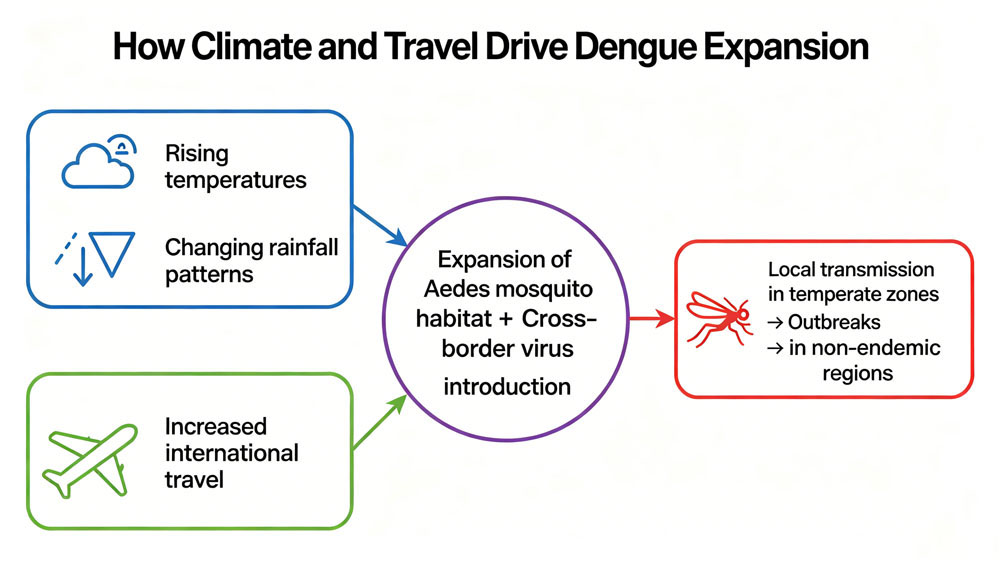
How climate and travel increase dengue spread
The primary catalyst for the widening dengue distribution is the intersection of climate change and global mobility. Rising average global temperatures and changing precipitation patterns have created highly favorable breeding conditions for Aedes aegypti and Aedes albopictus mosquitoes in previously inhospitable latitudes. Research indicates that the global population at risk of dengue could increase by over 2 billion by the year 2080 if current warming trends continue. Simultaneously, the resurgence of international travel following pandemic-era restrictions has accelerated the cross-border movement of the virus. Infected travelers act as carriers, introducing the pathogen to local mosquito populations in temperate zones and sparking new transmission cycles.
What WHO and ECDC warnings indicate
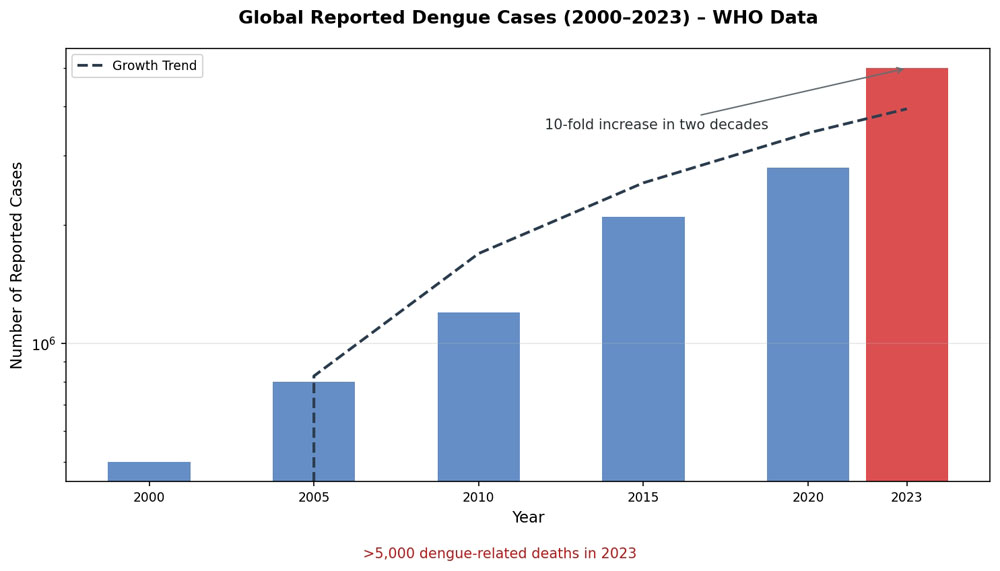
Global health authorities are issuing increasingly urgent alerts regarding the escalating dengue burden. The World Health Organization (WHO) reported a significant surge in global infections, documenting over 5 million cases and more than 5,000 dengue-related deaths in 2023 alone—a nearly ten-fold increase compared to historical baselines two decades ago. These figures represent only reported cases, with the actual burden likely significantly higher due to underreporting and asymptomatic infections. Similarly, the European Centre for Disease Prevention and Control (ECDC) has elevated its risk assessments for the European continent. The agency notes that prolonged warmer seasons are extending the active period for vector mosquitoes, increasing the probability of sustained local transmission events rather than isolated imported cases.
Section Summary Key Points:
- Climate shifts have expanded the habitable zones for Aedes mosquitoes, threatening up to 2 billion new individuals by 2080.
- International travel accelerates cross-border viral introduction into temperate zones.
- WHO data shows a 10-fold increase in global cases over two decades, surpassing 5 million reported cases in 2023.
How Dengue Risk Is Growing in Europe and North America

The traditional classification of dengue as a strictly tropical affliction is rapidly becoming obsolete. North America and Europe are now experiencing a paradigm shift in vector-borne disease dynamics, forcing public health agencies to confront a pathogen they historically only managed in returning travelers.
What evidence shows spread into non-traditional regions
Recent epidemiological data provide concrete evidence of dengue’s encroachment into non-traditional territories. In 2023, Europe recorded over 130 locally acquired dengue cases, a stark increase compared to the 71 cases documented over the entire preceding decade (2010–2021). Countries such as France, Italy, and Spain have reported multiple autonomous transmission clusters. In North America, the United States has seen a similar trend. Florida, Texas, and California have all reported localy acquired infections, with vector control agencies identifying established populations of Aedes aegypti in over 20 states. This data confirms that the virus is no longer merely imported; it is successfully overwintering and propagating in temperate climates.
Why awareness gaps and atypical symptoms delay detection
The emergence of dengue in these non-endemic regions presents severe diagnostic challenges, primarily driven by clinical awareness gaps. Healthcare providers in temperate zones often lack frontline experience with the virus. Because early dengue symptoms—such as high fever, myalgia, and fatigue—closely mimic those of influenza, COVID-19, or other common respiratory infections, physicians rarely include dengue in their initial differential diagnosis. This atypical clinical presentation in regions unaccustomed to the disease frequently leads to delayed detection. Consequently, patients may progress to severe dengue (dengue hemorrhagic fever) before receiving appropriate supportive care, increasing the risk of mortality above the standard 1% threshold seen in endemic areas with optimized care protocols.
Section Summary Key Points:
- Europe saw over 130 locally acquired cases in 2023, exceeding the total from the previous decade.
- US states like Florida, Texas, and California now report autonomous transmission clusters.
- Symptom overlap with flu and COVID-19 causes severe diagnostic delays, risking mortality rates above the 1% baseline.
Which Dengue Diagnostic Strategies Support Early Detection
To mitigate the impact of dengue’s geographical expansion, health systems require robust, scalable diagnostic strategies. Rapid and accurate testing is the cornerstone of effective outbreak management, enabling clinicians to triage patients effectively and public health officials to initiate targeted vector control measures.
How labs and frontline settings compare diagnostic methods
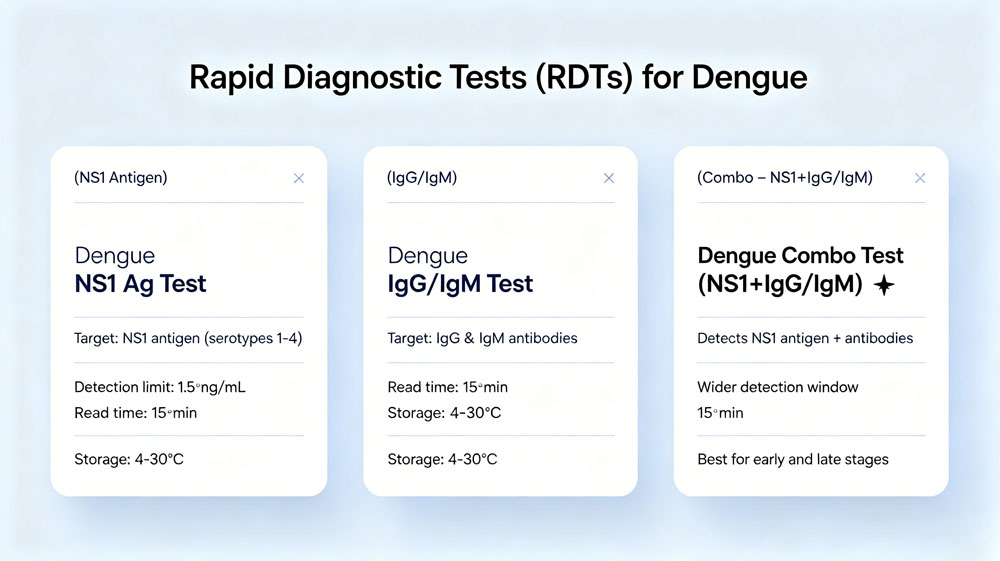
Diagnostic approaches vary significantly between centralized laboratories and frontline clinical settings. Polymerase Chain Reaction (PCR) testing remains the gold standard for early detection, offering exceptional sensitivity, but it requires specialized equipment, cold-chain logistics, and multi-hour turnaround times. In contrast, Rapid Diagnostic Tests (RDTs) are essential for decentralized screening. These lateral flow assays deliver results in just 15 minutes and require no complex instrumentation, making them ideal for point-of-care use in both endemic and newly affected regions.
| Feature | Dengue NS1 Antigen Test Cassette | Dengue IgG/IgM Test Cassette | Dengue IgG/IgM+NS1 Antigen Test Cassette |
|---|---|---|---|
| Target | NS1 Antigen (Serotypes 1-4) | IgG & IgM Antibodies | NS1 Antigen + IgG/IgM Antibodies |
| Detection Limit | 1.5 ng/mL | N/A (Antibody presence) | 1.5 ng/mL (NS1) + Antibodies |
| Storage Temp | 4–30°C (39–86°F) | 4–30°C (39–86°F) | 4–30°C (39–86°F) |
| Read Time | 15 minutes | 15 minutes | 15 minutes |
What framework helps health systems choose testing options
When selecting testing options, health systems must implement a framework based on the infection timeline and logistical constraints.
Key Takeaways
- The most important conclusions and rationale for Dengue
- Specs, compliance, and risk checks worth validating before you commit
- Practical next steps and caveats readers can apply immediately
Frequently Asked Questions
When is a dengue combo test most useful?
It is most useful in the early phase of fever, especially within the first 1–7 days, when NS1 antigen can help support prompt detection before antibodies fully develop.
What does an IgM/IgG/NS1 dengue combo test detect?
It detects NS1 antigen plus IgM and IgG antibodies, helping identify possible early infection and different immune response stages in one test format.
Why is early dengue testing important in Europe and North America?
Because dengue symptoms can resemble flu or COVID-19, early testing helps clinicians consider dengue sooner in non-endemic regions and respond faster to suspected cases.
Can climate change affect dengue testing demand?
Yes. Warmer temperatures and longer mosquito seasons can expand dengue risk zones, increasing the need for rapid screening tools in clinics, labs, and outbreak settings.
Is a rapid dengue test enough to confirm infection?
Rapid tests are valuable for screening and early decision-making, but results should be interpreted with clinical findings and, when needed, confirmed by PCR or other laboratory methods.
Post time: May-22-2026