
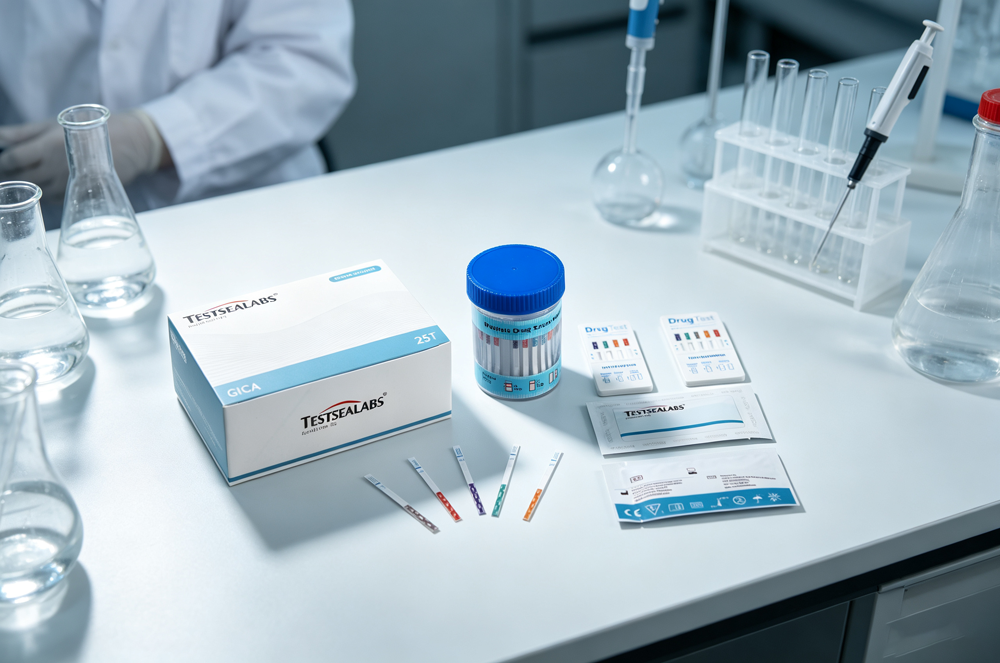
A drug-of-abuse (DOA) uncut sheet is a large-format nitrocellulose membrane carrying the conjugate pad, the sample pad, the absorbent pad, and the test/control lines. The assay house coats and dries the membrane, then ships the intact sheet to the assembly factory where it is cut into individual strips, laminated into cassettes, or sealed inside multi-drug panels. The uncut sheet is the most QC-sensitive component of the finished DOA rapid test — once it is cut, the lot identity is fragmented and a single defective conjugate spot can no longer be traced to a single membrane batch.
For assembly factories and OEM brand owners who are sourcing DOA uncut sheets in volume, the procurement question is not “what is the unit price” but “what must the assay house demonstrate before a PO is signed”. This guide walks through the twelve verification points that an experienced buyer in the IVD industry treats as non-negotiable, and shows how the Testsealabs production system supports each one. The same twelve points apply whether the finished format is a single-analyte strip, a multi-drug panel, or a mid-stream cup.
What a DOA Uncut Sheet Actually Carries
Before the verification list, it helps to make the anatomy of an uncut sheet explicit. A standard DOA sheet holds four functional layers laminated on a backing card:
- Conjugate pad — the dried antibody-colloid conjugate that binds the target analyte when the specimen reaches it. Stability of the conjugate is the single largest determinant of shelf life.
- Sample pad — the receiving layer that conditions the specimen (buffers pH, removes particulates). Composition is a known source of false negatives if over-buffered.
- Nitrocellulose membrane — the analytical layer on which the test line (T) and the control line (C) are striped. The T-line defines the cut-off; the C-line validates that the chromatographic flow completed.
- Absorbent pad — the wick that draws the specimen through the membrane. Capacity determines the maximum sample volume that can be processed in the reading window.
For a single-analyte DOA strip the sheet is striped with one T-line and one C-line. For a multi-drug panel the sheet carries multiple T-lines side-by-side, each with a different antibody and a different cut-off. The complexity rises sharply with the number of analytes: a 12-drug panel has 12 distinct T-lines plus a C-line, all of which must remain chromatographically independent on the same membrane.
The 12-Point Pre-Order Verification Checklist
Copy this checklist into the procurement file. Each row corresponds to a deliverable the assay house must produce before a binding quotation is accepted.
| Verification Point | What the Assay House Must Produce | Why It Matters |
|---|---|---|
| 1. Cut-off concentration per analyte | Lot-specific CoA listing the nominal cut-off (ng/mL) and the verified analytical sensitivity | The cut-off defines whether a clinical specimen is reported positive or negative; a lot that drifts 20 percent above the nominal cut-off shifts the clinical sensitivity of every downstream cassette. |
| 2. Analytical sensitivity | Verified detection at the cut-off in ≥90 percent of replicates | Sensitivity below 90 percent means one in ten low-positive specimens may be missed — a clinical and a regulatory problem. |
| 3. Cross-reactivity profile | Table of structurally related compounds and the percent cross-reactivity at the cut-off | A panel that does not cross-react with the relevant metabolites (for example, morphine-3-glucuronide for an OPI assay) will produce false negatives in real clinical specimens. |
| 4. Interfering-substance tolerance | Tested against common interferents: glucose, ascorbic acid, hemoglobin, albumin, pH 5-9 | Patient specimens that exceed the tolerance band can produce false negatives or invalid runs. |
| 5. Hook effect (prozone) range | Tested up to at least 100 times the cut-off without false-negative line disappearance | High-analyte specimens in clinical urine can saturate the antibody and clear the T-line; without prozone data the assay may fail at the upper end of the analytical range. |
| 6. Conjugate lot reproducibility | Three independent conjugate lots compared side-by-side on the same membrane lot | Reproducibility across conjugate lots is the strongest predictor that a finished cassette will reproduce the same clinical result when the next production batch ships. |
| 7. Membrane lot reproducibility | Two independent membrane lots striped from the same conjugate lot | Membrane variability is the second-largest source of lot-to-lot drift; verifying it isolates the membrane step from the conjugate step. |
| 8. Reading-window stability | Lines stable at the 3-5 minute read window and not fading by 10 minutes | Clinical interpretation requires a defined read window; lines that fade invalidate results after a few minutes and force the reader to re-run the assay. |
| 9. Storage condition | 4-30 degrees Celsius, sealed foil pouch with desiccant | Outside the storage band the conjugate denatures and the test line fades; a finished test that is shipped through a hot warehouse without climate control fails on arrival. |
| 10. Shelf life | 24 months from date of manufacture when stored at 4-30 degrees Celsius | A 24-month shelf life matches the typical distributor rotation cycle and avoids the cost of relabeling short-dated inventory. |
| 11. Quality-management certifications | ISO 13485 and MDSAP certificates covering the manufacturing site | Buyers in regulated markets (US, EU, Canada, Australia, Brazil, Japan) require ISO 13485 as the baseline; MDSAP covers the same sites under a single audit program accepted in five jurisdictions. |
| 12. Sample-policy and lot-traceability file | Free pre-production samples from three consecutive lots, plus the CoA and the QC release record | The only way to confirm the first eleven points before issuing the PO is to test the assay in the buyer’s own lab against the buyer’s own specimen panel. |
Uncut Sheet vs Finished Strip vs Multi-Drug Panel — Which Format Fits
The three finished formats serve different downstream needs. Choosing the wrong one locks the assembly factory into a manufacturing line that does not match its market.
| Format | Best For | MOQ (Testsealabs) | |
|---|---|---|---|
| Single-analyte strip (uncut sheet → cut strip) | High-volume single-analyte markets (AMP, COC, OPI, THC); assembly factories with cassette-loading lines | 5,000 strips | |
| Single-analyte cassette (uncut sheet → laminated cassette) | Retail pharmacy and point-of-care channels; lower-volume single-analyte brands | 5,000 cassettes | |
| Multi-drug panel (uncut sheet → panel) | Workplace drug-testing, clinical toxicology, and correctional markets requiring 5-12 analytes per device | 5,000 panels | |
| Multi-drug cup (panel + integrated collection cup) | Forensic and high-throughput screening with on-site adulteration checks | 5,000 cups | |
| OEM customization (custom cut-off, custom conjugate, custom packaging) | Brand owners launching a private-label DOA line | 50,000 units |
The MOQ threshold for OEM customization reflects the conjugate lot prep cost and the dedicated packaging tooling; a 5,000-piece custom run is not economically viable because the per-piece overhead exceeds the per-piece material cost.
Storage, Shelf Life, and the No-Cold-Chain Advantage
DOA uncut sheets and finished DOA rapid tests from Testsealabs carry a 4-30 degrees Celsius storage specification and a 24-month shelf life from the date of manufacture. The combination has two practical consequences for downstream logistics.
No cold chain required. Most DOA rapid tests in this category ship by ocean container or by truck without refrigeration. A buyer in a tropical port (West Africa, Southeast Asia, Central America) can receive the goods without paying for refrigerated containers or for last-mile refrigerated handling. The same shipment that would cost three times as much for a cold-chain product lands at standard freight rates.
Inventory rotation matches the shelf life. A 24-month shelf life is long enough for a distributor to clear a 5,000-piece batch through normal sales channels without relabeling or discounting for short-dated stock. The four-to-thirty-degree band covers the typical warehouse (15-25 degrees) and the typical transport container (5-40 degrees, with brief excursions to 45 degrees during summer transit).
The Testsealabs specification sheet lists the storage band as 4-30 degrees Celsius and the shelf life as 2 years (24 months) on every product page in the DOA series. Buyers who require a wider storage band (for example, -10 to 50 degrees) should request a stability study on the specific lot before committing to volume.
How the Assay House Production Workflow Maps to Each Verification Point
The Testsealabs production line is organized so that the twelve verification points map to specific process steps.
- Conjugate preparation (verification points 2, 6): Each conjugate is titrated against the nominal cut-off and verified in three independent lots. Lot-specific CoA documents the sensitivity in ≥90 percent of replicates at the cut-off.
- Membrane striping (verification points 1, 7, 8): Test lines and control lines are striped under controlled humidity on the analytical membrane. The membrane variability is captured in the inter-membrane coefficient of variation reported on the CoA.
- Cross-reactivity and prozone (verification points 3, 4, 5): Each new conjugate is tested against a panel of structurally related compounds (cross-reactivity) and against high-concentration specimens (prozone / hook effect) before the lot is released.
- Cutting and lamination (verification point 9): The uncut sheet is cut to strip width or laminated into cassettes under climate-controlled conditions (typically 18-24 degrees, <40 percent humidity) to preserve conjugate activity.
- Pouching (verification points 9, 10): Each finished strip or cassette is sealed in a foil pouch with a desiccant that carries the lot number, expiration date, and 4-30 degrees Celsius storage band.
- QC release (verification point 11): The finished lot is released only after the QC lab signs off on the lot-specific CoA, which bundles the data from all eleven previous points.
The Anatomy of a Production Line: From Conjugate Vial to Sealed Pouch
Walking through the production line makes the verification points concrete. The Testsealabs DOA line follows six discrete process steps, each of which corresponds to one or more verification points in the table above.
Step 1 — Conjugate preparation. The antibody-colloid conjugate is the most QC-sensitive reagent. Each conjugate batch is titrated against the nominal cut-off concentration, verified in three independent lots, and released only when the lot-specific CoA documents the analytical sensitivity in ≥90 percent of replicates at the cut-off. The conjugate is stored in a climate-controlled vial at 2-8 degrees Celsius until the striping step, typically within 14 days of preparation.
Step 2 — Membrane striping. The test line and the control line are striped under controlled humidity on a nitrocellulose membrane. The striping parameters (line position, line width, line intensity) are defined by the validated product specification. Two membrane lots are striped from the same conjugate lot to isolate membrane variability; the result is reported in the CoA as the inter-membrane coefficient of variation.
Step 3 — Cross-reactivity and prozone testing. Each new conjugate is tested against a panel of structurally related compounds (the cross-reactivity table) and against high-concentration specimens (the prozone or hook-effect range). The prozone range is reported up to at least 100 times the nominal cut-off; a panel that fails prozone testing is rejected before the lot enters production.
Step 4 — Cutting and lamination. The uncut sheet is cut to strip width (typically 4 mm) or laminated into cassettes under climate-controlled conditions, typically 18-24 degrees Celsius and below 40 percent relative humidity. The climate band preserves conjugate activity during the cutting step; outside the band the conjugate can denature at the cut edges.
Step 5 — Pouching. Each finished strip or cassette is sealed in a foil pouch with a desiccant. The pouch carries the lot number, the expiration date, and the storage band 4-30 degrees Celsius. The pouch material is selected to be impermeable to water vapor; a pouch that loses moisture barrier integrity in the warehouse will degrade the lot before the expiration date.
Step 6 — QC release. The finished lot is released only after the QC lab signs off on the lot-specific CoA, which bundles the data from all five previous steps. The CoA is delivered to the buyer with the shipment; a buyer who requests the CoA before shipment can verify the lot before it leaves the assay house.
The factory tour page documents the production lines, the cleanroom class, the QC lab, and the warehousing process. Buyers who require on-site audit can request a video walkthrough before placing a first PO, and a live on-site audit for volume commitments.
What to Ask the Assay House Before Signing the PO
Five questions cover the gap between the verification checklist and the actual procurement decision:
- Can you ship three consecutive lots of pre-production samples? Three consecutive lots reveal lot-to-lot drift; a single lot hides it.
- What is the CoA format and the data review window? A supplier that issues a CoA within 5 working days of lot release is operationally mature; one that takes 15 working days will block the buyer’s QC release cycle.
- What is the change-control policy on the cut-off concentration? A supplier that changes the cut-off by more than 10 percent without written notice will break every downstream clinical study that referenced the prior cut-off.
- What is the lot-reserve policy? Reserve a small quantity of each finished lot (typically 50-100 pieces) in the buyer’s name for complaint investigation and for retrospective testing.
- What is the regulatory status of the manufacturing site? ISO 13485 is the baseline; MDSAP adds the five-jurisdiction audit acceptance; FDA registration adds the US-market entry clearance.
Common Errors When Sourcing DOA Uncut Sheets
Five errors appear repeatedly in DOA uncut-sheet procurement. They are listed in order of frequency.
Error 1 — Ordering only on price. The cheapest uncut sheet on the market is often a sheet cut from a conjugate that was titrated at the lower edge of the cut-off band. The first lot passes; the second lot fails at the buyer’s verification step.
Error 2 — Skipping the cross-reactivity table. A panel that detects the parent drug but misses the glucuronide metabolite will produce false negatives in patients whose kidneys have conjugated the drug. The cross-reactivity table is the only document that proves the assay will work on the relevant specimen population.
Error 3 — Treating 4-30 degrees as a marketing line. The storage band is a stability specification, not a marketing line. A warehouse that exceeds 30 degrees for more than a few days during the summer will degrade the lot before the expiration date. Confirm that the buyer’s distribution channel respects the band.
Error 4 — Assuming MOQ is fixed. The 5,000-piece MOQ applies to standard catalog SKUs. OEM-customized SKUs start at 50,000 pieces. A buyer who needs 10,000 pieces with a custom cut-off should ask whether a hybrid run is possible — for example, custom packaging on a catalog conjugate.
Error 5 — Skipping the lot-reserve request. Once a lot is shipped, the assay house typically retains samples for 6-12 months; the buyer should request that a portion of the same lot be reserved in the assay house’s stability chamber for complaint investigation. Without this, a complaint about a lot that fails six months after delivery is impossible to investigate.
For buyers who need additional regulatory cross-references, the U.S. FDA medical-device framework, the Code of Federal Regulations (in particular 21 CFR Part 820 for Quality System Regulation and 21 CFR Part 809 for IVD labeling), and the Federal Register FDA section all carry the regulatory baseline that a DOA rapid test must satisfy in the United States market. The American Association for Clinical Chemistry publishes clinical-chemistry reference standards that overlap with the analytical-chemistry side of DOA assay validation.
Frequently Asked Questions
What is a DOA uncut sheet?
A drug-of-abuse (DOA) uncut sheet is the large-format nitrocellulose membrane that the assay house ships before cutting, laminating, and cassette-loading. The sheet carries the conjugate pad, the sample pad, the absorbent pad, and the test/control lines. Assembly factories cut the sheet into individual strips or panels for finished-product assembly.
What is the typical MOQ for DOA uncut sheets versus finished DOA rapid tests?
Standard catalog SKUs ship at a 5,000-piece MOQ for finished strip, cassette, and panel formats. OEM-customized DOA sheets (custom cut-off, custom conjugate, custom packaging, custom label) typically require a 50,000-piece commitment because of the conjugate lot prep and the packaging tooling.
What is the storage temperature and shelf life of a DOA uncut sheet?
DOA uncut sheets and finished DOA rapid tests from Testsealabs are stored at 4-30 degrees Celsius and carry a 24-month shelf life from the date of manufacture. No cold chain is required.
How do you verify the analytical sensitivity of a DOA uncut sheet before ordering?
Ask the assay house for a Certificate of Analysis (CoA) that lists the cut-off concentration, the lot-specific sensitivity in at least 90 percent of replicates, the cross-reactivity profile, and the interfering-substance tolerance. A reproducible lot reproduces the cut-off line intensity within a defined intensity band across three independent conjugate lots.
What is the typical reading time for a DOA rapid test?
Most DOA rapid tests read at 3-5 minutes. Lines appearing after 10 minutes are considered invalid for clinical reporting, regardless of intensity.
Which quality-management certifications should the uncut-sheet supplier hold?
At minimum, ISO 13485 (medical-device quality management) and where applicable MDSAP (Medical Device Single Audit Program for Australia, Brazil, Canada, Japan, and the United States) cover the regulatory baseline for in-vitro diagnostic devices.
What is the typical clinical specimen for a DOA rapid test?
Urine is the standard specimen. Some product variants accept oral fluid, but the cut-off concentrations and reading windows differ and must be specified separately.
Angela Qin is the International Sales Director at Hangzhou Testsea Biotechnology Co., Ltd. (Testsealabs), with 10+ years of experience in the in vitro diagnostic (IVD) and veterinary product industry. Founded in 2015 with the pursuit “serving society, health world,” Testsealabs specializes in the R&D, production, and sales of rapid diagnostic products, including tests for coronavirus disease, cardiovascular diseases, inflammation, tumor markers, infectious diseases, drug abuse, and pregnancy. Leveraging proprietary platforms (immunological detection, molecular biology, protein chip, and biological raw materials), Angela helps global distributors, hospitals, public health institutions, and veterinary clients source reliable, high-quality diagnostic solutions from China—backed by strict quality control and a customer-first philosophy. Testsealabs’ products are widely used in rapid diagnosis, treatment monitoring, maternal and child healthcare, drug and alcohol testing, and have been sold to over 100 countries worldwide.Connect on Facebook
Post time: Sep-07-2026