
Undifferentiated tropical fever is one of the most operationally difficult presentations in primary care, border screening, and outbreak response — because dengue, malaria, chikungunya, and Zika share a remarkably similar first-week clinical picture, and because the four pathogens require different treatments, different public health responses, and different reporting obligations. The right rapid-test matrix at the point of care is what closes that differential in a single visit, instead of running the patient through a week of ordered tests that arrive out of clinical sequence.
TL;DR — The Testing Matrix in Five Lines
- Dengue needs two markers, not one: NS1 antigen covers day 0–7, IgM covers day 3–5 onward, IgG covers exposure history — run them together or you will miss one end of the curve.
- Malaria sits on a different antigenic platform (HRP-2 and pLDH) and is typically run as a separate cassette; it cannot be combined onto a flavivirus panel.
- Chikungunya IgM is the early window marker (roughly day 5–7 onward); the joint pain is the clinical clue that should trigger the order.
- Zika IgM cross-reacts with dengue in flavivirus-experienced populations — a positive rapid result in endemic regions should be confirmed by PRNT before clinical decisions that are sensitive to a false positive.
- A single multi-analyte cassette (Dengue NS1 + Dengue IgG/IgM + Zika IgG/IgM + Chikungunya IgG/IgM) collapses the triage to one fingerstick, one cassette, one 15–20 minute readout — the operational answer for high-volume clinics and border screening.
Why the Differential Is Hard in the First Week
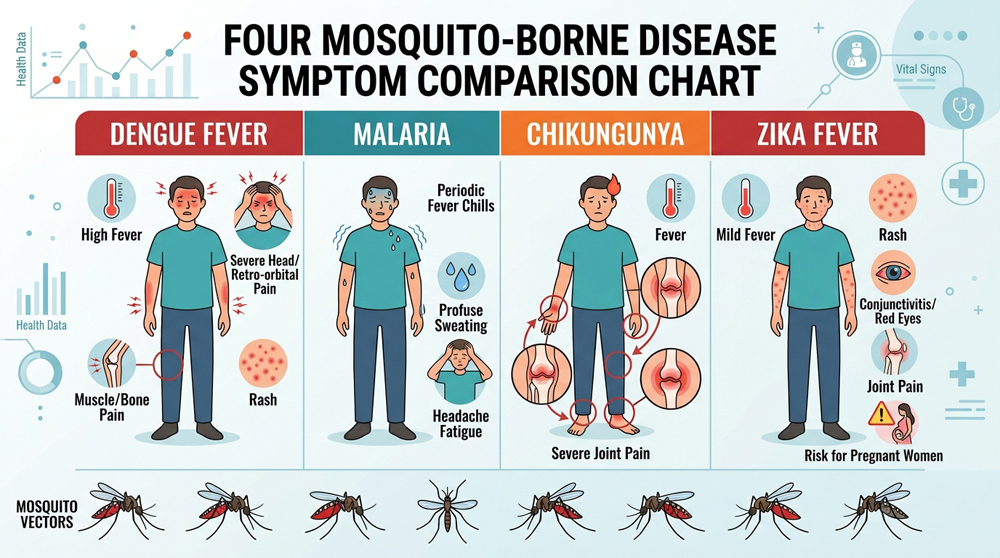
The honest clinical truth is that on day 2 of fever, you usually cannot tell these four apart by symptoms alone. Dengue presents with high fever, retro-orbital pain, myalgia, and sometimes a maculopapular rash. Malaria presents with paroxysmal fever, chills, and sweats that may not yet have settled into the classic tertian or quartan rhythm. Chikungunya announces itself with fever and severe arthralgia that can persist for months. Zika is often the mildest of the four but carries the most serious downstream consequence in pregnancy. The overlap is dense enough that the World Health Organization dengue case definition explicitly recommends laboratory confirmation rather than clinical diagnosis, and the same caveat applies across the rest of the panel.
The operational consequence is that the test order, not the test itself, is the variable that most often goes wrong. A patient who presents on day 2 with fever and joint pain and gets a dengue IgG/IgM-only order will get a negative result on day 2 and go home with the wrong reassurance; the same patient on the same day, tested with NS1 plus IgG/IgM, will get a positive NS1 and the right triage. The matrix below is built around the detection window of each marker, because the window is what makes the test positive or negative on the day the patient walks in.
The Day-of-Illness Detection Window for Each Marker
The single most common point-of-care failure in tropical fever triage is using a single test that only covers part of the clinical window. The four pathogens and their target analytes have different biological kinetics, and the kinetics — not the test sensitivity — are what determine whether the test turns positive on the day of presentation.
The visual reads cleanly. NS1 is the only marker positive in the first 72 hours; IgM takes over in the second half of the first week and runs through early convalescence; IgG comes later and persists for exposure history. If a patient shows up on day 2 with fever and you order dengue IgG/IgM only, you will miss roughly the entire early window. If the same patient shows up on day 9, NS1 has already faded and only the antibody tests will catch it. That is why the WHO dengue testing recommendation, and the equivalent guidance from most national public health agencies, is to run NS1 together with IgG/IgM — because the two tests together span the entire curve.
The kinetics, not the test, decide whether a rapid test turns positive on the day the patient walks in. A lab-quality rapid test used at the wrong point in the window returns a false negative; the same test used at the right point returns a true positive. Picking the right matrix is picking the right combination of detection windows for the day of presentation.
The Four-Pathogen Testing Matrix at a Glance
The matrix below is the operational answer to the question “what should we test, in what sample, with what target analyte, on what day of illness, and what does it tell us.” It is the chart a procurement officer, a public health program lead, or an outpatient clinic medical director should keep on the wall beside the test kit shelf.
| Pathogen | Target analyte | Sample type | Detection window | Result turnaround | Sensitivity / specificity (qualitative) |
|---|---|---|---|---|---|
| Dengue virus | NS1 antigen + IgG + IgM | Whole blood, serum, or plasma | NS1: day 0–~7 · IgM: day ~3 onward · IgG: day ~5 onward | ~15–20 minutes | High sensitivity in early window for NS1; high specificity with IgG/IgM confirmation |
| Plasmodium spp. | HRP-2 (P. falciparum) + pLDH (pan-species) | Whole blood, serum, or plasma | HRP-2: day 0 onward, persists after treatment · pLDH: day 0 onward, ~2 weeks | ~15–20 minutes | High sensitivity for P. falciparum; species-level confirmation by smear remains reference standard |
| Chikungunya virus | IgG + IgM | Whole blood, serum, or plasma | IgM: day ~5–7 onward · IgG: day ~7 onward, persists | ~15–20 minutes | High specificity in early window with clinical correlation; cross-reactivity with other alphaviruses is uncommon |
| Zika virus | IgG + IgM | Whole blood, serum, or plasma | IgM: day ~5–7 onward · IgG: day ~7 onward, persists | ~15–20 minutes | Cross-reactivity with dengue antibodies is documented — confirm with PRNT where the clinical decision is sensitive |
Three things in this matrix are worth flagging because they are the points that most often get quietly wrong on the ground:
- Dengue is a two-marker test, not a one-marker test. NS1 alone misses late-window cases; IgG/IgM alone misses early-window cases. The combo cassette that carries both is the operational standard, not the exception.
- Malaria sits on a separate antigenic platform. HRP-2 and pLDH are parasite enzymes, not virus antibodies, so a flavivirus combo cassette cannot carry them. A malaria rapid test is run alongside the arbovirus panel, not on it.
- Zika IgM cross-reacts with dengue. In flavivirus-experienced populations, a positive Zika IgM on a rapid test in a patient with recent dengue exposure should be interpreted with caution and confirmed by PRNT before irreversible clinical decisions.
How the Single Cassette Collapses the Triage Workflow
The clinical rationale for a multi-analyte cassette is not that it is a cleverer test — it is that it is a faster workflow. In a typical undifferentiated fever presentation at an outpatient clinic in an endemic region, the historical sequence is: (1) order a dengue NS1, wait 20 minutes; (2) if negative, order a dengue IgG/IgM, wait 20 minutes; (3) if dengue is ruled out, order a chikungunya IgM, wait 20 minutes; (4) if Zika is on the differential, order a Zika IgG/IgM, wait 20 minutes; (5) finally, run a malaria antigen test, wait 20 minutes. That is five separate test orders, five separate read windows, and roughly an hour and a half of clinic time for a single patient — most of it spent waiting.
The multi-analyte cassette collapses steps (1) through (4) into a single cassette with five read lines run from one fingerstick sample. One collection, one application, one 15–20 minute incubation, one readout that returns the dengue NS1, dengue IgG/IgM, Zika IgG/IgM, and chikungunya IgG/IgM results simultaneously. The malaria test stays as a separate cassette because of the antigenic platform difference, but the rest of the panel collapses cleanly, and the bedside workflow drops from five sequential test orders to two cassettes read in parallel.
The operational effect is what matters to the procurement officer and the clinic director. The same nursing minute that previously ran one dengue test now closes the entire viral differential; the same clinic room that previously held one fever patient for 90 minutes now holds that patient for 20 minutes; the same lab technician that previously batched five separate test kits now batches one combo cassette plus one malaria cassette. The per-test cost of the combo cassette is meaningfully higher than a single dengue NS1 cassette, but the cost per closed-differential patient is lower — which is the only cost that actually matters in a high-volume fever clinic.
The clinical question is not “which rapid test is best.” The clinical question is “which combination of detection windows, in one cassette, closes the differential in a single visit.” That combination is dengue NS1 plus dengue IgG/IgM plus Zika IgG/IgM plus chikungunya IgG/IgM — with malaria on a separate cassette by antigenic necessity.
Putting the Matrix to Work — Scenario-Based Decisions
The matrix above is the reference table. The scenarios below are how the matrix actually plays out at the bedside when a patient walks in with three days of fever in a dengue-endemic region with co-circulating Zika and chikungunya.
Scenario A — Day 3 of fever, returning traveler, joint pain
Presentation: 34-year-old returning from Southeast Asia with three days of fever, retro-orbital pain, and bilateral wrist arthralgia.
What to test: Dengue NS1 + Dengue IgG/IgM + Chikungunya IgM + Malaria antigen (single multi-analyte cassette plus malaria cassette).
How to read the result: NS1 positive + IgM negative on the dengue line confirms acute primary dengue. IgM positive on the chikungunya line + dengue NS1 negative points to chikungunya. A negative dengue NS1 plus negative chikungunya IgM on day 3 does not rule out either — it just means the patient is in the pre-antibody window for both, and a follow-up sample at day 7 should be drawn.
Scenario B — Day 5 of fever, no travel history, rural endemic area
Presentation: 28-year-old agricultural worker with five days of intermittent fever, chills, and fatigue; no international travel.
What to test: Malaria antigen first (HRP-2 and pLDH), then dengue NS1 + IgG/IgM if malaria is negative.
How to read the result: A positive HRP-2 line confirms P. falciparum infection that needs immediate antimalarial therapy. A positive pLDH without HRP-2 points to a non-falciparum species and triggers a smear for speciation and parasitemia grading. A negative malaria antigen with positive dengue NS1 + IgM confirms dengue. Persistent fever with all rapid tests negative on day 5 warrants a thick and thin smear to rule out low-parasitemia malaria that the antigen test missed, plus a clinical review for non-vector-borne causes.
Scenario C — Day 6 of fever, severe joint pain, household cluster
Presentation: 42-year-old with six days of fever and severe polyarthralgia; two household members had similar illness in the past two weeks.
What to test: Chikungunya IgG/IgM + Dengue NS1 + Dengue IgG/IgM. Household cluster raises the chikungunya probability significantly because of the person-to-person clustering that does not occur with dengue or Zika (which require the vector).
How to read the result: Chikungunya IgM positive on day 6 confirms the diagnosis and starts the conversation about persistent arthralgia management. A negative chikungunya IgM does not rule out the diagnosis on day 6 if the IgM has not yet risen; a follow-up sample at day 10 should be drawn if clinical suspicion remains high.
Scenario D — Day 7 of fever, mild illness, pregnant
Presentation: 29-year-old pregnant at 18 weeks with seven days of low-grade fever, mild rash, and mild arthralgia.
What to test: Dengue NS1 + Dengue IgG/IgM + Zika IgG/IgM. Chikungunya IgM is reasonable to add for completeness. Malaria antigen only if travel history warrants.
How to read the result: Because of the cross-reactivity problem between Zika IgM and dengue IgG/IgM on rapid tests, a positive Zika IgM in a flavivirus-experienced patient should be confirmed by PRNT at a reference lab before irreversible pregnancy counseling decisions are made. A negative rapid panel at day 7 with persistent clinical suspicion should trigger serum PCR for Zika and dengue at a reference lab, because the IgM may still be below the rapid test detection threshold.
What the Combo Cassette Does Not Replace
Even the best multi-analyte cassette is a triage tool, not a confirmatory test. Three follow-on steps are still required when the clinical situation calls for them, and they should be built into the procurement and training plan alongside the cassette itself:
- Thick and thin blood smear for malaria speciation and parasitemia grading. Antigen-positive malaria cases still need a smear to identify the species (P. falciparum vs P. vivax vs P. malariae vs P. ovale vs P. knowlesi) and to quantify parasitemia for treatment monitoring. Antigen-negative cases with persistent clinical suspicion also need a smear, because low-parasitemia infections can sit below the antigen detection threshold.
- Plaque reduction neutralization test (PRNT) for Zika confirmation in flavivirus-experienced populations. Anywhere the clinical decision is sensitive to a false positive — pregnancy counseling, donor deferral, returning traveler screening — a positive Zika rapid result should be confirmed by PRNT before the decision is locked in.
- RT-PCR for early-window arbovirus confirmation at a reference lab. In the first 1–3 days of illness, viral RNA is detectable by RT-PCR before antigen or antibody markers turn positive. Reference labs in endemic regions typically offer dengue, chikungunya, and Zika RT-PCR panels that can be ordered when a patient presents within that early window and the rapid panel is negative.
The honest framing of the cassette is that it moves the bottleneck from sample collection and incubation to clinical interpretation and downstream referral. The cassette is what closes the triage decision; the smear, the PRNT, and the RT-PCR are what close the diagnostic decision. Both steps matter.
Procurement View — What to Ask the Manufacturer Before You Order
For distributors, public health program buyers, and hospital procurement teams sourcing tropical fever rapid test panels in volume, the questions below are the ones that separate a working supplier from a catalogue-only reseller. Use them as a written checklist on the RFQ.
- Detection window coverage per marker. Confirm that the dengue component includes NS1 plus IgG plus IgM (not IgG/IgM alone), that chikungunya IgM is included as a separate line, and that Zika IgG and IgM are split lines rather than combined.
- Sample type acceptance. Confirm the cassette accepts fingerstick whole blood, EDTA venous whole blood, serum, and plasma. Most operators will run fingerstick in the field and serum or plasma from the lab, so the cassette has to accept both.
- Reading time and stability window. Confirm the result is read between 15 and 20 minutes and that the lines remain stable for the standard read window. Late-reading (after 30 minutes) is a common source of false interpretation.
- Storage and shelf life. Confirm the cassette stores at 4–30 °C in sealed foil pouches with desiccant, and that the shelf life is 24 months from manufacture. Anything outside that band is a logistics problem for tropical climates without refrigerated transport.
- Minimum order quantity and OEM/ODM options. Confirm the standard minimum order quantity (typically 5,000 units per catalog item for the cassette family) and the OEM/ODM minimum (typically 50,000 units for branded cassette production). Distributors planning private label work need the OEM band confirmed in writing before the brand artwork is committed.
- Regulatory documentation. Ask for the current CE / IVDR documentation, ISO 13485 certification of the manufacturing site, and any country-specific registrations relevant to the destination market (e.g., WHO PQ for UN agency procurement, FDA EUA if applicable, national MFDS / ANVISA / HSA listings).
Where Testsealabs Sits in This Picture
Testsealabs’ Dengue NS1 / Dengue IgG/IgM / Zika Virus IgG/IgM / Chikungunya combo cassette is the multi-analyte format built around the matrix in this article — five read lines on one cassette, run from one fingerstick sample, with results in 15–20 minutes. The cassette is part of our infectious disease rapid test kit portfolio and sits alongside the malaria antigen cassette and the broader tropical vector-borne disease panel for distributors building a complete fever clinic menu. Storage is 4–30 °C, shelf life is 24 months, standard minimum order quantity is 5,000 units, OEM/ODM minimum is 50,000 units — consistent across the cassette family.
The honest positioning for the combo cassette is that it is the triage answer, not the confirmatory answer. The cassette closes the viral differential at the bedside; malaria speciation, parasitemia grading, and Zika confirmation in flavivirus-experienced populations still need to happen at a reference lab. Our recommendation to distributors and program buyers is to pair the combo cassette with the malaria antigen cassette for the complete fever-clinic shelf, and to build the reference-lab referral pathway into the training program at the same time. Contact our team for the current technical dossier, evaluation kit pricing, and the OEM/ODM artwork workflow.
FAQ
Why does dengue need two different tests (NS1 plus IgG/IgM) and not just one?
Because dengue has three distinct biological windows that no single marker covers. NS1 antigen is a viral protein that circulates in the first roughly 0–7 days of illness and is the only marker that is reliably positive before the patient mounts an antibody response. IgM appears at roughly days 3–5 and stays positive for weeks; IgG appears slightly later and can persist for life. Using only an IgG/IgM test will miss early presenters; using only NS1 will miss late presenters and secondary infections where NS1 is often blunted by an anamnestic antibody response. That is why the WHO dengue testing guidance and most national guidelines recommend pairing NS1 with IgG/IgM — the combination gives you coverage across the entire acute and early-convalescent window.
Can a single multi-analyte cassette really replace four separate rapid tests for tropical fever triage?
Yes, for the four pathogen targets that most often present as undifferentiated tropical fever in returning travelers and endemic-population point-of-care settings — dengue NS1, dengue IgG/IgM, Zika IgG/IgM, and chikungunya IgG/IgM — a single cassette can run all of those markers from one sample at the same time, in roughly 15–20 minutes. Malaria is conventionally run as a separate antigen test because its target analytes (HRP-2 and pLDH) are biologically distinct, but the rest of the panel collapses cleanly. The net effect at the bedside is one fingerstick, one cassette, one readout that closes the differential in a single clinical visit rather than a sequence of three or four separate test orders.
What is the detection window for dengue NS1 antigen versus dengue IgM?
Dengue NS1 is detectable from the first day of fever through approximately day 5–7 of illness, after which circulating antigen levels typically fall below the detection limit of most rapid tests. Dengue IgM becomes detectable around day 3–5 of illness and remains positive for roughly 2–3 months, which makes it the dominant marker in the early-convalescent window. Dengue IgG begins to rise around day 5–7 and can persist for decades, which makes it useful for distinguishing primary from secondary infection but useless for diagnosing an acute episode in isolation. The clinical logic is NS1 first, then IgM as NS1 fades, then IgG to confirm exposure history.
How does a malaria rapid antigen test compare to thick and thin blood smear?
A malaria rapid antigen test detects Plasmodium-specific proteins — most commonly HRP-2 for P. falciparum and pLDH for the other Plasmodium species — in roughly 15–20 minutes from a fingerstick or venous whole blood. Thick and thin smear remains the reference standard because it can both quantify parasitemia and speciate the parasite morphologically, but it requires a trained microscopist, a functional microscope, and typically 30–60 minutes of slide preparation and reading time. At the point of care, antigen tests have become the triage tool while smear confirmation is reserved for species identification, parasitemia grading, treatment monitoring, and quality control.
Why is chikungunya so easy to miss clinically, and what test catches it early?
Chikungunya is easy to miss because its acute presentation — high fever, severe arthralgia, sometimes a maculopapular rash — overlaps heavily with dengue and Zika during the first 3–5 days of illness. The joint pain is the clinical hint, but the lab confirmation comes from chikungunya-specific IgM, which appears around day 5–7 and is the earliest reliable serologic marker. RT-PCR is positive earlier (days 1–5) but is rarely available outside of reference labs in endemic countries. The practical point-of-care answer is an IgM rapid test used in the second clinical window, paired with the dengue and Zika panel to rule out the more dangerous differential.
Can Zika IgG/IgM cross-react with dengue antibodies on a rapid test?
Yes — cross-reactivity between Zika and dengue IgG/IgM on rapid tests is a well-documented problem, particularly in secondary flavivirus infections where the antibody response is heavily cross-reactive. In endemic regions, a positive Zika IgM on a rapid test in a patient with recent dengue exposure should be interpreted with caution and confirmed with a plaque-reduction neutralization test (PRNT) at a reference lab if the clinical decision is sensitive — for example, pregnancy counseling or donor screening. For routine triage in returning travelers or outbreak surveillance, the rapid test remains useful as a presumptive result, with the caveat that the specificity is not as high as the package insert implies in flavivirus-experienced populations.
What sample type does a tropical fever multi-analyte rapid cassette accept, and what volume?
Most tropical fever multi-analyte cassettes for the dengue, Zika, and chikungunya panel accept whole blood from a fingerstick or EDTA venous draw, serum, or plasma, with a typical sample volume in the low single-digit microliters. Malaria antigen cassettes typically accept the same whole-blood, serum, or plasma range. Reading time is usually 15–20 minutes at room temperature. The four-in-one cassette format is designed to run from a single fingerstick so the bedside workflow stays to one collection, one application, one readout — which is what makes it operationally useful in busy outpatient clinics and border screening points where nursing time is the limiting reagent.
Sourcing a tropical fever combo panel for your distribution program?
Send us your target market, the catalog items you are evaluating, and the program volume. We will return the current technical dossier, the evaluation kit pricing, and the OEM/ODM artwork workflow for the combo cassette and the supporting malaria and tropical vector-borne disease panel.
Angela represents Testsealabs, founded in 2015 with the pursuit “serving society, health world.” Testsealabs specializes in the R&D, production, and sales of rapid diagnostic products, including tests for infectious diseases, tropical vector-borne diseases, coronavirus disease, cardiovascular diseases, inflammation, tumor markers, drug abuse, and pregnancy. Leveraging proprietary platforms (immunological detection, molecular biology, protein chip, and biological raw materials), Angela helps global distributors, hospitals, public health institutions, and veterinary clients source reliable, high-quality diagnostic solutions from China. Testsealabs’ products are widely used in rapid diagnosis, treatment monitoring, maternal and child healthcare, drug and alcohol testing, and have been sold to over 100 countries worldwide.
Post time: Sep-10-2026