
Three infections, one symptom list. Fever, cough, sore throat, fatigue and aching muscles do not separate influenza A, influenza B and COVID-19, so the separation has to come from a test – and the fastest way to get it is one swab that reports each pathogen on its own line.
Angela Qin, International Sales Director at Hangzhou Testsea Biotechnology Co., Ltd.|Published 2026-11-10|Updated 2026-11-10|Written for distributors, hospitals and public health buyers
One swab, three answers
- Sample – one nasopharyngeal swab, taken once, by the person who trained to take it.
- Read – one cassette, one 15 minute reading time, one instruction sheet.
- Read the lines – a separate result line for each target, so influenza A, influenza B and COVID-19 are reported separately rather than as a single “influenza-like illness” result.
- Then act – the result separates the decisions that follow: antiviral timing, isolation, cohorting and infection control.
Because symptoms do not separate these three conditions, and a test that returns one undifferentiated answer does not help much either, the honest starting point for any buyer in this category is that the separation has to come from a test. The clinical guidance for seasonal influenza is explicit that testing is what distinguishes influenza from other causes of a similar presentation, and public health bodies continue to advise influenza and COVID-19 testing together in seasons where both circulate. The IDSA influenza guideline is the reference document for how a diagnostic pathway around these patients is meant to work, and the ECDC seasonal influenza pages describe the surveillance context that makes the combination question unavoidable in Europe.
This article is written for professional buyers and distributors. It is not patient guidance, it does not replace local diagnostic protocols, and the final interpretation of any result belongs with a qualified clinician. What it does is set out what the products in our respiratory infectious disease range do, what a buyer should specify, and where the limits are.
Where the three conditions actually overlap
Fever, cough, sore throat, fatigue, headache and muscle aches are the shared core of all three, and the features people look for are suggestive rather than decisive. Loss of taste and smell is more common in COVID-19 than in influenza, and stomach upset is more often reported in COVID-19, but neither is present often enough to be relied on, and influenza in an unvaccinated adult can present with fatigue and body aches that feel like a bad cold for days before anyone thinks of testing. Onset speed, exposure history and the presence of a cough in the household all help a clinician form a view, which is precisely the point: a clinician can narrow the field, but only a test can separate it.
| Feature | Influenza A or B | COVID-19 | Use in practice |
|---|---|---|---|
| Fever, cough, sore throat | Common | Common | Does not separate |
| Fatigue, muscle aches | Common, often abrupt | Common, often gradual | Degree is not a reliable rule |
| Loss of taste or smell | Uncommon | Reported more often, but not always | Suggestive, not decisive |
| Gastrointestinal symptoms | Occasional | Reported more often | Suggestive, not decisive |
| Time course | Illness often appears over a day | Can be gradual or abrupt | Overlapping |
| Result that does separate | A laboratory or point-of-care test reporting each pathogen separately | Test, not symptom reading | |
There is one more distinction that matters for a buyer rather than for a patient, and it is the Flu A versus Flu B distinction. Influenza A is the strain that drives seasonal epidemics and the occasional pandemic, and influenza B circulates mainly in children and in mixed outbreaks. Commercially, the two behave differently in demand, and the product range reflects that: we list standalone influenza A, influenza B and combined A+B antigen cassettes alongside the combination formats, so a distributor can cover a retail line without carrying a full panel.
What a single test can and cannot tell you
Because a test that reports “influenza-like illness” has already lost the information you needed, the treatment, isolation and infection control decisions that follow are different for each pathogen. Influenza has a treatment window that opens early, as described in the IDSA guideline, and COVID-19 has its own window and its own conditions for treatment. RSV matters again in the youngest and the oldest patients. A separating cassette keeps each of those decisions attached to a named pathogen.
Our cassettes in this range are rapid chromatographic immunoassays for the qualitative detection of the target antigens in a nasopharyngeal swab specimen. The published parameters for the influenza A and B antigen cassette are a 15 minute reading time, cassette format, storage at 4 to 30 degrees Celsius and a shelf life of 2 years, with quality management certified to ISO 13485 and MDSAP. The kit contains the test cassette, a nasal swab, a pre-packed buffer tube and the instruction sheet, so the consumables a nurse needs are in the box.
Why combo testing wins in a season where everything circulates
Because one swab, one device and one 15 minute read replaces three assays, in a clinic with a queue that is the argument that actually holds. Running influenza A, influenza B and COVID-19 separately means three consumables, three sample collections in the worst case, three readings to interpret and three chances to run out of a reagent in the middle of a flu wave. One separating cassette means one collection, one result and one conversation with the patient.
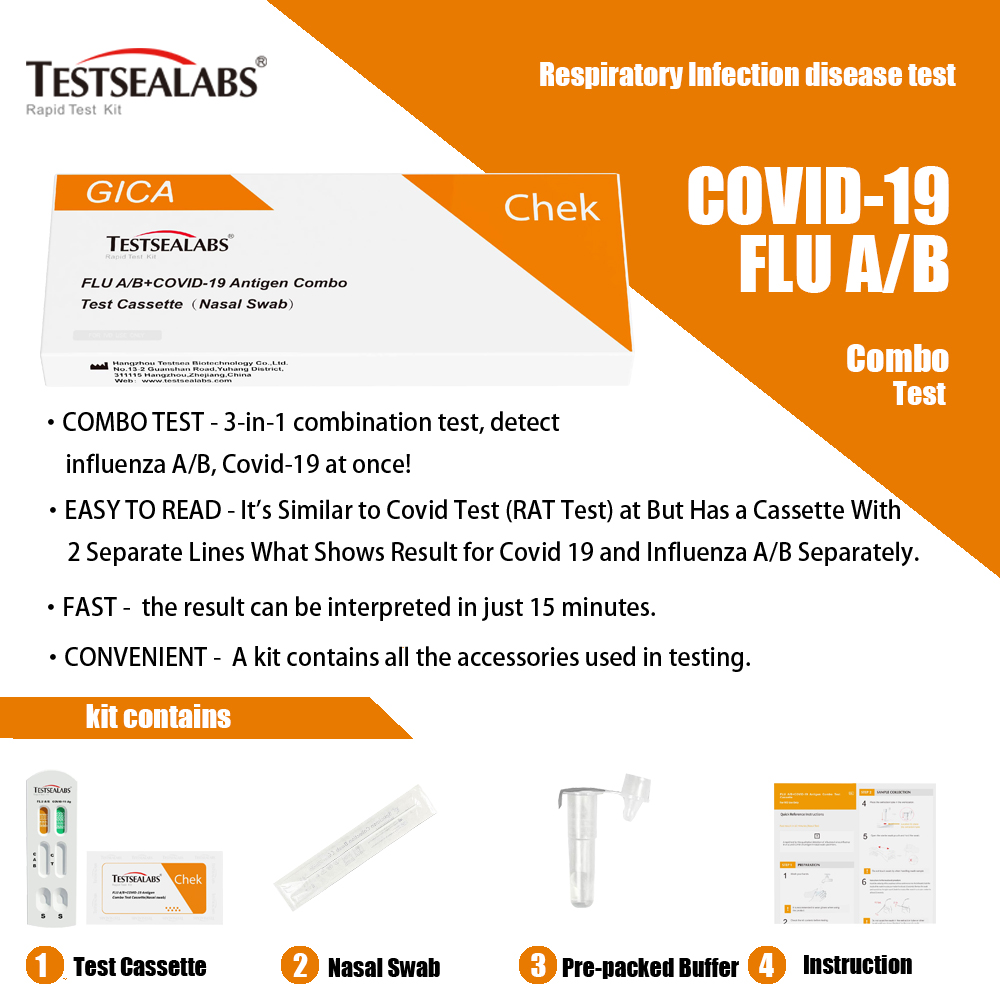
Three operational advantages follow from that. The first is throughput: one station instead of three. The second is documentation: one product record per patient instead of three separate ones, which matters when a public health programme is reconciling results later. The third is the isolation decision, because knowing whether influenza is in the room changes cohorting advice in a waiting area. None of these is a claim about accuracy, and accuracy is a separate question that the technical file answers.
Where combo testing does not win
Because a rapid antigen test is a front-line tool inside a diagnostic pathway rather than a replacement for one, a buyer who treats it as the whole pathway will be disappointed in exactly the season that matters. Rapid antigen tests perform best in symptomatic patients tested early, when the viral load in the specimen is high enough to detect. A negative result in a patient who is only on day one of symptoms, or who sampled poorly, does not exclude infection, and guidance in most markets says such a result should be followed by a molecular test rather than treated as a clean negative.
Two more limits are worth stating plainly in a procurement file. First, a combo cassette reports the pathogens it was designed to report, so a wider panel is not automatically a better panel: each added target adds a line to read and a reagent to the kit. Second, the regulatory route is the buyer’s responsibility to verify for their market – in the European Union that is the framework in Regulation (EU) 2017/746 on in vitro diagnostic medical devices, and the WHO COVID-19 hub and the ECDC COVID-19 pages set out the public health context that makes the test relevant in the first place.
What a distributor or hospital should specify
Eight lines turn a catalogue request into a comparable quotation, and every one of them is a number you will live with. These are the lines we ask for before we quote, and they are the lines we put in our own technical file:
- Target panel: influenza A and B, COVID-19, RSV, or a wider respiratory combination.
- Specimen type and volume, and whether saliva formats are acceptable in your workflow.
- Reading time and format, because a 15 minute read that fits inside a clinic session is a different product from one that does not.
- Storage temperature and shelf life, and what your warehouse and your distribution network can actually hold.
- Kit contents, because a kit without swabs and buffer tubes is not a kit.
- Quality system certification and the technical documentation your authority expects.
- Label language, IFU language and artwork for your brand, including your importer details.
- Order profile: standard quantity, forecast, and whether a private label programme is planned.
Our commercial terms for this range are a standard minimum order quantity of 5,000 pieces and an OEM custom programme from 50,000 pieces, with every cassette stored at 4 to 30 degrees Celsius and a shelf life of 24 months. The company behind the range, Hangzhou Testsea Biotechnology, was founded in 2015 and works from four platforms – immunological detection, molecular biology, protein chip and biological raw materials – with products sold into more than 100 countries and regions.
Frequently asked questions
Can you tell flu A, flu B and COVID-19 apart from symptoms alone?
What does a combo cassette give a clinic that three single tests do not?
How sensitive and specific are these rapid antigen tests?
Does a negative rapid test rule out influenza or COVID-19?
What are the minimum order quantity and the OEM terms?
How does a distributor specify a respiratory panel for its own market?
The short version
Symptoms cannot separate influenza A, influenza B and COVID-19, so the separation has to come from a test that reports each pathogen separately. One swab, one cassette, one 15 minute read, one result line per target, and one set of downstream decisions that are actually different per pathogen. Tell us the panel you need, the market you sell into and your order profile, and we will send the datasheet, the technical file and the samples.
Send us your panel requirement
Target panel, specimen type, destination market, labelling language and order profile. You get the published parameters, the technical file and the samples for evaluation.
Post time: Nov-27-2026