
Key Takeaways
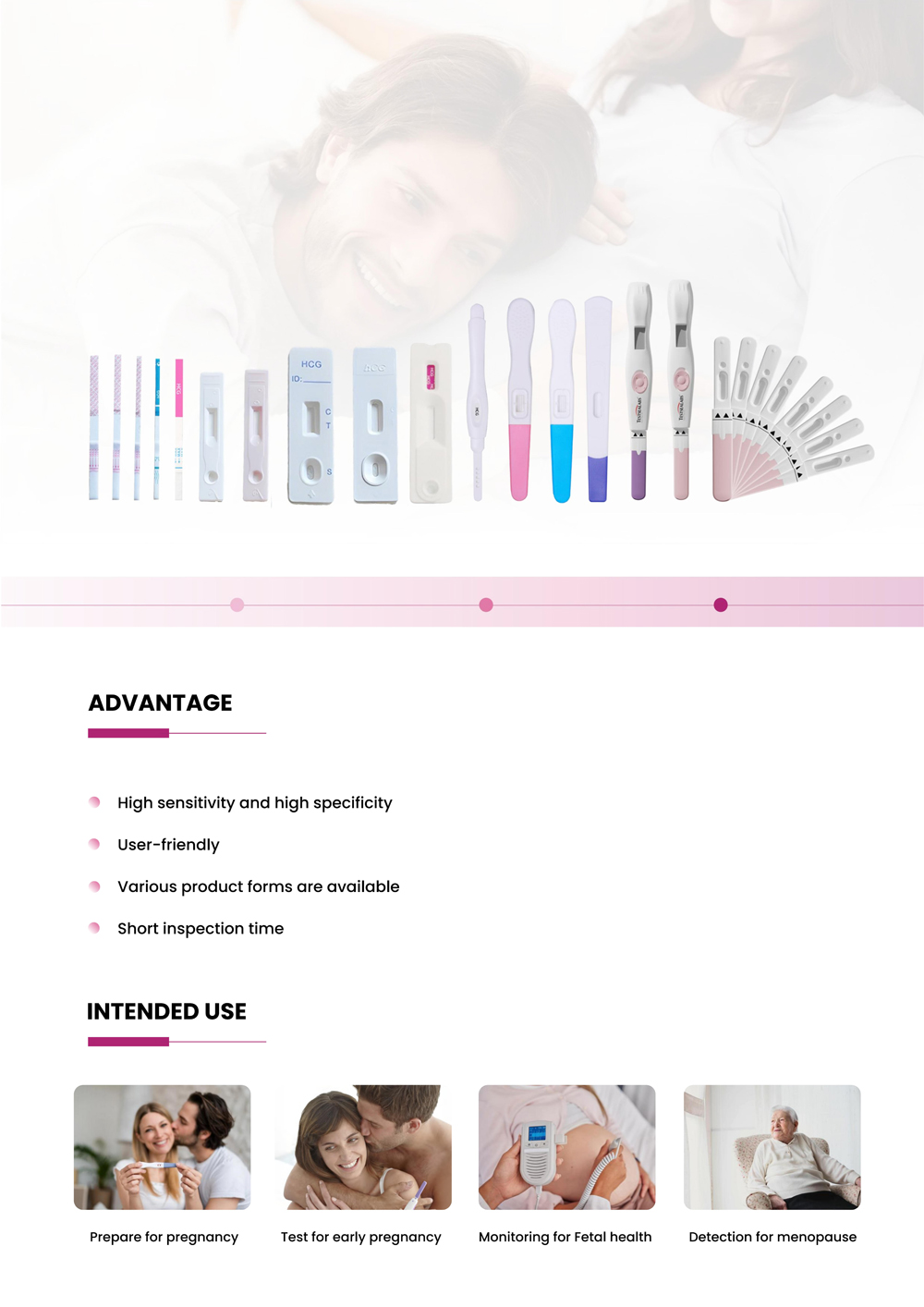
HCG Test Format Overview: Strip, Cassette, Midstream
The pharmacy-channel HCG pregnancy test market is structured around three physical formats that share the same antigen chemistry but differ in housing, per-test cost, and end-user experience. The strip format is a bare lateral-flow membrane mounted on a plastic backing, sold in bulk packs of 50 strips per canister.. The cassette format wraps the same strip inside a molded plastic housing with a sample-well and a result-window, and ships in 25-test or 40-test packs per our catalog spec. The midstream format integrates a plastic wand with an absorbent tip and a cap, designed for direct urine stream collection without a specimen cup.
All three formats in the Testsealabs HCG catalog use the same chromatographic immunoassay principle and detect human chorionic gonadotropin (hCG) in urine or serum. Our HCG Pregnancy Test Strip is the format our wholesale buyers most often lead with for high-volume pharmacy distribution, while the cassette version (the HCG Pregnancy Test on our fertility series page) carries the same antigen chemistry inside a molded housing that simplifies end-user workflow. The full fertility portfolio is listed in our Fertility Test Series catalog, alongside LH Ovulation and FSH Menopause tests for the broader maternal-health shelf.
The format decision is, first and foremost, an economics decision. The housing cost, the per-test material cost, and the per-test landed cost differ enough across the three formats that the procurement decision for a single pharmacy chain can shift the total landed-cost line by a meaningful margin. We walk through the per-test economics in the next section.
Per-Test Cost Economics for Wholesale Buyers
The three HCG formats sit at distinct cost tiers, and the tier separation is driven mostly by the housing material rather than by the antigen chemistry. Our strip format strips away the molded plastic cassette housing and the midstream wand assembly, so the per-test material cost is the lowest among the three formats in our catalog. The cassette format adds a molded ABS or polypropylene housing with a sample well and a result window, which adds material and assembly cost per test. The midstream format adds the plastic wand, the absorbent tip, the desiccant cap, and the integrated urine-collection geometry, which adds the most material and assembly cost per test in our line.
For wholesale buyers, the per-test landed cost also depends on the pack size and the inbound shipping efficiency. Strips ship in canisters of 50 or 100 tests per canister, and our buyers find that the high tests-per-cubic-centimeter ratio makes strips the most freight-efficient format. Cassettes ship in 25-test or 40-test packs per our spec, with each cassette in a sealed foil pouch. The per-cubic-centimeter freight ratio is lower for cassettes, but the cassette format trades that against the end-user workflow advantage in clinical channels.
| Format | Housing Cost Driver | Per-Test Material Tier | Pack Size in Our Catalog | Best-Fit Buyer Channel |
|---|---|---|---|---|
| Strip | Bare lateral-flow membrane on plastic backing | Lowest | 50 strips per canister | Distributor wholesale, clinic bulk, OEM private-label |
| Cassette | Molded plastic housing with sample well and result window | Mid | 25 or 40 cassettes per pack | Pharmacy chain, hospital, clinical lab |
| Midstream | Plastic wand with absorbent tip and desiccant cap | Highest | Single-test (1T) or 20-test (20T) retail box | Consumer self-test retail, pharmacy front-of-store |
Our buyers typically anchor the volume split on the end-user channel mix. A pharmacy chain that sells the majority of HCG tests at retail front-of-store tends to allocate the larger share of units to midstream tests, because the consumer self-test channel commands the highest retail margin per unit in our catalog. A chain that sells the majority of HCG tests through its wholesale or clinic-bulk channel tends to allocate the larger share to strips, where the per-test landed cost supports a thinner wholesale margin. Our buyers find that the cassette format sits in the middle and serves both channels at moderate per-test cost.
Shelf Life, Storage, and Pharmacy Warehouse Logistics
The storage envelope and the shelf life are the same across all three HCG formats in our catalog, and that uniformity is the operational anchor for the wholesale buyer. Testsealabs HCG tests are validated for storage between 4 and 30 degrees Celsius, with a 24-month shelf life from the date of manufacture. The 4-30 range eliminates the cold-chain requirement for most pharmacy distribution routes, and the 24-month shelf life gives the buyer enough headroom to absorb the typical pharmacy inventory cycle without expiring into waste on our end.
For pharmacy chains, the storage envelope translates into a few operational practices that our buyers tend to bake into their internal SOPs. The first is warehouse temperature mapping: the warehouse should hold ambient temperature between 4 and 30 degrees Celsius across all storage zones where HCG tests are racked. The second is FIFO inventory rotation: the 24-month shelf life is long enough that buyers can rotate by batch number rather than by receipt date, and the batch number is printed on each foil pouch and on the outer carton in our catalog. The third is vehicle transit discipline: although the cassette passes the 30-degree Celsius ceiling, field data from FIND and MSF procurement frameworks both reference the same ambient envelope for community health worker deployment, and our buyers apply the same discipline to last-mile delivery vans.
The accelerated stability data and the real-time stability data sit in our technical file for buyers that need to defend the 4-30 range to a national regulatory authority or a pharmacy chain compliance reviewer, and we walk through the data with our buyers on request. The same storage envelope also keeps our OEM artwork straightforward: when our buyers private-label the HCG catalog, the storage instruction on the outer carton is the same across strip, cassette, and midstream, which simplifies the chain’s compliance training on our side.
Channel Fit: Retail Self-Test, Clinic Bulk, Distributor Wholesale
The three formats are not interchangeable in the end-user channel. The strip format is the workhorse of the wholesale and clinic-bulk channel: strips are sold to clinical buyers that have specimen collection cups and trained operators, and the per-test cost advantage is most visible at scale. The cassette format is the standard for pharmacy chain front-of-store and clinical point-of-care, where the molded housing and the result window make the test accessible to a less-trained operator. The midstream format is the consumer self-test channel: the integrated wand replaces the specimen cup and the pipette, and the consumer reads the result directly from the window on the wand.
Our buyers find that the channel-fit question drives the SKU mix more than the per-test cost question does. A pharmacy chain that fronts the majority of its HCG volume at retail consumer self-test tends to allocate 60 to 70 percent of units to midstream tests, with cassette tests filling the prescription-channel gap and strip tests filling the wholesale-and-clinic channel. A chain that runs a wholesale-heavy distribution model tends to allocate the larger share to strips, with cassettes for the in-store clinic and midstream for a smaller retail self-test segment.
| Channel | Primary Format | Secondary Format | Typical Volume Share in Our Catalog Buyers |
|---|---|---|---|
| Consumer self-test retail | Midstream | Cassette | 50-70% midstream, 30-40% cassette |
| Pharmacy front-of-store | Cassette | Midstream | 60% cassette, 40% midstream |
| Clinic bulk and hospital | Cassette | Strip | 60% cassette, 40% strip |
| Distributor wholesale | Strip | Cassette | 70% strip, 30% cassette |
The end-user geometry difference between the three formats is also where regulatory frameworks tend to differentiate them. WHO’s pregnancy fact sheet and the WHO Sexual and Reproductive Health research team both treat HCG testing as a basic reproductive health tool, but the consumer self-test midstream format is the form most often referenced in maternal-health procurement frameworks because of its accessibility. Our buyers writing a procurement specification should map the format choice to the channel mix before locking the SKU list on our side.
Building a Three-Format HCG SKU Mix for a Pharmacy Chain
The SKU mix is the procurement decision that ties the per-test cost, the channel fit, and the storage envelope together. Our buyers tend to build the SKU list around the channel mix first and the per-test cost second, because the channel mix is harder to change after the SKU list is locked into the pharmacy chain’s inventory system. The format choice is the second decision: strip for the wholesale and clinic-bulk channels, cassette for the pharmacy front-of-store and clinical point-of-care, and midstream for the consumer self-test retail channel.
Once the channel mix and the format mix are set, the pack-size decision is the next step. Strips ship in canisters of 50 tests, and our buyers tend to lead with that size for the wholesale channel where the per-test cost advantage is the priority.Cassettes ship in 25-test or 40-test packs, and our buyers lead with the 40-test pack for pharmacy chain front-of-store and the 25-test pack for clinical point-of-care and small-format distribution.Midstream tests ship in single-test (1T) retail boxes or 20-test (20T) consumer multipacks, and our buyers lead with the 20-test multipack for the consumer self-test channel and the single-test box for the prescription channel on our side.
Our buyers also tend to build the SKU mix with a fallback channel in mind. The midstream format can absorb some of the retail self-test channel that is typically served by cassettes when the chain runs a stock-out on cassettes. The cassette format can absorb some of the clinical point-of-care channel that is typically served by strips when the chain runs a stock-out on strips. The strip format is the fallback for both channels when cassette and midstream stock-outs hit, but the strip format requires specimen cups and trained operators that the consumer self-test channel does not have. The cross-format fallback works best when the chain’s pharmacy staff is trained on the three-format workflow.
Procurement Specification for Wholesale RFQs
The procurement specification is the document that ties the channel mix, the format mix, and the pack-size decision together, and we recommend that our buyers write the specification per channel rather than per SKU. The retail self-test channel should list midstream as the primary SKU and cassette as the secondary SKU, with pack size and shelf-life requirements called out per SKU. The pharmacy front-of-store channel should list cassette as the primary SKU and midstream as the secondary SKU. The clinic bulk and distributor wholesale channels should list strip as the primary SKU and cassette as the secondary SKU on our end.
The specification should also call out the storage envelope (4-30 degrees Celsius in our catalog), the shelf life (24 months from the date of manufacture), the manufacturing compliance envelope (ISO 13485 and MDSAP on our side), and the per-SKU MOQ (5,000 units for catalog, 50,000 units for OEM private-label). The specification should confirm the intended-use specimen on each SKU (urine, serum, or both), the read time (5 minutes on our cassette format), and the pack-size and outer-carton labeling requirements for each shipping destination on our buyer side.
The biggest specification mistake we see is locking the chain into a single format before the channel mix is finalized. Our buyers avoid that mistake by mapping the channel mix first, listing the primary and secondary format per channel, and writing the specification around the format-by-channel matrix. The second-largest mistake is specifying a single compliance framework when multiple shipping destinations are involved, and our buyers avoid that mistake by listing the local regulatory approval status per shipping destination alongside the ISO 13485 and MDSAP certification on our manufacturing side.
Our full HCG portfolio is listed in our Fertility Test Series catalog, alongside LH Ovulation and FSH Menopause tests for the broader maternal-health shelf. The HCG Pregnancy Test Strip product page carries the format-specific spec sheet, and our sales team provides the dossier package, the stability data file, and the OEM artwork templates on request. Pharmacy chains that want to start the conversation can submit their RFQ through our contact page with the channel mix, the per-SKU volume estimate, and the destination country list, and our team responds with a quote and the per-format tier breakdown within two business days.
Frequently Asked Questions
What is the shelf life and storage temperature for Testsealabs HCG pregnancy tests?
Testsealabs HCG pregnancy tests are validated for storage between 4 and 30 degrees Celsius with a 24-month shelf life from the date of manufacture. The same storage envelope applies across the strip, cassette, and midstream formats in our catalog, which keeps pharmacy chain warehousing simple and lets our buyers mix formats on a single purchase order without splitting cold-chain or expiry management by SKU. ISO 13485 and MDSAP quality management certification backs the manufacturing side, and our sales team provides the stability data file for buyers that need to defend the storage envelope to a national regulatory authority or a pharmacy chain compliance reviewer.
What is the MOQ for Testsealabs HCG test strips, cassettes, and midstream tests?
Our standard MOQ is 5,000 units per SKU for catalog format HCG tests across strip, cassette, and midstream. For private-label or pharmacy-chain-specific OEM programs, our OEM MOQ is 50,000 units per SKU. The MOQ is per SKU, so a chain that wants all three formats in a single order is quoted per SKU on our buyer side, and the production schedule is built per SKU rather than per order to keep the launch timeline predictable. Our sales team confirms the per-SKU MOQ on the RFQ response and walks buyers through the production schedule and the OEM artwork timeline before the PO is signed.
Which HCG format is most cost-efficient for high-volume pharmacy wholesale?
HCG strips typically carry the lowest per-test landed cost among the three formats, because the cassette housing and the midstream plastic wand both add material and assembly cost. For pharmacy chains that ship in 25-test or 40-test cassette packs to clinical buyers, the cassette format balances per-test cost against ease of use for the end user. Midstream tests carry the highest per-test cost but command the strongest retail margin in the consumer self-test channel. Our buyers tend to stock all three formats and split volume by end-user channel, anchoring the volume share on the channel mix rather than on the per-test cost tier on our buyer side.
Do Testsealabs HCG tests work on both serum and urine specimens?
The HCG Pregnancy Test in our catalog is validated for serum and urine specimens, with a chromatographic immunoassay principle and a 5-minute read time on our cassette format. The same antigen chemistry applies across the strip and midstream variants, which use the same antibody pair on a different physical housing for end-user workflow. Our buyers should confirm the intended-use specimen on the inquiry, since some chains prefer a urine-only SKU for retail pharmacy channels where the serum workflow is not part of the end-user journey, and our sales team sizes the catalog SKU to the intended-use profile on each inquiry response.
Can pharmacy chains private-label Testsealabs HCG tests with their own brand?
Yes, our OEM program supports private-label and pharmacy-chain branding across strip, cassette, and midstream HCG formats. The OEM MOQ is 50,000 units per SKU, and the lead time for branded cassette and midstream housings is longer than for strip because the plastic tooling carries a fixed setup cost per housing design. Our sales team walks pharmacy chains through the OEM artwork, the cassette color options, the strip pouch layout, and the bilingual labeling requirements during the inquiry response, and we confirm the artwork proof before the production run starts on our buyer side to keep the chain’s launch date on track.
Request a Quote or HCG Sample
Pharmacy chain and wholesale buyers can submit an RFQ with the channel mix, the per-SKU volume estimate, and the destination country list through our contact page. Our sales team responds with a per-format tier breakdown, the OEM artwork templates, and the stability data file within two business days.
Browse the full HCG portfolio in our Fertility Test Series catalog, or jump to the HCG Pregnancy Test Strip product page.
Angela Qin
International Sales Director at Hangzhou Testsea Biotechnology Co., Ltd. (Testsealabs)
Angela Qin is the International Sales Director at Hangzhou Testsea Biotechnology Co., Ltd. (Testsealabs), with 10+ years of experience in the in vitro diagnostic (IVD) and veterinary product industry. Founded in 2015 with the pursuit “serving society, health world,” Testsealabs specializes in the R&D, production, and sales of rapid diagnostic products, including tests for coronavirus disease, cardiovascular diseases, inflammation, tumor markers, infectious diseases, drug abuse, and pregnancy. Leveraging proprietary platforms (immunological detection, molecular biology, protein chip, and biological raw materials), Angela helps global distributors, hospitals, public health institutions, and veterinary clients source reliable, high-quality diagnostic solutions from China—backed by strict quality control and a customer-first philosophy. Testsealabs’ products are widely used in rapid diagnosis, treatment monitoring, maternal and child healthcare, drug and alcohol testing, and have been sold to over 100 countries worldwide.
Post time: Aug-28-2026