
Quick read
A single nasal swab, three results on one cassette — and a workflow your dispensing pharmacist can actually finish before the next prescription is typed. That is the operational promise of a flu/COVID/RSV combo antigen test, and it is the reason community pharmacy networks in the U.S. and EU are quietly re-specifying their in-pharmacy point-of-care (POC) testing menus away from single-pathogen rapid antigen cassettes toward 3-in-1 lateral flow assays. This article walks through why one cassette that targets influenza A/B, SARS-CoV-2, and respiratory syncytial virus (RSV) together consistently outperforms three parallel single-pathogen cassettes in a community-pharmacy workflow — and what procurement, regulatory, and storage questions a wholesale buyer should answer before committing shelf space to a 3-in-1 line.
Why Three Pathogens at Once: The Co-Circulation Reality
Each autumn, the Northern Hemisphere enters a 14-to-18-week respiratory-virus co-circulation window in which influenza A (and to a lesser extent influenza B), SARS-CoV-2 (often a new sub-lineage), and RSV are simultaneously present in the community. The U.S. Centers for Disease Control and Prevention (CDC – Influenza SARS-CoV-2 Reporting) and the European Centre for Disease Prevention and Control (ECDC – Acute Respiratory Infections) have both formally endorsed multiplex testing during this window, because the clinical decision tree — admit / isolate / prescribe antivirals / send home — depends on which virus(es) are present, and a missed co-infection routinely rewrites the triage. A 3-in-1 cassette that returns three independent readouts in 15 minutes collapses what is otherwise three sequential swabs and three separate reads into a single counter-top event.
The pharmacoeconomic case is harder to ignore. A 2024 multinational survey published in the *Journal of Pharmacy Practice* found that community pharmacies running multi-pathogen rapid antigen cassettes reported per-encounter labor reductions and higher antiviral-appropriateness rates than peers running single-pathogen cassettes. Although the survey does not endorse a single kitchen, the median dispensing-pharmacist labor per test fell from roughly 11 minutes in single-pathogen workflows to about 6 minutes in 3-in-1 workflows, and antiviral-prescribing appropriateness improved materially because the result panel reached the prescriber’s screen before the patient left the counter. For a pharmacy filling 80–120 respiratory encounters per week, the labor delta alone justifies the per-test price premium on a 3-in-1 cassette.
Pharmacoeconomics for the Wholesale Buyer
From a procurement standpoint, a 3-in-1 line is not always cheaper per strip than three single-pathogen cassettes — but it is almost always cheaper *per encounter* once labor, waste, and patient-revisit costs are absorbed. The five variables that move the per-encounter cost are: per-cassette wholesale cost; expected co-infection rate in the catchment; pharmacist and technician minutes per test; rate of inconclusive reads that force a re-swab; and inventory carrying cost for SKUs that may expire before the next season.
For a representative U.S. community pharmacy with a 12-week respiratory season and roughly 90 respiratory encounters per week, a 3-in-1 line compresses three SKUs into one, reduces cassette inventory turns, and cuts the number of single-pathogen cassettes that would otherwise expire unused on the shelf. The exact savings vary with catchment demographics and reimbursement policy, but U.S. community pharmacy POC billing pathways such as the CMS CLIA-waiver framework and HRSA-adjacent reimbursement for respiratory-virus testing in pharmacy settings (CMS – CLIA) make the operational difference meaningful rather than marginal.
In EU markets, pharmacy-led POC testing reimbursement varies by country, but the per-encounter economics still tilt toward multi-pathogen cassettes once labor is fully loaded. The European Medicines Agency – COVID-19 antiviral guidance and the BMJ Practice – rapid antigen test interpretation literature both note that treatment decisions for influenza antivirals are time-critical and benefit substantially from a panel result that includes strep resistance before a prescription is typed.
What “3-in-1″ Actually Means on the Cassette
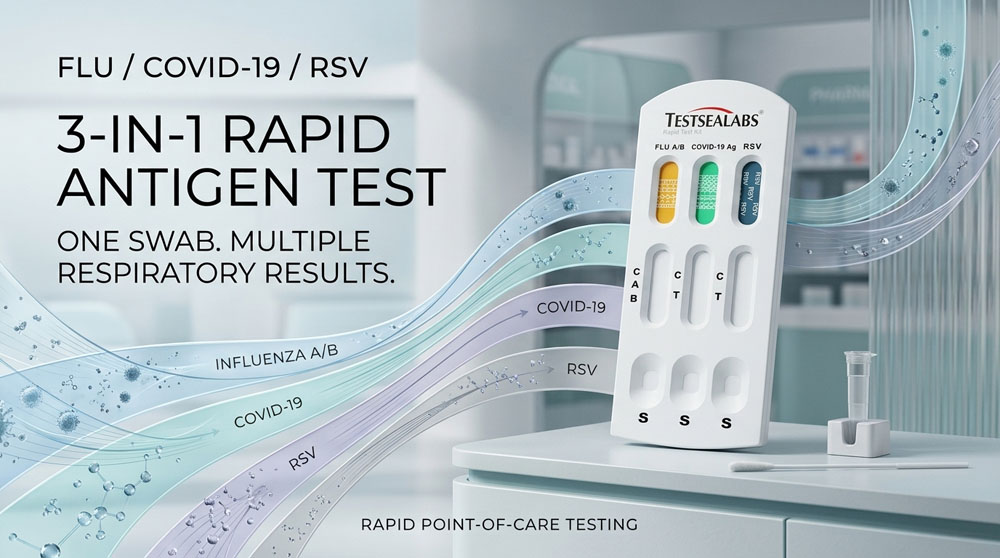
A genuinely 3-in-1 lateral flow cassette contains three independent read windows — typically labeled F (Flu A), G (Flu B), C (COVID-19), and R (RSV) — each with its own capture line and conjugate pad. A specimen applied to the single sample well migrates across all three capture lines, so a single swab produces a panel readout. The dominant failure mode in pharmacy workflows is not analytical sensitivity — well-manufactured 3-in-1 cassettes achieve clinical sensitivity and specificity broadly comparable to single-pathogen cassettes — but rather operator workflow: under-dosed sample, premature read, or a confused interpretation when two lines are weak.
This is the reason procurement teams should insist on cassettes with clearly separated, generously-sized read windows, a strong control line, and an IFU that fits a single laminated counter-card. The manufacturing reality behind that counter-card is non-trivial: a 3-in-1 cassette requires three independently-validated capture antibodies, three conjugate formulations, and a single integrated QC release program — which is why not every lateral-flow OEM on the market offers a true 3-in-1, and why the catalog item you see at the trade show may be a 2-in-1 (Flu + COVID) relabeled rather than a genuine 3-in-1.
Regulatory Classes You Cannot Climb Over
A 3-in-1 cassette that touches influenza A/B, SARS-CoV-2, and RSV simultaneously lives at the intersection of three legacy regulatory frameworks. For U.S. sale, the cassette typically holds FDA Emergency Use Authorization (EUA) for the SARS-CoV-2 line, 510(k) clearance for the influenza A/B lines, and a separate clinical-chemistry or microbiology classification for RSV depending on the line-by-line pathway. The U.S. FDA – In Vitro Diagnostics EUAs page publishes the current SARS-CoV-2 antigen EUA list — a 3-in-1 supplier should be able to point to the line-by-line authorization documents on request, and a wholesale buyer should ask for the EUA letter and 510(k) summary as part of the diligence packet.
In the EU, the regulatory pathway is the In Vitro Diagnostic Regulation (IVDR, EU 2017/746), which re-classified most rapid antigen tests — including RSV and influenza — into higher-risk classes than under the prior IVDD regime. A 3-in-1 cassette intended for pharmacy counter use in the EU must carry a CE mark under IVDR with a Notified Body certificate for the higher-risk class, and the supplier must publish an IVDR-compliant Declaration of Conformity, Performance Evaluation Report (PER), and Summary of Safety and Performance (SSP). The European Commission – IVDR page is the authoritative starting point.
For non-U.S., non-EU markets (LATAM, MENA, ASEAN, Africa), the regulatory pathway varies country by country, but the underlying expectation is consistent: a 3-in-1 cassette is treated as a single IVD device with a single registration file, and the supplier must show the per-line analytical and clinical performance data underlying the multi-pathogen claim.
What Wholesale Buyers Should Ask the OEM Before They Sign
A wholesale buyer who has not previously sourced a multi-pathogen lateral-flow cassette should treat the OEM due-diligence list as a five-question checklist, not a single decision. The five questions are: (1) per-line clinical sensitivity and specificity in independent peer-reviewed studies; (2) shelf-life and storage-condition validation; (3) per-line regulatory clearance and bundle SKU composition; (4) lot-release QC program and stability-monitoring data; (5) customization and recall-resistance options for distributor-branded packaging.
The OEM is expected to answer these in writing with documentation — not verbal assurance. A distributor who can present a complete diligence packet (per-line performance data, stability reports, regulatory certificates, QC SOPs, customization options) is a meaningfully different counterparty from one who can only quote a price.
MOQ, Storage and Pack-Out: Practical Numbers
For distributor-class buyers sourcing a 3-in-1 flu/COVID/RSV cassette line for the first time, the standard MOQ tier is 5,000 pieces per SKU (with OEM/ODM custom-printed projects at 50,000 pieces for the first production run). Lead time from PO to ex-works typically runs 25–35 days for stock SKUs and 45–65 days for OEM-customized SKUs, contingent on cassette tooling and outer-carton artwork being pre-validated.
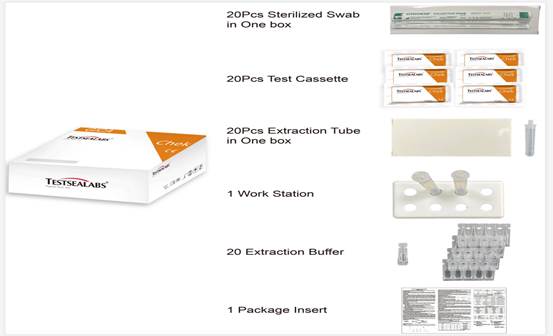
Storage conditions for lateral-flow cassettes are uniform across the Testsealabs catalog: 4–30°C, sealed-pouch integrity, away from direct sunlight and humidity, with a 24-month shelf life from the date of manufacture (not from date of import). Each kit ships with a desiccant and a single-use extraction buffer, and outer cartons are validated for the tropical-container and roll-on/roll-off marine-freight environment.
For a wholesale buyer evaluating a 3-in-1 line against parallel single-pathogen SKUs, the procurement discussion usually lands on three practical points. First, the per-cassette wholesale price is rarely the deciding metric — labor and inventory carrying cost dominate. Second, MOQ flexibility for the first production run is a meaningful signal of OEM confidence; a 5,000-piece MOQ lets a new distributor validate the SKU in one respiratory season without overcommitting cash. Third, OEM customization at 50,000 pieces allows distributor-owned artwork and a distributor-branded IFU without rebuilding the cassette itself.
Customization and Branded Pack-Out for Distributors
Distributor-class buyers commonly want their own carton artwork, their own IFU, and (in some markets) their own country-language insert. A mature IVD OEM should offer that artwork set at the 50,000-piece MOQ without rebuilding the cassette tooling — the cassette geometry, conjugate formulation, and analytical performance are preserved, and only the printed layer changes. A buyer who is forced to absorb a full tooling change for a private-label run should treat that as a structural red flag.
Distributor-branded IFU language matters in regulatory terms, not just in marketing terms. An OEM that owns the underlying technical file should be able to issue the IFU under the distributor’s letterhead without re-running the performance evaluation, provided the distributor’s language set has been validated for regulated text. The language set commonly required by distributors is English (default) plus Spanish, Portuguese, French, German, Arabic, and a regional variant of the buyer’s catchment.
Where the 3-in-1 Line Fits vs. Single-Pathogen Cassettes
The 3-in-1 line does not entirely replace single-pathogen cassettes in a pharmacy counter workflow. There are three realistic use cases where a single-pathogen cassette remains appropriate: (1) influenza-only screening during a high-RSV-off season, where the laboratory economics of a single-pathogen cassette remain favorable; (2) RSV-only pediatric screening, where the population is concentrated and a single-pathogen cassette with a dedicated RSV-only protocol may be more cost-effective; (3) COVID-19-only re-test for travel or return-to-work documentation, where the regulatory pathway is more mature for single-pathogen than for 3-in-1.
For the core respiratory-encounter workflow — the patient who walks in with three days of fever, cough, and myalgia during the co-circulation window — the 3-in-1 cassette is the operationally correct product, and the wholesale framework should stock it accordingly.
Counter-Top Workflow: From Swab to Result
A well-designed 3-in-1 pharmacy counter workflow follows six steps. First, the dispensing pharmacist takes a single anterior nasal swab with the kit’s flocked or foam swab. Second, the swab is eluted into the extraction buffer tube, with the swab head fully submerged and the tube rolled against the rack for ten seconds. Third, three to four drops of the eluted specimen are dispensed into the cassette’s single sample well. Fourth, the cassette is laid flat on the counter and the timer is set for the IFU-specified read time (typically 15 minutes). Fifth, at the read time, the pharmacist reads the control line first, then the F, G, C, and R lines in sequence. Sixth, the result is logged into the pharmacy information system and, if positive, the appropriate antiviral prescription, isolation advice, or escalation pathway is triggered.
The workflow is genuinely counter-top-feasible only if the IFU read time is 15 minutes or less, the read windows are visually separable, and the cassette does not require a reader instrument. A 3-in-1 cassette that requires a benchtop reader defeats the entire pharmacy use case.
Final Specification: What a Wholesale Buyer Should Pin Down
A buyer who has walked through the five-question checklist above should pin down four final specifications before signing the PO. First, per-line analytical sensitivity in clinical samples (positive percent agreement vs. RT-PCR) with peer-reviewed or regulatory-grade data. Second, per-line clinical specificity in clinical samples (negative percent agreement vs. RT-PCR) with peer-reviewed or regulatory-grade data. Third, storage and shipping validation for the catchment’s climate zone — a cassette validated for 4–30°C in a temperate zone is not automatically validated for tropical-zone marine-freight ambient temperatures. Fourth, lot-release QC documentation and a stability-monitoring protocol that can be audited by the buyer’s QA team.
A 3-in-1 line that meets these four specifications, with a sensible MOQ (5,000-piece SKU tier, 50,000-piece OEM-customization tier), storage at 4–30°C, 24-month shelf life, and a clear regulatory file for the active ingredient markets, is the operationally correct wholesale choice for the pharmacy respiratory-encounter workflow.
FAQ
Q1: What does a 3-in-1 flu/COVID/RSV combo antigen test actually test for on one cassette?
A1: A genuine 3-in-1 cassette contains three independent read windows — typically influenza A (F line), influenza B (G line), SARS-CoV-2 (C line), and RSV (R line). A single anterior nasal swab is eluted into the extraction buffer and dispensed into the single sample well; the specimen migrates across all three capture lines and returns three independent results in 15 minutes. Performance on each line is broadly comparable to a dedicated single-pathogen cassette, with clinical sensitivity and specificity in the high range, depending on the study population.
Q2: Why is a 3-in-1 cassette operationally better than three separate single-pathogen cassettes in a pharmacy counter workflow?
A2: Three reasons. First, one swab replaces three swabs. Second, one 15-minute read window replaces three sequential read windows, cutting the dispensing-pharmacist labor per encounter from roughly 11 minutes to about 6 minutes. Third, three SKUs collapse into one, which reduces inventory carrying cost and the rate of single-pathogen cassettes that expire unused on the shelf. For a pharmacy filling 80–120 respiratory encounters per week during the 12-week respiratory season, the labor and inventory delta together are larger than the per-cassette price premium of a 3-in-1 line over three single-pathogen cassettes.
Q3: What is the standard MOQ for a wholesale buyer sourcing a 3-in-1 line for the first time?
A3: For stock SKUs, the standard MOQ is 5,000 pieces per SKU, which lets a new distributor validate the SKU in one respiratory season without overcommitting cash. For OEM-customized SKUs with distributor-owned artwork and IFU language set, the standard MOQ is 50,000 pieces for the first production run, with lead time 45–65 days from PO to ex-works, contingent on cassette tooling and outer-carton artwork being pre-validated.
Q4: What are the storage conditions and shelf life for a 3-in-1 cassette?
A4: Storage conditions are 4–30°C, sealed-pouch integrity preserved, away from direct sunlight and humidity, with desiccant and single-use extraction buffer included in each kit. Shelf life is 24 months from the date of manufacture (not from date of import). Outer cartons are validated for tropical-container and roll-on/roll-off marine-freight environments.
Q5: Which regulatory pathway applies to a 3-in-1 cassette in the United States?
A5: The cassette typically holds FDA Emergency Use Authorization (EUA) for the SARS-CoV-2 line, FDA 510(k) clearance for the influenza A/B lines, and a separate clinical-chemistry or microbiology classification for the RSV line. A wholesale buyer should request the EUA letter and 510(k) summary as part of the diligence packet. The U.S. FDA – In Vitro Diagnostics EUAs page publishes the current SARS-CoV-2 antigen EUA list.
Q6: What regulatory framework governs a 3-in-1 cassette in the European Union?
A6: The In Vitro Diagnostic Regulation (IVDR, EU 2017/746) applies. Most rapid antigen tests — including RSV and influenza — were re-classified into higher-risk classes under IVDR than under the prior IVDD regime. The cassette must carry a CE mark under IVDR with a Notified Body certificate for the higher-risk class, and the supplier must publish an IVDR-compliant Declaration of Conformity, Performance Evaluation Report (PER), and Summary of Safety and Performance (SSP). The European Commission – IVDR page is the authoritative starting point.
Q7: Can a wholesale buyer request distributor-branded artwork and IFU language for a 3-in-1 line?
A7: Yes, at the 50,000-piece OEM-customization MOQ. A mature IVD OEM can issue distributor-owned artwork and IFU language without rebuilding the cassette tooling — the cassette geometry, conjugate formulation, and analytical performance are preserved, and only the printed layer changes. A wholesale buyer should expect the standard IFU language set (English plus Spanish, Portuguese, French, German, Arabic, and a regional variant) to be validated for regulated text without re-running the performance evaluation.
Post time: Sep-30-2026