
TL;DR — Key Takeaways
- GPO procurement of rapid test kits requires three things: ISO 13485 certification, national regulatory registration in each market, and Lot Release performance data — not just datasheet specs.
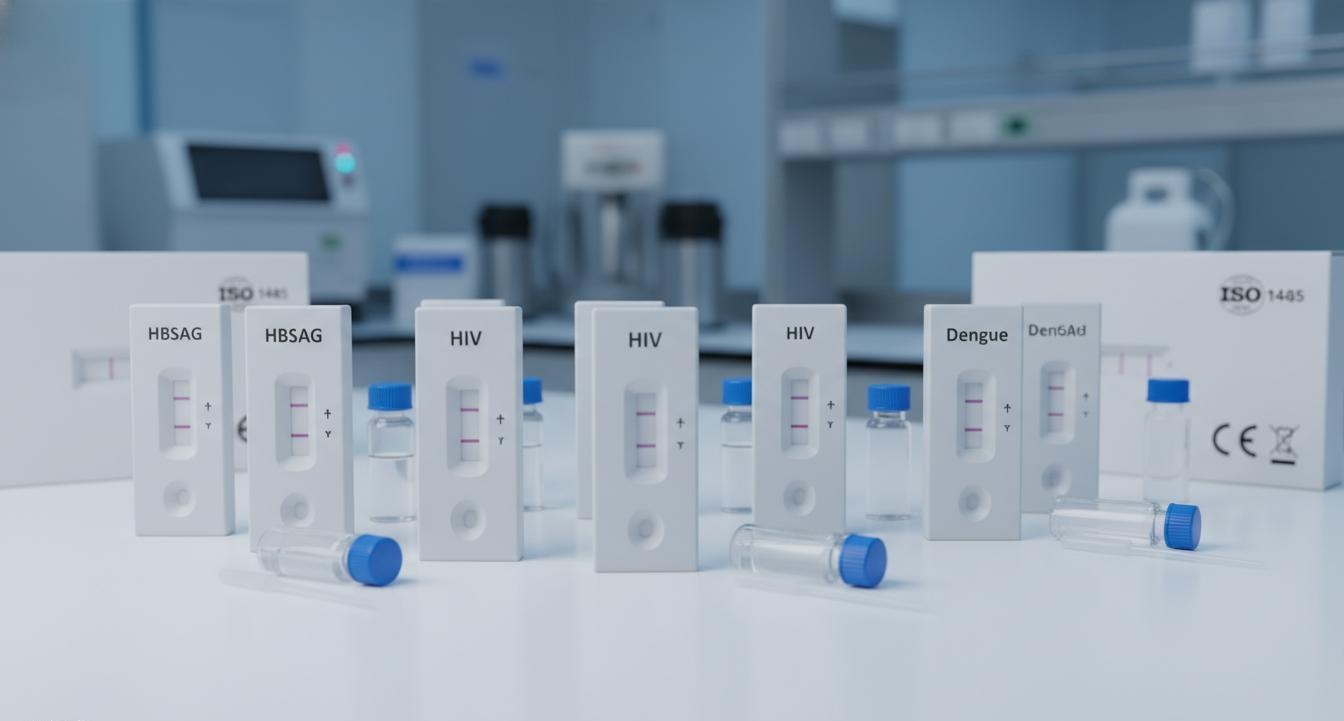
- HBsAg rapid tests (HBsAg Hepatitis B Surface Antigen Test): specimen whole blood/serum/plasma; format cassette or strip; specifications 25T/40T/50T. Demonstrates high sensitivity and high specificity in clinical validation studies.
- HIV 1+2 Antibody Test: specimen whole blood/serum/plasma; format cassette or strip; specifications 25T/40T/50T. High sensitivity and specificity confirmed for both HIV-1 and HIV-2.
- Dengue NS1 Antigen Test: detects all four dengue serotypes (1,2,3,4); specimen whole blood/serum/plasma; cassette format; specifications 25T/40T. Demonstrates high sensitivity and specificity in clinical validation studies.
- All three products are manufactured under ISO 13485 and CE-certified quality systems with documented batch traceability and Certificate of Analysis per lot. Storage: 4-30°C, 24-month shelf life.
- For high-volume screening: request Lot Release data (mass production quality) from the manufacturer, not just clinical trial data.
In 2024, a hospital network in Southeast Asia discovered that 23% of the HBsAg rapid test kits they had procured through a regional distributor were producing false negatives in field use — patients who had been cleared by the rapid test were subsequently found to be HBsAg positive in the hospital’s reference laboratory. The investigation found that the distributed lot of test kits had been stored at above-specification temperature for 6 weeks during a monsoon season when the regional warehouse had inadequate climate control. The kits had passed incoming quality inspection when they arrived, but the thermal excursion had degraded the antibody conjugates on the test membrane, reducing kit sensitivity without producing visible degradation that would have triggered a visual QC check. The hospital network had to recall 8,000 tests, retest 2,300 patients, and absorb the cost of 14 cases of missed HBV diagnosis that required follow-up clinical management.
This failure was not a specification failure — the kits had been correctly specified and had passed quality control at delivery. It was a supply chain management failure that the hospital’s procurement process had not adequately addressed. The question that hospital group purchasing organizations (GPOs) and procurement officers must ask is not just “does this kit meet the performance specification?” but “does this manufacturer have the quality systems, regulatory compliance infrastructure, and supply chain controls to ensure that every lot we receive performs as specified?”
In this guide, I draw on over a decade of experience in IVD rapid test manufacturing and international sales to explain the performance specifications that hospital procurement officers should verify, the certification requirements that are non-negotiable for hospital network procurement, and the supply chain risk factors that determine whether a rapid test kit manufacturer is a reliable long-term GPO partner.
| Product | Specimen | Format | Specifications | Performance |
|---|---|---|---|---|
| HBsAg Hepatitis B Surface Antigen Test | WB/S/P | Strip / Cassette | 25T / 40T / 50T | High sensitivity and specificity |
| HIV 1+2 Antibody Test | WB/S/P | Strip / Cassette | 25T / 40T / 50T | High sensitivity and specificity |
| Dengue NS1 Antigen Test | WB/S/P | Cassette | 25T / 40T | High sensitivity and specificity |
All three products are manufactured under ISO 13485 quality management system with CE marking. Storage: 4-30°C. Shelf life: 24 months from date of manufacture.
The Three Key Rapid Test Panels: HBsAg, HIV, and Dengue
HBsAg Hepatitis B Surface Antigen Test
Hepatitis B surface antigen (HBsAg) rapid tests are among the highest-volume screening tests in hospital networks, used both for routine clinical diagnostics and for blood bank screening in resource-limited settings. HBsAg is the primary serological marker of active Hepatitis B infection: the presence of HBsAg in a patient’s blood indicates an ongoing HBV infection, either acute or chronic. Per WHO guidelines on hepatitis B testing, HBsAg testing is the critical first step in the hepatitis B testing algorithm for diagnosis and for blood donor screening.
The Testsealabs HBsAg Hepatitis B Surface Antigen Test is a rapid chromatographic immunoassay for the qualitative detection of HBsAg in whole blood, serum, or plasma. Available in both strip and cassette formats with specifications of 25T, 40T, or 50T per pack, it is designed for flexibility across hospital laboratory and point-of-care settings. The test delivers results within 15 minutes and is manufactured under ISO 13485 quality management systems with CE marking.
Clinical performance data from the product’s validation study demonstrates strong sensitivity and specificity across a large sample set, with no cross-reactivity observed with anti-RSV, anti-Adenovirus, anti-H.Pylori, or anti-HCV positive specimens. No interference was observed from triglyceride, ascorbic acid, hemoglobin, bilirubin, or total cholesterol at tested concentrations.
For hospital procurement, the critical parameter beyond sensitivity and specificity is storage stability. The HBsAg test is stored at 4-30°C with a 24-month shelf life from date of manufacture — specifications that suit hospital inventory management across varied climate conditions. Batch traceability is maintained from raw material lot numbers through final shipping, and every batch ships with a Certificate of Analysis.
HIV 1+2 Antibody Test
HIV rapid tests are uniquely important in hospital network procurement because they serve two distinct use cases with different performance requirements: clinical diagnostics in hospital settings and outreach/screening testing in community health programs where laboratory infrastructure is unavailable. The WHO Recommended Algorithms for HIV Testing specify a testing strategy in which a first test (screening test) is followed by a second test (confirmatory test) from a different manufacturer — this two-test algorithm means the screening test’s sensitivity is the critical parameter; false negatives at the screening stage create the most clinical and public health risk.
The Testsealabs HIV 1+2 Antibody Test is a rapid chromatographic immunoassay for the qualitative detection of antibody to human immunodeficiency virus in whole blood, serum, or plasma. Available in strip and cassette formats at 25T, 40T, or 50T specifications, the test is designed for hospital laboratory screening, point-of-care diagnostics, and community outreach testing programs. Results are available in 15 minutes. The test contains HIV-1 and HIV-2 antigen as capture reagent and HIV antigen as detection reagent. A goat anti-mouse IgG and goat anti-rabbit IgG antibody are employed in the control line system.
Clinical validation data demonstrates strong sensitivity and specificity for both HIV-1 and HIV-2, with no cross-reactivity observed with anti-RSV, anti-Adenovirus, HBsAg, anti-Syphilis, anti-H.Pylori, or anti-HCV positive specimens. No interference was observed from triglyceride, ascorbic acid, hemoglobin, bilirubin, or total cholesterol at tested concentrations.
For hospital procurement, the HIV 1+2 Antibody Test carries CE marking under IVDR and is manufactured under ISO 13485 certification. Storage is 4-30°C with a 24-month shelf life from date of manufacture. Every batch ships with a Certificate of Analysis.
Dengue NS1 Antigen Test
Dengue is transmitted by the bite of an Aedes mosquito infected with any one of the four dengue virus serotypes (DENV-1, DENV-2, DENV-3, DENV-4). It occurs in tropical and sub-tropical areas of the world affecting infants, young children, and adults. Early clinical diagnosis and careful clinical management by experienced physicians and nurses can increase survival of patients, making reliable point-of-care dengue diagnostics essential for hospital networks in endemic regions.
The Testsealabs Dengue NS1 Antigen Test is a rapid chromatographic immunoassay for the qualitative detection of dengue virus NS1 antigen in whole blood, serum, or plasma. The test simultaneously detects all four dengue serotypes (DENV-1, DENV-2, DENV-3, DENV-4). Available in cassette format at 25T or 40T specifications, the test delivers results within 15 minutes and is manufactured under ISO 13485 quality management systems with CE marking.
Clinical validation data demonstrates strong sensitivity and specificity across a robust sample set, with no cross-reactivity observed with a comprehensive panel of related pathogens including Japanese encephalitis, Chikungunya, Measles, Rubella, Typhoid, Influenza, Leptospirosis, HIV, and Malaria. No interference was observed from hemolytic, lipemic, or icteric specimens.
For hospital networks operating in dengue-endemic regions, cold chain management is the critical procurement consideration. The Dengue NS1 Antigen Test is stored at 4-30°C with a 24-month shelf life from date of manufacture. Batch traceability and Certificate of Analysis accompany each shipment.
The GPO Procurement Framework: What to Verify Before Signing an Agreement
ISO 13485 and the Quality Management System
ISO 13485:2016 is the foundation of quality assurance for any medical device manufacturer — and the first document a hospital GPO procurement officer should request from a rapid test kit manufacturer. ISO 13485 certification confirms that the manufacturer has a documented quality management system covering design control, supplier management, incoming material inspection, in-process controls, final release testing, storage and distribution, and post-market surveillance. For hospital procurement, the relevant QMS elements are: incoming material inspection (the antibodies and antigens used on the test membrane are the most critical raw materials — their quality directly determines kit sensitivity), in-process controls (the coating of the test membrane, the assembly of the cassette, and the packaging all have critical process parameters that must be controlled), and Lot Release testing (every production lot must be tested against QC reference standards before release — this is not optional and is the single most important quality gate for rapid test kit consistency).
National Regulatory Registration
ISO 13485 is a quality system certification — it does not by itself authorize sale in any specific country. Each country where the hospital network operates requires product-level regulatory clearance from the national authority. For the major markets: China requires NMPA (National Medical Products Administration) registration; the European Economic Area requires CE marking under IVDR 2017/746; the United States requires FDA 510(k) clearance or PMA approval; many African and Asian markets require registration with the national medicines regulatory authority (e.g., Nigeria NAFDAC, Kenya PPB, Indonesia FDA).
For a hospital GPO procuring from a Chinese manufacturer, the critical question is whether the manufacturer holds regulatory registration for the specific products in the specific markets where the GPO’s member hospitals operate — not just in China. A manufacturer may have a well-documented ISO 13485 system and a strong product portfolio but have registrations in only a handful of markets. The GPO’s procurement team should request a list of current registrations by product and country and verify each against the regulatory authority’s public database before committing to volume.
Supply Reliability and Manufacturing Capacity
The hospital network’s supply contract is only as reliable as the manufacturer’s ability to produce committed volumes consistently. Key questions: What is the manufacturer’s monthly production capacity for the test kits being procured? Can they scale to meet demand during outbreak surges (particularly for dengue tests in endemic regions)? Do they hold adequate raw material inventory for committed volumes, or do they procure against orders creating supply risk? What is their average lot-to-lot consistency (expressed as coefficient of variation in QC panel readings)? A manufacturer who cannot provide lot-to-lot consistency data is a procurement risk that will materialize as performance variation in field use.
Consolidated Procurement from a Single Manufacturer
Because HBsAg, HIV, and dengue rapid tests target different pathogens with different reagent formulations and sample handling requirements, they are supplied as individual assay panels rather than combined into a single multi-analyte cassette. However, hospital GPOs can achieve significant operational advantages by consolidating procurement of all three products from a single qualified manufacturer rather than sourcing each from a different supplier.
The GPO that consolidates with a manufacturer offering all three products under one ISO 13485 quality system benefits from: one supplier qualification audit instead of three; one consolidated documentation file with product-specific appendices; one logistics and cold chain management protocol across all products; combined volume commitment that strengthens negotiating leverage; and reduced customs clearance documentation complexity (single manufacturer declaration for all products in the shipment). This is the procurement model that Testsealabs supports for hospital networks — three individually validated and registered rapid test products, each with its own clinical data package, delivered under one quality system and one supply chain.
The Hospital GPO Procurement Checklist
- ☐ ISO 13485:2016 certificate: request the certificate and verify it covers the specific manufacturing site for the products being procured
- ☐ Performance data: request sensitivity, specificity, and accuracy data from clinical trials for each individual product — verify against the manufacturer’s validated data package
- ☐ Lot Release data: request Lot Release QC data from the 3 most recent production lots — this is the most reliable indicator of ongoing manufacturing quality consistency
- ☐ Regulatory registrations: confirm the manufacturer holds active registration for the specific products in each country where the GPO’s member hospitals operate — request a registration list and verify against regulatory authority databases
- ☐ Stability data: request real-time stability data at the specified storage temperature (4-30°C) — confirm 24-month shelf life from date of manufacture
- ☐ Manufacturing capacity: verify monthly production capacity against the GPO’s committed annual volume and confirm the manufacturer can surge production during outbreak demand spikes
- ☐ Supply chain controls: verify cold chain requirements (4-30°C storage) and confirm the manufacturer’s distribution network maintains proper conditions to the GPO’s delivery points
- ☐ Batch traceability: confirm raw material lot number traceability from incoming inspection through final shipping — every batch should ship with a Certificate of Analysis
- ☐ Sample evaluation: request 50–100 evaluation units per product before committing to volume — perform your own QC testing on the evaluation lots to verify the manufacturer’s Lot Release data
- ☐ Post-market surveillance: confirm the manufacturer has a complaint handling and adverse event reporting process aligned with the regulatory requirements of the target market
Conclusion: Specification Is the Starting Point, Not the Destination
The hospital procurement failure I described at the beginning of this article — the thermal excursion that degraded 8,000 HBsAg test kits in a regional warehouse — was ultimately a supply chain management failure that no datasheet specification could have prevented. The kits met the specification when they left the factory. They failed in the field because the procurement process had not adequately addressed cold chain management, lot-to-lot consistency monitoring, and the recall and replacement logistics that a responsible manufacturer should provide as part of a GPO framework agreement.
The GPO procurement framework above is designed to move the evaluation beyond the datasheet. Verify the ISO 13485 scope, verify the regulatory registrations for each individual product, verify the Lot Release quality data, and verify the manufacturer’s supply chain management capability before signing any volume agreement. A reliable rapid test kit manufacturer will welcome this level of scrutiny — it demonstrates the procurement professionalism that leads to long-term partnership.
Testsealabs (Hangzhou Testsea Biotechnology Co., Ltd.) is an ISO 9001/13485-certified IVD manufacturer specializing in rapid diagnostic products including HBsAg rapid test kits, HIV 1+2 rapid test kits, and Dengue NS1 rapid test kits for hospital, blood bank, and public health screening programs. Angela Qin and the international sales team support global distributors and hospital group purchasing organizations with technical documentation, regulatory registration support, and supply chain planning. Contact the Testsealabs team to discuss your hospital network’s rapid test kit procurement requirements.
Disclaimer: This article provides general industry guidance for hospital group purchasing organizations and procurement officers sourcing rapid test kits. Performance specifications (sensitivity, specificity, accuracy), regulatory requirements (ISO 13485, CE marking under IVDR 2017/746, FDA 510(k)), and clinical use guidance referenced in this article are based on WHO guidelines, publicly available regulatory frameworks, and general industry knowledge. All performance data should be verified against the specific manufacturer’s product technical file and the regulatory registration documentation for the target market. Clinical decisions based on rapid test results must be made in accordance with applicable clinical protocols, national testing algorithms, and regulatory guidance. Hospital procurement officers should verify all regulatory registrations and quality certifications with the specific manufacturer before procurement.
Post time: May-26-2026