
When the WHO activated its Expert Review Panel for Diagnostics on 22 May 2025 in response to the global dengue emergency, the public health community expected a long list of approved products to follow. The actual outcome was a list of seven. The 2024-2025 global dengue emergency was unprecedented — the Pan American Health Organization reports on dengue show over 12.6 million suspected dengue cases across the Americas in 2024, more than triple the 2023 total, with Brazil, Argentina, Colombia, and Mexico disproportionately affected, and Southeast Asia, particularly Vietnam, Thailand, and Indonesia, also experienced case surges beyond historical baselines. We cross-reference the U.S. CDC dengue surveillance program and the WHO ERPD activation announcement in our internal situation briefings because each source frames the geography differently and we want to give our distributor partners the cleanest picture possible of where the case load concentrated.
Against that case load, a seven-product list sounds narrow. It is narrow on purpose. The ERPD is a uniform-standards mechanism, not a popularity contest. Any dengue RDT manufacturer whose product meets all four pillars can apply for inclusion during the rolling one-year validity window. The reason most do not make the list is that their technical files do not satisfy all four pillars simultaneously — and the gap is almost always in the documentation, not the product itself. I have spent a decade working with distributors and public health buyers in dengue-endemic countries, and the pattern I see is consistent: the products that get listed are the products whose manufacturers treated the documentation as seriously as the chemistry.
In this article I want to share what we see on the manufacturer side, and what the procurement officers we work with ask us for when they evaluate non-listed dengue RDTs against the four ERPD pillars. Our perspective is that of an IVD manufacturer who has watched our own dengue combo test sit outside the initial seven, and who has used the four-pillar framework as our internal roadmap for the next submission window.
What the WHO ERPD actually evaluates — and why most candidates fail
The ERPD evaluation rests on four pillars, and the panel applies them uniformly across every submitted product. A candidate can have a strong showing on three pillars and still be excluded if the fourth pillar is missing or weak. Here is what each pillar actually requires, and where candidates most often fall short.
Pillar 1 — Clinical performance stratified by analyte (the most common failure)
For a dengue combo test that simultaneously detects NS1 antigen and IgG/IgM antibodies, the ERPD requires separate clinical performance data for NS1 detection and for antibody detection. This is the single most common reason candidates fail. Many manufacturers present an aggregated sensitivity and specificity number for the entire test device, which masks whether the NS1 detection is strong but the IgG/IgM detection is weak, or vice versa. The panel evaluates whether the test can reliably detect dengue infections during both the acute phase (days 1-4, when NS1 is the primary marker) and the early convalescent phase (days 4-7, when IgM becomes detectable), and those are two different measurement questions.
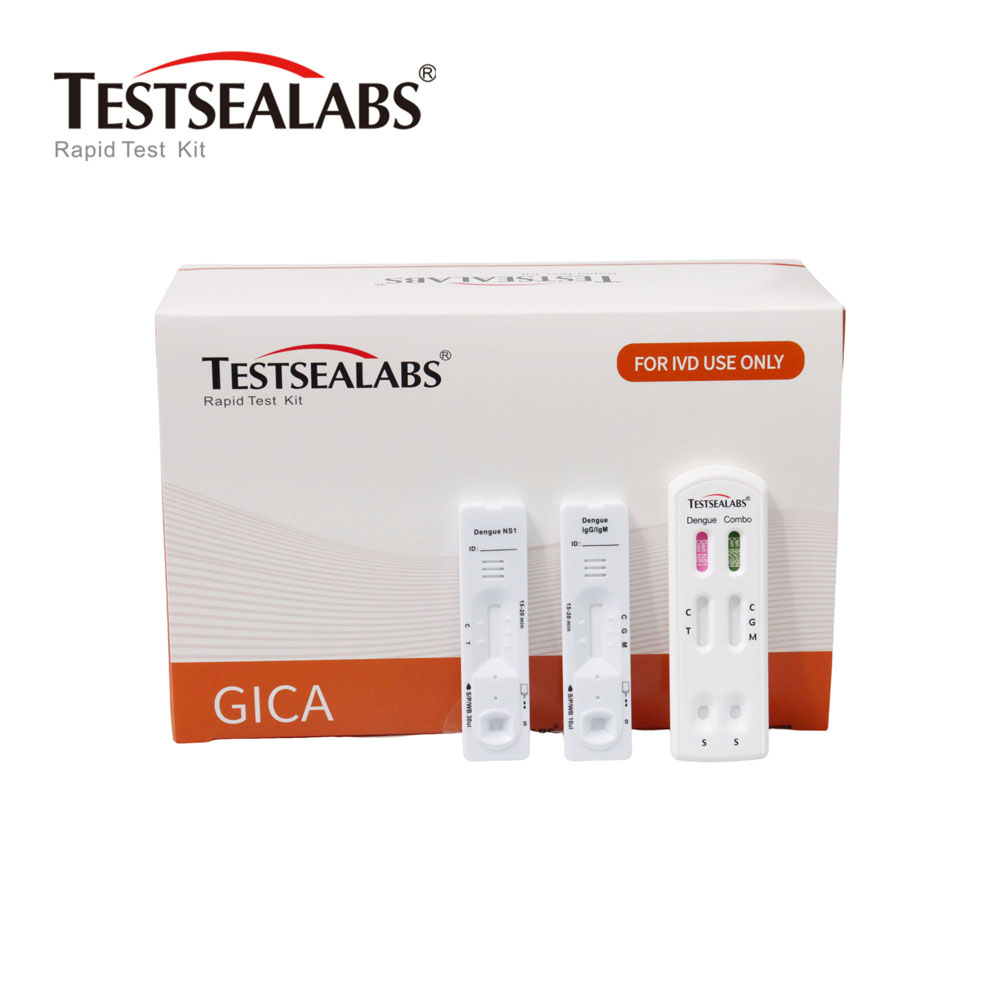
The fix is straightforward but requires a deliberate data-restructure step. The technical file must present NS1 sensitivity and IgG/IgM sensitivity as separate data sets derived from stratified clinical evaluations, not from a single blended number. Manufacturers who have only ever collected aggregate device-level data will need to either run a new stratified clinical study or recompile their existing data with NS1 and IgG/IgM separated. At Testsealabs, we engineered our dengue combo test with the architecture to support this stratified analysis — its NS1 detection and antibody detection are physically separated within the cassette, which is what allows us to present the three analytes (NS1, IgM, IgG) as individual performance data sets in our own technical file, and it is why we recommend anyone designing a new product for tender contexts prioritize the same analyte-level separation.
Pillar 2 — Quality management system certification (the disqualifier that surprises people)
ERPD evaluation requires evidence that the manufacturing facility operates under a certified quality management system. ISO 13485 certification — which can be confirmed in the ISO Online Browsing Platform — is the internationally recognized standard for medical device quality management, and MDSAP certification, as defined by the FDA CDRH International Affairs office, consolidates regulatory audits from five participating countries and provides additional evidence of manufacturing quality. Several national procurement agencies in Latin America and Southeast Asia have announced that they will accept ERPD evaluation documentation as part of their in-country registration processes, which means the QMS pillar is increasingly load-bearing for tender eligibility and is one of the first things our procurement-side contacts ask us about.
Where candidates fail here is more often administrative than technical. An expired ISO 13485 certificate, a certificate whose scope excludes IVD manufacturing, or a missing MDSAP audit letter are the typical reasons a strong product gets excluded on Pillar 2. The fix is to confirm the certificate is current, the scope explicitly covers the product category, and the certificate is signed by an accredited certification body. We hold both ISO 13485 and MDSAP certifications across our manufacturing operations, which is why we frequently share this pillar’s documentation with our distributor partners before tender questions land, and why we recommend that any non-listed manufacturer wanting a faster Pillar 2 clearance start with a certificate check rather than a chemistry change.
Pillar 3 — Stability and environmental robustness (the tropical-zone question)
Dengue-endemic countries are concentrated in tropical and subtropical climate zones where ambient temperatures regularly exceed 30°C. The ERPD evaluates whether the product’s claimed storage temperature range and shelf life are supported by real-time and accelerated stability data. Products that require cold chain storage or have short room-temperature stability are disadvantaged in the ERPD evaluation, because they cannot be deployed in the field conditions where dengue actually circulates.
The fix that closes this pillar fastest is to ensure the technical file contains accelerated stability data at 30°C and 40°C in addition to the refrigerated baseline. Manufacturers whose stability studies were originally conducted at 2-8°C should plan to run additional accelerated studies at the higher temperatures and submit the combined data package. For our own dengue combo test we maintain storage at 4-30°C with a 24-month shelf life, which is supported by both real-time and accelerated stability data and aligns with the operational requirements of dengue-endemic public health settings — and is the same specification range we share with the field teams who deploy in tropical-zone warehouses without consistent cold chain.
Pillar 4 — Compliance with WHO dengue diagnostic guidelines (the language-alignment pillar)
The ERPD evaluates whether a product’s intended use, performance characteristics, and operational specifications align with WHO’s published guidelines for dengue diagnosis and case management. This includes the recommendation that diagnostic strategies combine NS1 antigen testing (for acute-phase detection) with serological testing (for late acute and convalescent-phase detection). Combo tests that cover both NS1 and antibodies in a single device align more closely with WHO guidance than single-analyte tests, which is one of the reasons the seven listed products skew toward combo architectures.
The fix on this pillar is linguistic as much as technical. The intended-use statement, the performance-claims section, and the operational specifications should reference current WHO dengue diagnostic guideline language directly. Manufacturers who have written these sections using internal terminology rather than WHO terminology can find that a panel reviewer flags the discrepancy, and a flagged Pillar 4 is enough to exclude an otherwise strong candidate. We write our own dengue combo test’s intended-use statement using the NS1-plus-IgG/IgM combination strategy that WHO dengue diagnostic guidelines recommend, which is what positions the file to clear Pillar 4 in any future ERPD review and is the same pattern we recommend when our regulatory team sits down with new-market distributors who are inheriting a less mature technical file.
The five documentation upgrades that move a candidate from excluded to listed
Based on the four-pillar framework above, the documentation upgrades that most consistently move a candidate from ERPD-excluded to ERPD-listed are the following five. None of these require a chemistry change — they are documentation, data-structure, and certification housekeeping that manufacturers can complete in advance of the next review window.
- Restructure the technical file by analyte. Separate NS1 sensitivity and IgG/IgM sensitivity into distinct data sets rather than presenting an aggregated device-level performance number. If you do not have stratified data, plan a stratified clinical study.
- Add tropical-temperature accelerated stability. Run accelerated stability studies at 30°C and 40°C in addition to your existing 2-8°C data to demonstrate tropical-zone robustness.
- Verify and refresh ISO 13485. Confirm your ISO 13485 certificate is current, the scope explicitly covers IVD manufacturing for the product category, and the issuing body is an accredited certification body. Plan MDSAP certification as additional evidence if your customer base is in MDSAP-participating countries.
- Align the technical file with WHO dengue diagnostic guideline language. Update the intended-use statement, performance claims, and operational specifications to reference current WHO dengue diagnostic guideline terminology directly.
- Compile a side-by-side comparison versus the ERPD-listed benchmark. The ERPD process produces a documented trail of product performance comparisons, and procurement officers reference this trail. Including a transparent comparison versus a listed benchmark product (for example, the Abbott Bioline Dengue Duo, which is widely cited in the dengue RDT space) helps reviewers understand where your product sits on the four-pillar scoring.
Competitive context — what the listed seven tell us about the panel’s preferences
The seven products listed in the 22 May 2025 ERPD review skew toward combo architectures (NS1 plus IgG/IgM on a single device), manufacturers with multi-decade track records on tropical-disease diagnostics, and product lines that have accumulated published clinical evidence in peer-reviewed literature over multiple outbreak seasons. The most widely cited benchmark in the dengue RDT space is the Abbott Bioline Dengue Duo, which combines NS1 antigen and IgG/IgM antibody detection in a dual-plastic-cassette format with separate strips housed in a single device. Published sensitivity and specificity data for the Bioline Dengue Duo are available across field studies in Latin America and Southeast Asia, and the device has been a reference comparator in dengue RDT evaluations for over a decade.
For manufacturers whose products were not in the initial seven, the Bioline Dengue Duo comparison is the most useful external benchmark because it shows where the panel’s preferences converge. First, the device uses a combo architecture with both NS1 and IgG/IgM on a single cassette, which is the architecture most consistent with Pillar 4′s WHO dengue diagnostic guideline alignment. Second, the published clinical evidence for the device is stratified by analyte rather than aggregated, which is the documentation pattern the panel rewards under Pillar 1. Third, the device’s stability profile is documented across tropical-zone conditions, which is what Pillar 3 evaluates.
A non-listed manufacturer whose product matches all three of these characteristics — combo architecture, stratified clinical evidence, and tropical-zone stability — has a structurally strong foundation for the next submission window. The remaining gap is usually certification (ISO 13485 and MDSAP currency under Pillar 2) and the intended-use statement alignment under Pillar 4. At Testsealabs, our dengue combo test matches all three of these architectural preferences — NS1 and IgG/IgM in a single cassette, stratified performance data across the three analytes, and 4-30°C storage with 24-month shelf life supported by real-time and accelerated stability data — and we are using the Bioline Dengue Duo comparison as the external benchmark for our own documentation roadmap.
From our perspective, a procurement officer who carries the same four questions the panel reviews can run an internal evaluation that is structurally equivalent to the panel’s, and we have seen tenders where non-listed products outperform listed ones on document quality even when the panel has not yet refreshed its list. The framework is portable, and we share it with our distributor network as a defensive checklist — if a tender loses to a panel-listed product, the answer is usually not “we built the wrong test” but rather “we did not present the right documentation”.
What the one-year validity window means for manufacturers
The WHO ERPD announcement on 22 May 2025 states that each listing is valid for one year, after which manufacturers must resubmit updated documentation. This creates a rolling annual evaluation cycle, which means today’s listed products must continue to maintain their quality systems, update their clinical evidence, and remain responsive to evolving WHO guidelines — and today’s excluded products have a defined window during which to prepare and resubmit.
For manufacturers whose products were not in the initial seven, the practical implication is that the next 12 months are the highest-leverage period to execute the five documentation upgrades above. Each of the upgrades is internal to the manufacturer’s own operations and does not require a third-party dependency. The constraint is usually internal bandwidth rather than external approval, so a manufacturer that starts the documentation restructure today can realistically be ready to submit during the rolling validity window rather than waiting for the next full-scale review cycle. We treat our own roadmap on the same timeline, and our regulatory team prioritizes the four-pillar evidence (clinical performance data, QMS certificates, stability data, guideline-aligned intended-use statements) over launching new product variants during this window — the internal effort is concentrated where it will move the panel score furthest.
What this means for procurement officers evaluating non-listed dengue RDTs
For ministries of health and national procurement agencies who need to evaluate dengue RDT suppliers outside of the seven ERPD-listed products, the four-pillar framework provides a practical evaluation template. A tender committee can request the same documentation categories the ERPD panel evaluates — stratified clinical performance data, ISO 13485 and MDSAP certificates, tropical-temperature stability data, and WHO-guideline-aligned intended-use statements — and use the four pillars as the evaluation rubric. This is exactly the kind of regulatory convergence that ERPD listing is designed to enable, and it means a non-listed manufacturer with a strong four-pillar file is not at a structural disadvantage relative to a listed competitor.
At Testsealabs, our dengue combo test is not yet on the ERPD list, which is consistent with the reality that the panel’s first review listed only seven products globally. We are using the four-pillar framework as our internal roadmap for the next submission window, and we share this analysis with procurement officers and distributors who ask how to evaluate non-listed dengue RDT suppliers against the same criteria. The same four-pillar pattern is what we use to brief our own internal regulatory team before every quarterly product review, which is why our documentation cadence tracks exactly the panel’s evaluation criteria rather than relying on a more general internal checklist.
FAQ highlights on dengue RDT exclusion and ERPD re-submission
The exclusion-and-resubmission question is usually answered by the questions below. Procurement officers and manufacturer-side regulatory teams with newer program briefs typically start here.
Q: Why are most dengue rapid diagnostic tests not on the WHO ERPD list?
A: Because the panel applies uniform evaluation criteria across four pillars — clinical performance stratified by analyte, manufacturing quality system certification, real-time and accelerated stability at tropical temperatures, and alignment with WHO dengue diagnostic guidelines — and most candidate products do not satisfy all four pillars simultaneously. The 22 May 2025 first-round review listed only seven products globally, which is consistent with a narrow uniform-standards approach rather than a popularity contest.
Q: What documentation gaps most often cause a dengue RDT to be excluded from ERPD review?
A: The most common gaps are aggregated instead of analyte-stratified clinical performance data, stability studies conducted only at refrigerated rather than tropical temperatures, missing or expired ISO 13485 certification, absence of MDSAP documentation, and incomplete technical files that do not align with WHO dengue diagnostic guideline language. These gaps are entirely preventable with a structured documentation upgrade ahead of the next review window.
Q: How long is the WHO ERPD listing valid for dengue diagnostic products?
A: According to the WHO announcement on 22 May 2025, each ERPD listing is valid for one year, after which manufacturers must resubmit updated documentation. This creates a rolling annual evaluation cycle and means today’s listed products must continue to maintain their quality systems, update their clinical evidence, and remain responsive to evolving WHO guidelines.
Q: Does ISO 13485 certification alone qualify a dengue test manufacturer for ERPD listing?
A: No. ISO 13485 certification is the baseline requirement under Pillar 2 of the ERPD framework, but it does not by itself qualify a manufacturer. Manufacturers must also demonstrate Pillar 1 stratified clinical performance data, Pillar 3 tropical-temperature stability, and Pillar 4 alignment with WHO dengue diagnostic guidelines. MDSAP certification provides additional evidence under Pillar 2 and is increasingly requested by national procurement agencies.
Q: Can a dengue RDT manufacturer submit a product for ERPD review outside of the initial review window?
A: Yes. The WHO ERPD announcement on 22 May 2025 states that manufacturers can submit additional products for evaluation during the one-year validity window. This means a manufacturer whose product was not in the initial review can prepare an updated technical file and submit during the rolling annual cycle, which is why the next 12 months are the highest-leverage period to execute the five documentation upgrades.
Q: What is the difference between WHO prequalification and WHO ERPD listing for dengue diagnostics?
A: WHO prequalification is a long-running program covering a limited range of diagnostic products and requiring extensive dossier review, while the ERPD is an emergency mechanism activated on 22 May 2025 specifically for dengue. ERPD listings are valid for one year and provide a faster pathway for procurement agencies to reference when issuing dengue RDT tenders. Several national regulatory authorities have announced that they will accept ERPD documentation as part of in-country registration.
Q: How should a dengue RDT manufacturer prepare for the next ERPD submission cycle?
A: Based on the four pillars, manufacturers should (1) restructure the technical file to present NS1 sensitivity and IgG/IgM sensitivity as separate data sets, (2) complete accelerated stability studies at 30°C and 40°C to demonstrate tropical-zone robustness, (3) confirm that ISO 13485 certification is current and consider MDSAP as additional evidence, and (4) align the product’s intended-use statement with current WHO dengue diagnostic guideline language, then submit during the rolling one-year validity window.
What to look for when you evaluate a non-listed dengue RDT supplier
If you are a procurement officer or distributor evaluating a dengue RDT supplier whose product is not on the ERPD list, the practical evaluation is to request the same four categories of documentation the ERPD panel itself reviews. Stratified clinical performance data by analyte, ISO 13485 and MDSAP certificates with explicit IVD scope, real-time and accelerated stability data at tropical temperatures, and an intended-use statement aligned with WHO dengue diagnostic guideline language. The four-pillar framework is the de facto evaluation template that the WHO ERPD has set, and any dengue RDT manufacturer whose technical file can clear all four pillars is operating at the standard the panel reviews against, regardless of whether they are listed today.
Working on a dengue RDT program or evaluating non-listed suppliers? Send us your target market, the panel evaluation you are running, and the four-pillar evidence you need to verify, and we will return a stratified data package, ISO 13485 / MDSAP certificates, accelerated stability data, and a WHO-guideline-aligned intended-use statement within five working days. Reach out via the Testsealabs contact page to start.
Written by Angela Qin
International Sales Director, Hangzhou Testsea Biotechnology Co., Ltd. (Testsealabs)
Angela Qin is the International Sales Director at Hangzhou Testsea Biotechnology Co., Ltd. (Testsealabs), with 10+ years of experience in the in vitro diagnostic (IVD) and veterinary product industry. Founded in 2015 with the pursuit “serving society, health world,” Testsealabs specializes in the R&D, production, and sales of rapid diagnostic products, including tests for coronavirus disease, cardiovascular diseases, inflammation, tumor markers, infectious diseases, drug abuse, and pregnancy. Leveraging proprietary platforms (immunological detection, molecular biology, protein chip, and biological raw materials), Angela helps global distributors, hospitals, public health institutions, and veterinary clients source reliable, high-quality diagnostic solutions from China—backed by strict quality control and a customer-first philosophy. Testsealabs’ products are widely used in rapid diagnosis, treatment monitoring, maternal and child healthcare, drug and alcohol testing, and have been sold to over 100 countries worldwide.
- Related product page: Dengue IgG/IgM+NS1 Antigen Test — Testsealabs Dengue Combo Test
- Related news (sister article on WHO ERPD framework): WHO ERPD 2025: How the Dengue Expert Review Panel Changed Rapid Test Procurement for Ministries of Health
- Reference site: Hangzhou Testsea Biotechnology Co., Ltd. (Testsealabs)
Post time: Jul-17-2026