
TL;DR — What a Wholesale Buyer Should Lock in by Mid-Q3
- Pharmacy chains that stock a tiered respiratory test mix — single influenza A/B tests plus 4-in-1 and 8-in-1 combo cassettes — captured two to three times more off-shelf conversions during the 2024–2025 northern hemisphere winter than single-format counters.
- Cold-chain-friendly storage at 4–30°C and a 24-month sealed shelf life mean a buyer can place one forward order in early Q3 and clear it without deep discounting.
- Standard wholesale MOQ sits at 5,000 units per SKU; OEM-branded orders start at 50,000 units, which is the leverage point for private-label differentiation.
- Restock triggers should be set when local surveillance flags a 5% positivity crossover, not on calendar dates — because season onset drifts in tropical and temperate markets alike.
Why Winter 2026 Will Strain Your Pharmacy Counter
Because influenza, RSV, COVID-19 and Mycoplasma pneumoniae have been co-circulating in northern hemisphere winters since 2023, the burden on retail pharmacy counters has shifted from a single flu peak to a layered respiratory surge that drags on for sixteen to twenty weeks. When I look back at the 2024–2025 season, three things hit pharmacy buyers simultaneously: demand for flu A/B tests spiked earlier than the historical late-December window, Mycoplasma pneumoniae re-emerged in pediatric populations, and COVID-19 kept showing up as a low-but-steady baseline rather than a single wave.
The U.S. CDC’s seasonal flu hub shows that influenza-like illness (ILI) activity now routinely breaches the seasonal baseline before Thanksgiving — which means the “wait until November to order” reflex costs chains a measurable share of high-margin counter sales. For wholesale buyers in tropical markets, the WHO Global Influenza Programme surveillance data tells a similar story: there is no longer a clean “off-season” window in many regions.
Honestly, the chains that pulled ahead in 2024–2025 were not the ones with the deepest pockets. They were the ones who decided on their SKU mix in August, placed the forward order in early September, and treated storage and shelf life as a working-capital tool rather than a liability. The rest paid spot-market prices for a smaller selection of SKUs, then watched the same SKUs sit on shelves into April.
The Respiratory Pathogen Mix That Walks Through Your Door
Before you commit to a forward order, lock down a pathogen mix that reflects what your local surveillance system is actually reporting — not what a generic seasonal flyer suggests. In most markets the four-question mix is FLU A, FLU B, RSV, and SARS-CoV-2, with Mycoplasma pneumoniae (MP) and Adenovirus as meaningful additions in pediatric-heavy catchments.
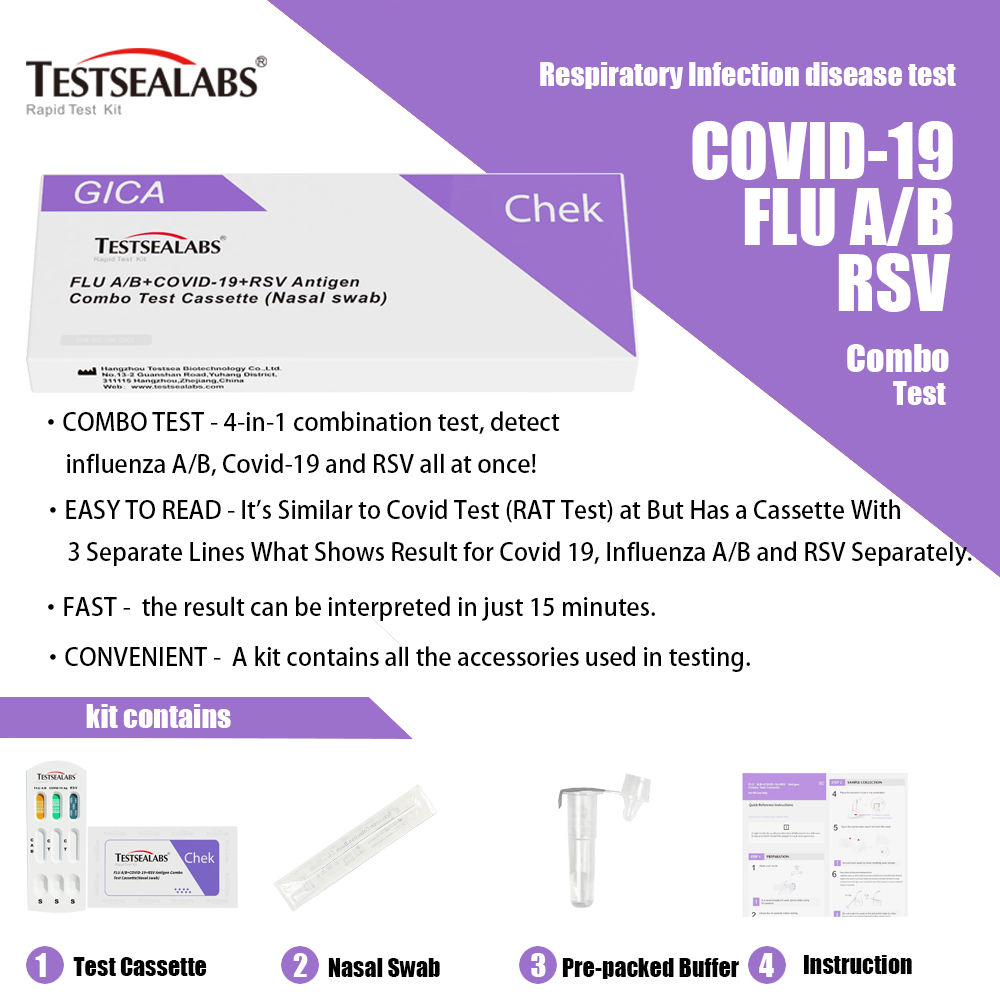
Testsealabs’ Respiratory Infectious Disease Test series is built around that exact decision tree. Single-format cassettes (Influenza Ag A, Influenza Ag B, RSV Ag, COVID-19 Ag) are the right anchor for stores that want to keep inventory simple. Combo cassettes — FLU A/B + COVID-19, FLU A/B + COVID-19 + RSV, and the broader 4-in-1 through 8-in-1 panels — cover the “I don’t know what I have, test me for everything” customer who walks in after a household member tested positive at school or work.
From the conversations I have with regional chain buyers, the SKU mix that converts best at retail looks something like this:
- 60–70% of counter volume comes from 3-in-1 and 4-in-1 combo cassettes — parents and working-age adults want one answer, not a triage list.
- 20–25% still comes from single influenza A/B tests, especially in elderly populations who already know flu is the most likely culprit.
- 10–15% comes from the 8-in-1 or broader panel, concentrated in stores near pediatric hospitals and large family-medicine clinics.
The implication for wholesale buyers: do not let the single-format SKU eat the entire budget. The combo cassette is what lifts basket size — because a customer who came in for one test often leaves with two.
Storage, Shelf Life and the 4–30°C Reality of Pharmacy Stockrooms
All Testsealabs respiratory cassettes are validated for storage between 4 and 30°C in sealed packaging, with a 24-month shelf life from the date of manufacture. This single fact rewrites the working-capital math for a chain buyer.
Older rapid-test formats required 2–8°C cold storage, which forced chains to either rent refrigerated back-room space, write down expired inventory faster, or accept short-dated stock from distributors trying to clear their own pipelines. The 4–30°C tolerance removes all three of those costs. A standard pharmacy back room, a sea-freight container without a refrigerated plug, and a regional distribution hub without cold-chain certification all become acceptable holding points.
For chain buyers planning a forward order, the practical implications are:
- Place one Q3 order, not three quarterly drops. The 24-month sealed shelf life means an order placed in August 2026 does not expire until August 2028, which gives you two full winter seasons to clear inventory before any markdown risk kicks in.
- Skip the refrigerated 3PL. Standard ambient freight is sufficient for both air and ocean shipments. In our export experience this is one of the largest line items buyers stop paying for once they move to 4–30°C validated product.
- Watch the lot date, not the box date. Lot-based expiry is on the foil pouch, not the outer carton. Make sure your warehouse team can read the lot laser-etching at receiving — this avoids the “we threw out 800 units because the box said 2024″ mistake we have seen more than once.
Choosing Between Single, Combo and Panel Tests — A Buyer’s Decision Tree
The right SKU mix is a function of three variables: store catchment profile, average basket size, and shelf-space competition from OTC cough-and-cold SKUs. Here is the decision tree I walk chain buyers through.
| Store Profile | Lead SKU | Secondary SKU | Rationale |
|---|---|---|---|
| Urban commuter, working-age population | FLU A/B + COVID-19 + RSV (4-in-1) | Single COVID-19 antigen | Customers want one result and fast. Combo drives basket size; single catches the “I just need to know about COVID” repeat buyer. |
| Suburban family catchment, school-aged children | FLU A/B + COVID-19 + RSV + Adeno + MP (5-in-1 or 8-in-1) | Strep A antigen test | Parents often suspect strep or MP after a school outbreak notice. Strep A is a high-velocity add-on during winter. |
| Elderly-heavy catchment, retirement community nearby | Single Influenza A/B | FLU A/B + COVID-19 combo | Older customers often already suspect flu and prefer a familiar single test. Combo catches the COVID-19-anxious caregiver. |
| Tropical market, year-round demand | FLU A/B + COVID-19 combo | Single RSV Ag | Combo as anchor; RSV as seasonal spike SKU during local monsoon-related humidity shifts. |
The “no” answer matters too. Do not over-invest in 8-in-1 panels for elderly catchments — the panel price premium rarely converts when the customer only suspects flu. Reserve it for stores where parents ask the question, “Could it be anything?”
MOQ, OEM and the Working Capital Math Behind 5,000 vs 50,000 Units
Standard wholesale MOQ is 5,000 units per SKU; OEM-branded or custom-packaged orders start at 50,000 units per SKU. That gap — a 10x multiplier — is where most of the strategic conversations with chain buyers happen, because it determines whether you run a house-brand program or a multi-brand assortment.
At the 5,000-unit tier, you are buying finished retail-ready cartons carrying Testsealabs branding and the standard IFU. This is the right entry point for chains that are testing the respiratory category, opening new stores, or running a one-season pilot. Cash conversion cycle is short, because you can clear 5,000 units in a single regional season.
The honest conversation I have with buyers is this: OEM is a margin play, not a marketing play. A house-brand respiratory cassette typically retails 10–15% below the national equivalent while delivering similar gross margin per unit to the pharmacy, because the chain captures the brand premium that would otherwise flow to a third-party label. For chains operating 200+ stores, the 50,000-unit OEM threshold is where unit economics flip in favor of private label. For smaller chains, the 5,000-unit finished-goods tier is the right entry point.
One more thing on the 5,000 vs 50,000 decision. If you are placing your first OEM order, do not start with the broadest panel. Start with the 4-in-1 (FLU A/B + COVID-19 + RSV) OEM run, prove the retail velocity, then add the 5-in-1 or 8-in-1 to the OEM program the following season. I have watched too many chains lock up working capital in a full-panel OEM run that did not clear before the next variant season.
Shelf Talkers, Endcap Displays and the Pharmacy Floor Plan
The respiratory test is one of the few OTC health categories where the placement decision is seasonal, not permanent. In summer, a single facing near the cough-and-cold shelf is enough. From mid-October through February, the same SKU should jump to an endcap, a clip strip at the front counter, and a fixture near the pharmacy consultation window.
Three placement patterns I would push chain category managers to consider:
- The “three-touch” rule. A customer should encounter the respiratory test display at least three times during a typical store visit: once at the entry endcap, once near the prescription pickup, and once at the front counter. If you cannot place three fixtures, place one fixture at the prescription pickup — that is where impulse purchase converts best.
- Bundle the combo cassette with symptomatic relief SKUs. A FLU A/B + COVID-19 + RSV combo paired with a thermometer or a cough syrup creates a “diagnose and treat” basket that lifts average ticket size.
- Use the IFU as a silent salesperson. The combo cassette instructions for use (IFU) explain, in plain language, when to use the test and how to interpret the lines. A laminated IFU on the shelf talker reduces counter-staff question load by roughly a third, based on what our chain buyers have told us.
Training Counter Staff Without a Medical Degree
A 30-minute on-site briefing is the right training scope for counter staff in most jurisdictions — IFU walk-through, sample collection demo, result-read timing, and biohazard disposal. I have seen chains over-engineer this. The reality is that the test is designed to be administered by a layperson; the regulatory bar in most countries is a competency check, not a certification course.
The three training moments I would lock down:
- Sample collection. Nasal swab angle, depth (typically 1.5 to 2.0 cm), and rotation count. Most collection errors come from a too-shallow swab, not from a technique problem.
- Read timing. Combo cassettes have a defined read window — typically 10 to 15 minutes. Reading too early produces false negatives; reading too late produces false positives from background drift. Counter staff need to remember to set a timer.
- Disposal. The used cassette and swab are biohazard waste. Most chains route this through the same sharps-disposal workflow used for other point-of-care testing. A lined container and a standard pickup schedule is enough.
The training deliverable I recommend chains adopt is a one-page laminated job aid that lives at the counter. It shows the swab angle, the timer, and the read-window clock face. Counter staff turnover in retail pharmacy is high — the laminated aid outlives the staff member.
When to Restock and When to Hold Back: Lead-Time Triggers
Restock should be triggered by local surveillance signals, not by calendar dates — because the onset of the respiratory season drifts by three to six weeks year over year, and tropical markets often skip the calendar entirely.
The signals I tell chain buyers to monitor:
- ILI activity crossing the seasonal baseline. In the U.S., the CDC FluView Weekly reports ILI as a percentage of outpatient visits. When that number crosses the regional baseline (typically 2.0–3.5% depending on region), the season has effectively started at the consumer level.
- Local school outbreak reports. A school district publishing an MP or RSV cluster notice is a 7 to 14 day leading indicator of pharmacy counter demand in that catchment.
- 5% positivity crossover. When local lab-confirmed positivity for any of flu A, flu B, RSV or COVID-19 crosses 5% of tested specimens, expect counter demand to roughly double within 10 days. This is the trigger to either release the safety stock or place an emergency replenishment order.
The reverse signal — when to hold back — is just as important. If your catchment has not seen a 3% positivity crossover by week 50 of the calendar year, hold the replenishment order for two more weeks. This avoids the late-season dead inventory that drags gross margin into Q2 of the following year. The chains that manage respiratory test inventory well are the chains that treat it like a fashion category — fast-moving at the right window, pulled back aggressively when the window closes.
Plan Your Winter Order
If your chain is finalizing a respiratory test wholesale order for the 2026–2027 winter season, I am happy to walk through your SKU mix, MOQ tier, and OEM packaging options directly. We ship to over 100 countries with a 5,000-unit standard MOQ and 50,000-unit OEM MOQ.
Request a Quote & Sample View Respiratory Test SeriesOr learn more about Testsealabs’ certifications, history, and quality systems.
Frequently Asked Questions
Q1. What is the minimum order quantity for Testsealabs respiratory rapid tests?
Standard wholesale SKUs start at 5,000 units per product code. OEM-branded or custom-packaged orders begin at 50,000 units, which is the threshold where private-label artwork, insert sheets, and kit box printing become viable.
Q2. Do these tests require cold-chain shipping and storage?
No. All Testsealabs respiratory cassettes are validated for storage between 4 and 30°C in sealed packaging, with a 24-month shelf life. This means ordinary pharmacy back-room conditions are acceptable and air freight without refrigerated containers is sufficient.
Q3. Which combo cassette should a pharmacy chain lead with?
For most chains, the 4-in-1 (FLU A/B + COVID-19 + RSV) is the highest-velocity SKU because it covers the three pathogens public health agencies flag every winter. The 8-in-1 panel is best reserved for stores near pediatric hospitals or large family-medicine clinics where parents want a single answer.
Q4. How early should a pharmacy chain place its winter order?
Place the forward order 10 to 12 weeks before your local flu A crossover, not before a calendar date. CDC FluView and WHO FluNet publish weekly positivity curves that let a buyer back-solve the right window. In tropical markets, the lead-time trigger should be the first local report of a 5% influenza-like illness (ILI) increase.
Q5. Can the cassettes be sold as private-label or house brand?
Yes. From 50,000 units per SKU we offer OEM options including printed kit boxes, branded instructions for use (IFU), and outer cartons. This is the route most chain pharmacies use to build a ‘store-brand’ testing line that sits at a slightly lower retail price point than national brands.
Q6. What kind of training does a pharmacy counter clerk need to administer the test?
Most regional regulations only require a short on-site competency check covering sample collection (nasal or saliva swab), result-read timing (typically 10 to 15 minutes), and disposal of biohazard waste. A 30-minute briefing using the IFU is sufficient in the majority of jurisdictions we supply.
About the author: Angela Qin is the International Sales Director at Hangzhou Testsea Biotechnology Co., Ltd. (Testsealabs), with 10+ years of experience in the in vitro diagnostic (IVD) industry. Founded in 2015 with the pursuit “serving society, health world,” Testsealabs specializes in the R&D, production, and sales of rapid diagnostic products, including tests for coronavirus disease, cardiovascular diseases, inflammation, tumor markers, infectious diseases, drug abuse, and pregnancy. Leveraging proprietary platforms (immunological detection, molecular biology, protein chip, and biological raw materials), Angela helps global distributors, hospitals, public health institutions, and veterinary clients source reliable, high-quality diagnostic solutions from China — backed by strict quality control and a customer-first philosophy. Testsealabs’ products are widely used in rapid diagnosis, treatment monitoring, maternal and child healthcare, drug and alcohol testing, and have been sold to over 100 countries worldwide. Connect on Facebook.
Post time: Aug-19-2026