

1. How do drug detection windows actually work, and why do they vary so much?
A “detection window” is the time period during which a drug or its metabolites remain present in a biological specimen above the test’s cut-off concentration. The window is not a fixed number — it is the result of six interacting variables:
- Drug half-life. The half-life of the parent drug and its active metabolites determines how long the body takes to clear the substance. Short-half-life drugs (cocaine, methamphetamine) clear faster than long-half-life drugs (THC, benzodiazepines, methadone).
- Dose and frequency of use. A single low dose will clear faster than chronic heavy use. For THC, occasional users have a urine window of 1-3 days; chronic heavy users can test positive for 30+ days.
- User metabolism. Liver function, body composition (fat percentage), age, and genetic variation in CYP450 enzyme activity all shift the window by 30-50% in either direction.
- Specimen cut-off concentration. Lower cut-offs detect drug use for longer. A urine test with a 20 ng/mL THC cut-off will detect more users than a 50 ng/mL cut-off, but at the cost of more false positives from passive exposure.
- Specimen collection quality. Adulterated, substituted, or dilute urine samples can produce artificially low readings. The creatinine and specific-gravity validity checks in modern test cups catch this.
- Drug polarity and fat solubility. Fat-soluble drugs (THC, benzodiazepines) accumulate in adipose tissue and release slowly, extending the window. Water-soluble drugs (cocaine, methamphetamine) clear faster.
The three routine specimen types — urine, saliva, and hair — each have a fundamentally different relationship to those six variables, which is why the windows look so different across the tables below.
2. Drug detection times in urine — the standard 1-7 day window
Urine is the most common specimen for workplace drug testing worldwide because it balances detection window, cost, and ease of collection. Most drugs and their metabolites concentrate in urine during the 24-72 hours after use, with chronic users showing longer windows. The table below summarizes the standard detection windows for 18 drug classes in urine at SAMHSA-recommended cut-off concentrations.
| Drug class | Common abbreviations | SAMHSA cut-off (ng/mL) | Standard window | Chronic-use window |
|---|---|---|---|---|
| Amphetamine | AMP | 1,000 | 1-3 days | Up to 7 days |
| Methamphetamine | MET | 1,000 | 1-3 days | Up to 7 days |
| Cocaine / Benzoylecgonine | COC | 300 | 1-3 days | Up to 7 days |
| Marijuana / THC metabolite | THC | 50 | 1-3 days (occasional) | Up to 30+ days |
| Opiates (morphine, codeine) | OPI / MOP | 2,000 | 1-3 days | Up to 7 days |
| Oxycodone | OXY | 100 | 1-3 days | Up to 7 days |
| Phencyclidine | PCP | 25 | 2-4 days | Up to 14 days |
| Benzodiazepines | BZO | 300 | 1-7 days | Up to 30 days (long-acting) |
| Barbiturates (short-acting) | BAR | 300 | 1-3 days | Up to 7 days |
| Methadone | MTD | 300 | 1-7 days | Up to 14 days |
| Methadone metabolite (EDDP) | EDDP | 100 | 1-7 days | Up to 14 days |
| Ketamine | KET | 1,000 | 1-3 days | Up to 7 days |
| Fentanyl | FYL | 10 | 1-3 days | Up to 7 days |
| Ecstasy / MDMA | MDMA | 500 | 1-3 days | Up to 5 days |
| Synthetic cannabis (K2/Spice) | K2 | 50 | 1-3 days | Up to 7 days |
| Buprenorphine | BUP | 10 | 1-7 days | Up to 14 days |
| Propoxyphene | PPX | 300 | 1-3 days | Up to 7 days |
| Tricyclic antidepressants | TCA | 1,000 | 1-7 days | Up to 14 days |

3. Drug detection times in saliva (oral fluid) — the 5-48 hour window
Saliva (oral fluid) testing has become the fastest-growing specimen type in workplace and roadside drug testing because it captures very recent drug use and is observed directly during collection. The window is shorter than urine, but the trade-off is that saliva is the best specimen for detecting use within the last 5-48 hours — critical for post-accident and reasonable-suspicion testing. The table below summarizes the standard saliva detection windows for 12 of the most commonly tested drug classes.
| Drug class | Common abbreviations | Typical saliva cut-off (ng/mL) | Standard window | Notes |
|---|---|---|---|---|
| Amphetamine | AMP | 50 | 12-36 hours | Detects recent use |
| Methamphetamine | MET | 50 | 12-36 hours | Includes MDMA cross-reactivity |
| Cocaine / Benzoylecgonine | COC | 20 | 5-24 hours | Shortest window in saliva |
| Marijuana / THC | THC | 4-25 | 5-24 hours | Detects very recent use only |
| Opiates | OPI / MOP | 40 | 12-36 hours | Lower cut-off than urine |
| Phencyclidine | PCP | 10 | 12-36 hours | Rare in routine panels |
| Benzodiazepines | BZO | 10-30 | 12-48 hours | Variable by compound |
| Methadone | MTD | 30 | 12-36 hours | EDDP rarely in saliva |
| Ketamine | KET | 50 | 12-36 hours | Used in clinical panels |
| Ecstasy / MDMA | MDMA | 50 | 12-36 hours | Often paired with MET |
| Fentanyl | FYL | 10 | 12-36 hours | Growing in roadside testing |
| Alcohol | ALC | 0.02 g/dL | 6-12 hours | Detects recent drinking |
4. Drug detection times in hair — the 7-90 day retrospective window
Hair testing is the only specimen type that provides a retrospective view of drug use over weeks to months. As hair grows approximately 1 cm per month, a 3 cm hair sample taken from the scalp can detect drug use over the past 90 days. The window is much longer than urine or saliva because drugs and their metabolites become trapped in the hair shaft as it grows. The table below summarizes standard hair detection windows for 8 drug classes commonly screened in hair specimens.
| Drug class | Common abbreviations | Typical hair cut-off (pg/mg) | Standard window | Notes |
|---|---|---|---|---|
| Amphetamine | AMP | 300 | Up to 90 days | Stable in hair shaft |
| Methamphetamine | MET | 300 | Up to 90 days | Common in workplace panels |
| Cocaine / Benzoylecgonine | COC | 300 | Up to 90 days | Includes crack cocaine |
| Marijuana / THC | THC | 50-100 | Up to 90 days | Detects chronic use |
| Opiates | OPI / MOP | 300 | Up to 90 days | Codeine and morphine |
| Phencyclidine | PCP | 300 | Up to 90 days | Detects chronic use |
| Methadone | MTD | 300 | Up to 90 days | Used in rehab monitoring |
| Synthetic cannabis (K2/Spice) | K2 | 50 | Up to 90 days | Variable by compound |
5. Comparing urine vs saliva vs hair: 5 selection criteria for employers and clinics
The choice between urine, saliva, and hair is not a matter of which is “best” — it is a matter of which specimen matches the goal of your testing program. The five criteria below will help you make that choice for each scenario.
6. What affects the detection window? (6 variables, in detail)
Earlier in this guide I named the six variables that shift the detection window. Here is how each one changes the window in practice.
- Drug half-life. A drug with a 4-hour half-life (cocaine) clears in 1-3 days. A drug with a 24-hour half-life (methadone) clears in 5-7 days. A drug with active metabolites that have 50+ hour half-lives (diazepam → nordiazepam) can be detected for 30+ days.
- Dose and frequency of use. A single 50 mg dose of methamphetamine clears in 2-3 days. A chronic user taking 500 mg per day may test positive for 5-7 days after the last dose.
- User metabolism. CYP450 enzyme polymorphisms mean that two users of identical body weight taking the same dose can have detection windows that differ by 30-50%. Liver impairment extends the window significantly.
- Specimen cut-off concentration. Drop the THC urine cut-off from 50 ng/mL to 20 ng/mL and the detection window extends by 1-2 days for occasional users. Drop it to 5 ng/mL and the window extends further but at the cost of more false positives from passive exposure.
- Specimen collection quality. Adulterated, substituted, or dilute urine will produce false negatives. The creatinine (≥ 20 mg/dL) and specific gravity (1.0030-1.0250) integrity checks in modern test cups catch this. Dilute samples must be reported as “invalid” or “dilute” and a recollection ordered.
- Drug polarity and fat solubility. THC and benzodiazepines are fat-soluble. They accumulate in adipose tissue, then release slowly over weeks. This is why chronic THC users can test positive for 30+ days. Water-soluble drugs like cocaine release in 1-3 days.
7. How to choose the right specimen type for workplace, clinical, and forensic programs
The right specimen depends on the question your program is asking.
- Pre-employment screening (safety-sensitive industries: aviation, nuclear, transportation): Hair is the strongest choice because it documents 90 days of use and cannot be cheated. Urine is the standard for most other pre-employment programs.
- Random workplace testing: Urine is the default under SAMHSA, EWDTS, and most national guidelines. Saliva is gaining acceptance in roadside and reasonable-suspicion contexts.
- Post-accident testing: Saliva is the right choice because it captures use within the last 5-48 hours and is observed during collection. Urine can be added as a secondary specimen to extend the window backward.
- Reasonable-suspicion testing: Saliva or urine. Both are observed. Saliva is faster; urine covers a wider window.
- Return-to-duty and abstinence monitoring: Hair is the gold standard because chronic use produces a pattern in the hair shaft that cannot be concealed by short-term abstinence.
- Clinical and emergency settings: Urine is the most common. Saliva is used when rapid results are needed for acute intoxication assessment.
- Forensic and legal contexts: Hair and urine both accepted. Hair is preferred for custody and child-protection cases because the longer window documents a pattern of use.
8. Testsealabs drug-of-abuse test series: 3 specimen types, 1 workflow
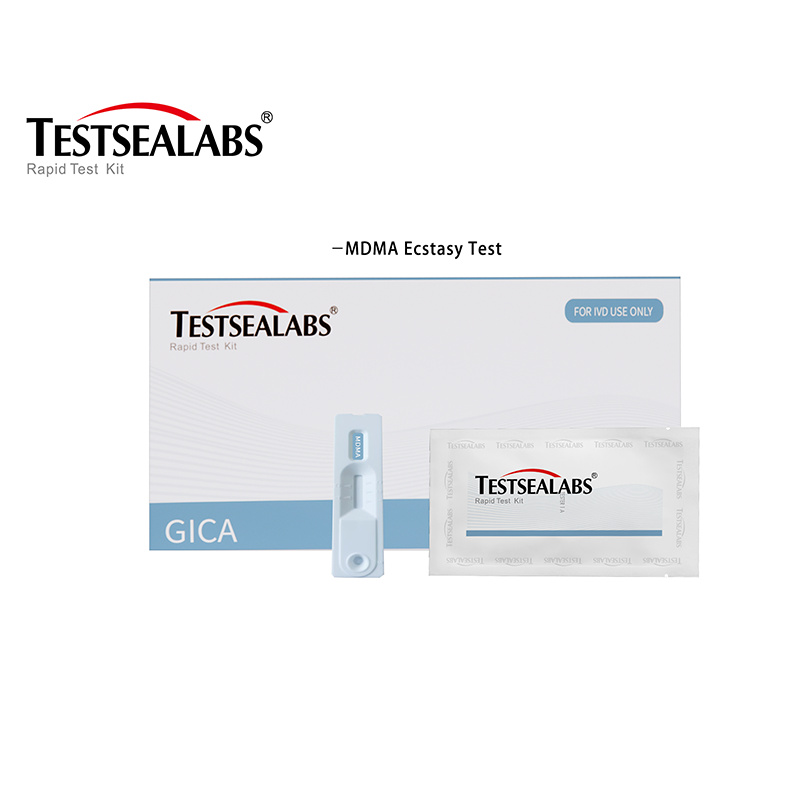
Testsealabs manufactures a complete drug-of-abuse test series covering urine, saliva, and serum specimens, with more than 40 individual drug tests and 12 standard multi-drug panels. All products share the same lateral flow immunoassay workflow, the same cut-off calibration standards, and the same storage and shelf-life specifications. This means a distributor or employer program can switch between specimen types without retraining staff.
- Urine formats: Multi-Drug Screen Test Cup (most common, 3-5 minute read), Multi-Drug Screen Test Panel (dip card format), and Multi-Drug Screen Test Cassette (lab-preferred format).
- Saliva format: Saliva Drug Test Cassette — designed for observed collection, deep-throat saliva sampling, 10-15 minute read time, storage at 4-30°C, shelf life 24 months from date of manufacture.
- 40+ individual drug tests: AMP, MET, COC, THC, OPI, MOP, OXY, PCP, BZO, BAR, MTD, EDDP, KET, FYL, MDMA, BUP, K2, GHB, ETG, MQL, CLO, MPD, PGB, SOMA, TCA, PPX, MEP, MCAT, MDPV, LSD, 6-MAM, ALP, APAP, CAF, COT, GAB, HM, plus adulteration panels (CRE, SG, pH, NIT, GLUT, BLE).
- 12 standard multi-drug panels: from 2-drug (THC/COC) to 16-drug workplace panels, all customizable for OEM/ODM programs.
All Testsealabs drug-of-abuse tests are manufactured under ISO 13485 quality systems, carry CE marking for European distribution, and meet MDSAP requirements for the U.S., Canada, Japan, Australia, and Brazil. The minimum order quantity for stock configurations is 5,000 units, with custom OEM configurations starting at 50,000 units. To request a quote or sample, contact our international sales team at testsealabs.com/contact-us.
Frequently asked questions
What is the shortest drug detection window across all three specimen types?
Blood has the shortest window of all, typically 6-12 hours for most drugs. Among the three routine specimen types discussed here, oral fluid (saliva) has the shortest window, typically 5-48 hours for most drug classes. Saliva is therefore the right specimen when the goal is to detect use within the last day or two — post-accident testing, reasonable-suspicion testing, and roadside drug testing programs all use saliva for this reason.
What is the longest drug detection window across all three specimen types?
Hair is the longest, with a standard retrospective window of up to 90 days (1 cm of hair ≈ 30 days of growth). Urine is the standard medium-range specimen (1-7 days for most drugs), and saliva is the shortest (5-48 hours). The longer hair window comes from the fact that drugs and their metabolites become trapped in the hair shaft as it grows, creating a historical record of drug use that urine and saliva cannot match.
Why do urine drug tests have different cut-off concentrations for the same drug?
Cut-off concentrations differ because they target different use patterns and detection goals. SAMHSA’s 1,000 ng/mL urine cut-off for amphetamines, for example, is calibrated to detect recent use while minimizing passive exposure. Lower cut-offs (500 ng/mL) are used in clinical or forensic contexts to catch lower-level exposure. Hair and saliva cut-offs are typically higher than urine cut-offs because the analyte concentration in those matrices is lower. Choosing the right cut-off is a balance between sensitivity (catching more true users) and specificity (avoiding false positives from passive exposure or cross-reactivity with other compounds).
Can secondhand smoke make a urine drug test positive?
For THC specifically, passive exposure in a poorly ventilated space can occasionally push a non-user above the 50 ng/mL SAMHSA cut-off, but only under extreme conditions. Workplace studies show that normal passive exposure to marijuana smoke in ventilated environments does not produce positive results at standard cut-offs. The other 17 drug classes in this guide have negligible passive-exposure risk. Adulteration checks (creatinine, specific gravity, pH) also catch the most common attempts to dilute or substitute a urine sample.
Does drinking water flush drugs out of your system faster?
No. Hydration dilutes the urine sample (which adulteration checks will detect as a low creatinine or specific gravity reading) but does not accelerate drug metabolism. The body metabolizes drugs at a fixed rate determined by liver enzyme activity, body composition, and the half-life of the specific drug. Drinking excessive water before a drug test typically produces an “invalid” or “dilute” result, not a negative result. In most U.S. federal workplace programs, a dilute result is treated the same as a refusal to test.
How does chronic heavy use change the detection window?
Chronic heavy use of fat-soluble drugs (THC, benzodiazepines, cocaine metabolites) can extend the urine detection window from the standard 1-7 days to 30+ days, because metabolites accumulate in fatty tissue and release slowly. For occasional users, the window sits at the lower end of the ranges shown in the table. This is one of the reasons hair testing is preferred for return-to-duty and abstinence monitoring — the long retrospective window documents a pattern of chronic use that single-event urine tests can miss.
Post time: Aug-07-2026