
Both detect blood in stool, both are non-invasive, both are cheap enough to run at population scale — but the two tests are not interchangeable. FIT detects human hemoglobin specifically, accepts a single sample, requires no dietary restriction, and reads quantitatively on an automated analyzer. FOBT detects peroxidase activity in stool — any peroxidase, including animal hemoglobin from diet — and needs three samples, dietary prep, and a manual visual read. The clinical-guideline shift over the last fifteen years has been consistently consistent: FIT has the better participant compliance, the better sensitivity for colorectal neoplasia, and the better program economics. This guide explains the FIT vs FOBT difference, walks through the clinical evidence, and frames the procurement decision for a screening program.
Quick read
- FOBT (guaiac) detects peroxidase activity in stool — animal hemoglobin from meat, certain vegetables, and iron supplements can produce a false positive result; dietary restriction is required.
- FIT detects human hemoglobin specifically using antibodies against the globin moiety; dietary restriction is not required and a single stool sample is sufficient.
- FIT reads quantitatively on automated analyzers (typical threshold 10–20 µg Hb/g feces), enabling the program to tune the positivity rate against colonoscopy capacity.
- USPSTF, the US National Cancer Institute, CDC, WHO, IARC, and ESMO all recommend FIT over FOBT for organized population screening. The
- For a screening program, FIT is the default choice; FOBT remains relevant only where FIT supply, FIT analyzers, or program budget make FIT infeasible, or for opportunistic screening in primary care where an existing FOBT workflow already runs.
What each test measures and why the difference matters
The two tests look similar at the point of use — a small stool sample, a card or a tube, a reagent, and a visual line at the end — but the chemistry is fundamentally different. FOBT (guaiac) uses a guaiac resin that turns blue in the presence of peroxidase activity. Any peroxidase activity, including animal hemoglobin from a steak eaten the night before, certain raw vegetables, and iron supplements, produces the blue color. The test cannot distinguish human from non-human blood, and the result depends on the participant’s compliance with a three-day prep diet before sample collection.
FIT (fecal immunochemical test) uses antibodies specific to human hemoglobin’s globin moiety. The test does not cross-react with animal hemoglobin, and dietary restriction is not required. The test reads either qualitatively (visual line, similar to FOBT) or quantitatively on an automated analyzer that reports the hemoglobin concentration in µg Hb per gram of feces. The quantitative read is the key feature: it turns screening from a yes/no decision into a continuous measurement that the program can tune against its colonoscopy capacity.
Why the chemistry difference cascades through program operations
Because FIT does not require dietary prep, the participant collects a single stool sample at home and mails it back or drops it at a collection point. The compliance rate is markedly higher than FOBT, where the three-day diet and three-sample protocol produce drop-out in the participant’s first 24 hours. Because FIT reads quantitatively, the program sets a hemoglobin threshold (typically 10–20 µg Hb/g feces) and tunes it up or down to match the colonoscopy referral rate to the available colonoscopy capacity. Because FIT detects lower gastrointestinal bleeding specifically, the false-positive rate from upper GI sources is lower than FOBT, which sees both upper and lower GI peroxidase activity.
Sensitivity and specificity: the evidence that moved the guidelines
The clinical evidence comparing FIT and FOBT is large and consistent: FIT has higher sensitivity for colorectal cancer and for advanced adenomas than FOBT, with comparable or better specificity. The magnitude varies by study, by cut-off, and by population, but the direction does not change. Cochrane systematic reviews, PubMed-indexed comparative trials, and the IARC handbook on colorectal cancer screening have all reached the same conclusion.
| Performance metric | FOBT (guaiac) | FIT | Implication for the program |
|---|---|---|---|
| Sensitivity for colorectal cancer | Moderate | High | FIT catches more cancers per round of screening |
| Sensitivity for advanced adenomas | Low to moderate | Moderate to high | FIT detects more precancerous lesions that colonoscopy can remove |
| Specificity (no dietary prep) | Reduced by diet | High | FIT has fewer false positives |
| Detection of upper GI bleeding | Yes (peroxidase activity) | Minimal (globin degraded in upper GI) | FIT is more specific to lower GI pathology |
| Sample count per participant | Three | One | FIT improves participation rate |
| Dietary preparation | Required | Not required | FIT improves compliance |
| Result interpretation | Visual, manual | Quantitative on analyzer | FIT enables threshold tuning |
| Positive predictive value for CRC | Lower | Higher | FIT produces more true positives per colonoscopy |
The headline comparison is sensitivity for colorectal cancer, but the more important number for the program is the positive predictive value (PPV). PPV is the fraction of FIT-positive or FOBT-positive participants who actually have colorectal neoplasia on follow-up colonoscopy. A higher PPV means the program gets more true positives per colonoscopy performed, which matters because colonoscopy is the expensive downstream resource. FIT’s combination of higher sensitivity and comparable specificity produces a higher PPV, which is why the program economics favor FIT even at a higher per-test cost.
Why the sensitivity advantage compounds across rounds
A single round of screening catches only the neoplasia that is bleeding enough to be detected at the moment of the test. The neoplasia that is too small to bleed this round will bleed next round, or the round after. FIT’s higher per-round sensitivity means that a larger fraction of the neoplasia is caught in the first round it is detectable, which means the program’s cumulative detection rate climbs faster over multiple rounds. Over a 10-year program, the cumulative detection advantage of FIT over FOBT is meaningful — published estimates put the difference in cumulative CRC detection at 10–25 percentage points depending on the population and the screening interval. The 2021 USPSTF recommendation codifies the per-round advantage into a screening guideline that lists stool-based options (FIT, FOBT, stool DNA) and recommends organized FIT programs for their higher sensitivity and participation rate.
Clinical guidelines that have moved programs from FOBT to FIT
The shift from FOBT to FIT in organized screening programs is not a marketing claim; it is the position of every major clinical guideline that covers colorectal cancer screening. The shift has been consistent for the last fifteen years and is now the global consensus.
No major clinical guideline body that covers FIT or FOBT has issued a recommendation in favor of guaiac FOBT over FIT for organized population screening. The remaining role for FOBT is opportunistic screening in primary care where an existing FOBT workflow already runs, or in low-resource settings where FIT supply, FIT analyzers, or FIT cold-chain logistics make FIT infeasible. Even in low-resource settings, the guideline direction is to plan a transition to FIT as supply stabilizes.
How FIT works as an immunochemical assay
FIT is a lateral flow immunochromatographic assay. The participant collects a small stool sample — typically 10–100 mg — into a buffer-filled collection device or onto a collection paper. The buffer solubilizes any hemoglobin in the sample. An aliquot of the resulting suspension is applied to the test cassette. The suspension flows along a membrane that has anti-human-hemoglobin antibodies immobilized in two bands: a test band and a control band. If hemoglobin is present in the sample above the assay’s detection threshold, a visible line appears at the test band; if hemoglobin is absent or below threshold, no line appears at the test band. The control band confirms that the sample has flowed correctly through the membrane and the reagents are active.
The test cassette can be read visually for a qualitative yes/no result, or it can be read on a small benchtop analyzer that quantifies the hemoglobin concentration from the test band’s optical density. The analyzer reports the result in µg hemoglobin per gram of feces (or ng hemoglobin per mL of buffer, depending on the manufacturer’s convention). The quantitative result is what enables the program to set a threshold that matches its colonoscopy capacity — a tighter threshold catches more neoplasia but produces more colonoscopy referrals; a looser threshold catches less but produces fewer referrals. The US National Cancer Institute (NCI) physician data query on colorectal screening reflects the same preference: FIT as the stool-of-record for organized programs, with FOBT as an acceptable alternative where FIT supply is not available.
What the control line tells the program operator
The control line is the assay’s built-in QC. A visible control line confirms that the sample was collected, that the buffer solubilized the stool, that the suspension flowed through the membrane, and that the antibodies in the test band were active. A missing control line invalidates the test regardless of whether the test band is visible — a missing control line is a failed run, not a negative result. For program operators, the missing-control-line rate is a key performance indicator: a rate above roughly 3–5% suggests a problem with sample collection, sample shipping, or cassette storage, and the program should investigate before reporting a high positivity rate that is partly artifact.
Sample collection and program workflow
The FIT workflow is simpler than the FOBT workflow in three operational ways. The participant collects one sample instead of three. The participant does not need to follow a restricted diet for the days before collection. The sample is stable in the collection buffer for several days at room temperature, which simplifies the return-by-mail logistics. The result is that participation rates in FIT-based programs are typically 15–30 percentage points higher than in FOBT-based programs, and the gain is concentrated in populations that the FOBT protocol tends to lose: lower socioeconomic groups, lower-literacy participants, and participants who do not have access to a primary care visit.
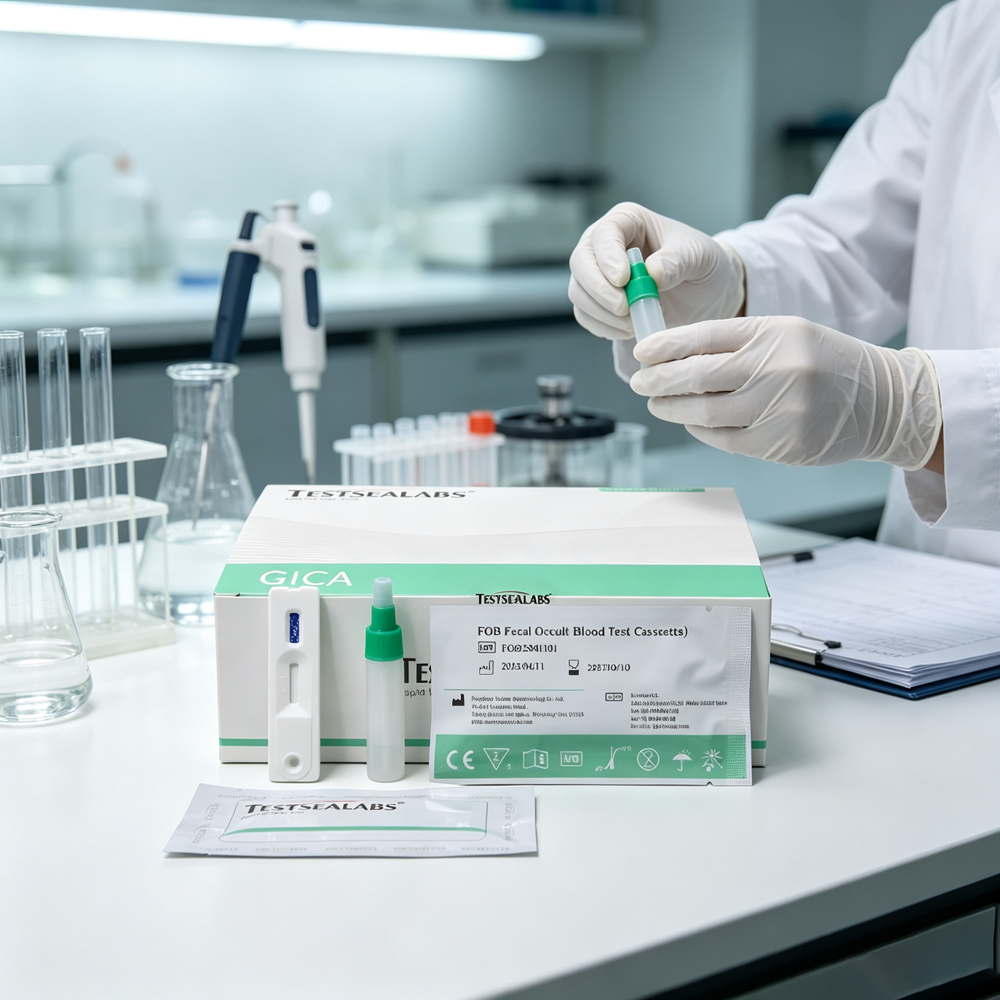
For the program operator, the workflow is: distribute collection kits; receive returned kits; load cassettes into an analyzer or read visually; flag positives for colonoscopy referral; track follow-up. The collection kit is the participant’s interface with the program; the analyzer is the program’s interface with the lab. Both have to be reliable. The Testsealabs FOB test specification describes a cassette format with strip and cassette variants, 25-test packaging, ISO 13485 and MDSAP certification, and storage at 4–30°C with a 24-month shelf life — specifications that map directly onto the FIT cassette format as well, because the assay chemistry is the same regardless of whether the test is read visually or on an analyzer. The US Centers for Disease Control and Prevention (CDC) Colorectal Cancer Control Program funds US state-level FIT-based screening on the same workflow, with FIT cassette distribution, mail-back, and analyzer-read at the recipient lab.
Why the workflow difference matters more than the per-test cost
FOBT is cheaper per test than FIT, sometimes by a factor of two. But the program economics are dominated by the cost of colonoscopy, not the cost of the screening test. A higher participation rate, a higher sensitivity, and a higher PPV all reduce the number of colonoscopies per detected cancer. When the program economics are modeled across a 10-year screening cycle, FIT is almost always cheaper per detected cancer than FOBT, because the per-test cost is a small fraction of the per-cancer cost and the per-cancer cost is dominated by colonoscopy.
Cut-off, threshold, and quantitation
FIT’s quantitative read is the feature that lets a program tune its positivity rate against its colonoscopy capacity. The hemoglobin threshold — the µg Hb per gram of feces above which the test is reported as positive — is the program’s primary operating parameter. A lower threshold catches more neoplasia but produces more colonoscopy referrals; a higher threshold catches less but produces fewer referrals.
| Hemoglobin threshold | Approximate positivity rate | Use case |
|---|---|---|
| 10 µg Hb/g feces | ~5–8% | High-sensitivity screening; high colonoscopy capacity |
| 15 µg Hb/g feces | ~4–6% | Common default; balanced balance of detection and capacity |
| 20 µg Hb/g feces | ~3–5% | Conservative screening; constrained colonoscopy capacity |
| Higher thresholds (30, 40, 50 µg/g) | ~2–3% | Very constrained capacity; opportunistic screening |
The right threshold for a given program depends on the program’s colonoscopy capacity, the program’s budget, and the program’s tolerance for missed neoplasia. A well-resourced national screening program will run at 10–15 µg/g; a constrained regional program will run at 20 µg/g or higher. The point is that the threshold is a tunable parameter on FIT, and it is not a tunable parameter on FOBT (which is a qualitative read at the assay’s inherent detection limit). For programs in low-, middle-, and high-income settings, the World Health Organization (WHO) cancer fact sheets position FIT as the preferred non-invasive screening test for organized programs; the threshold-tuning flexibility is part of why FIT scales across these settings.
Why quantitation matters for program equity
A qualitative FOBT that runs at its inherent detection limit produces the same positivity rate in every clinic, every region, and every demographic group — which means that clinics with similar populations produce similar positivity rates, but clinics with different populations produce different positivity rates that reflect the assay, not the population. A quantitative FIT lets the program set the same threshold everywhere, which means the positivity rate reflects the population, not the assay. This is the foundation of an equitable organized screening program: every participant is held against the same quantitative bar, and the program’s reported positivity rates are comparable across regions.
Population-level outcomes
The downstream outcome that screening programs track is colorectal cancer mortality reduction. Both FOBT and FIT reduce mortality relative to no screening; FIT reduces mortality more than FOBT. The mortality reduction is the cumulative effect of higher sensitivity, higher participation, and higher PPV, and it shows up in randomized trials, in observational cohort studies, and in the published mortality figures of national screening programs that have run for a decade or more.
National programs that have transitioned from FOBT to FIT report a stepwise improvement in the program metrics after the transition: participation rate up 15–30 percentage points, detection rate of CRC and advanced adenoma up 30–50%, interval cancer rate down. The transition is operationally non-trivial — the program has to switch collection devices, analyzers, IT systems, and participant communication — but the published outcomes support the transition in essentially every health system context where the FIT supply chain is feasible. The International Agency for Research on Cancer (IARC) handbook on colorectal cancer screening is the consolidated reference for these program-level outcome comparisons, with the FIT-over-FOBT recommendation grounded in the IARC evidence review.
Procurement for screening programs
A program manager procuring FIT or FOBT for an organized screening program should anchor the procurement on six specifications, not on the headline price. The headline price is the smallest line item in the program budget; the colonoscopy downstream is the largest.
- Assay format. FIT cassette (visual or analyzer-read) vs FOBT card (visual only). FIT is the preferred format for organized screening; FOBT card is acceptable for opportunistic screening in low-resource settings.
- Storage conditions. Both formats typically ship at 4–30°C. A cold-chain requirement (< 8°C) disqualifies a product for most last-mile screening programs. Verify that the storage temperature range covers the program’s ambient conditions.
- Shelf life. 24 months is the published shelf life for the Testsealabs hemoglobin assay. A shorter shelf life (< 18 months) increases the program’s inventory write-off rate and reduces the program’s flexibility on shipment timing.
- Quality systems certification. ISO 13485 is the floor; MDSAP recognition (US FDA, Health Canada, Japan PMDA, Australia TGA, Brazil ANVISA) simplifies multi-country procurement. CE marking under the IVDR is required for the European market.
- Packaging format. 25-test cassettes per kit is the typical pack format; bulk packs (50, 100) reduce per-test cost but increase inventory write-off risk if the kit is opened and not used in time.
- Manufacturer support. For an OEM-branded program, the OEM’s MOQ is 50,000 tests and the lead time is the gating constraint; verify both with the manufacturer’s published terms. For an OBL (own-brand-label) program running under a distributor’s own brand, the standard pack-and-ship MOQ is 5,000 tests and the lead time is shorter.
The procurement decision is not a single-spec decision; it is a multi-spec decision that the program manager walks through against the program’s requirements. A program that runs FIT at 15 µg Hb/g feces and reads on an analyzer will spec the analyzer-compatible cassette, the analyzer’s service contract, and the IT interface separately from the cassette procurement. A program that runs FIT visually will spec the cassette only, with no analyzer dependency. The two programs have different cost structures, different logistics, and different reporting workflows.
MOQ, OEM, and supply chain realities
The published MOQ for the Testsealabs hemoglobin test kit is 5,000 tests per standard order; an OEM-branded program runs at 50,000 tests per order and requires the manufacturer to commit a dedicated production slot. Lead time scales with order size: a 5,000-test order is typically ready in 2–4 weeks; a 50,000-test OEM order is typically 6–10 weeks. Programs that ramp from one to the other should plan the OEM slot 4 months in advance to align with the program’s screening cycle.
Fecal transferrin and combo panels
The next step up from a standalone hemoglobin FIT is a fecal transferrin combo panel. Transferrin is a more stable protein than hemoglobin in the gut environment — it resists degradation better as the stool sample ages — and it provides a complementary signal that improves detection of upper GI bleeding sources. Published combo panels from Testsealabs include Fecal Occult Blood + Transferrin + Calprotectin, which combines the hemoglobin signal (lower GI), the transferrin signal (upper GI and stable hemoglobin surrogate), and the calprotectin signal (inflammatory bowel disease).
For a colorectal screening program, the combo panel is not a replacement for FIT; it is a different test with a different clinical indication. The combo panel’s primary indication is differential diagnosis of GI symptoms (bleeding, inflammation) rather than population screening. Programs that are evaluating a participant with GI symptoms — abdominal pain, change in bowel habits, weight loss — will use the combo panel; programs that are screening an asymptomatic average-risk population will use FIT alone.
Why transferrin matters for sample logistics
Transferrin is a more robust analyte than hemoglobin for samples that travel through a postal system in warm weather. The hemoglobin in a stool sample degrades over hours at room temperature, especially in tropical climates; transferrin is stable for days. A program that uses a FIT in a temperate climate will not see the issue; a program that uses FIT in a tropical climate or in a setting where mail delivery takes 5–10 days should consider a transferrin-included panel or a sample-stabilization protocol.
Outside the US, the European clinical guideline body for medical oncology has weighed in. The European Society for Medical Oncology (ESMO) clinical practice guidelines list FIT as the preferred non-invasive screening test for average-risk adults, and the British Society of Gastroenterology (BSG) guidelines list FIT as the preferred non-invasive screening test in the UK bowel cancer screening programme. The two European positions align with the USPSTF and the IARC handbook, completing the convergence of major guideline bodies on FIT for organized screening.
FAQ
What is the difference between FIT and FOBT?
FIT (fecal immunochemical test) detects human hemoglobin specifically using antibodies against the globin moiety; it does not require dietary preparation, accepts a single stool sample, and can read quantitatively on an analyzer. FOBT (guaiac fecal occult blood test) detects peroxidase activity in stool, which is not specific to human blood; it requires a three-day dietary prep, three stool samples, and a manual visual read. FIT has higher sensitivity and higher specificity for colorectal neoplasia, and FIT-based programs report higher participation rates than FOBT-based programs.
Which test do the major guidelines recommend?
USPSTF, the US National Cancer Institute, the US CDC, WHO, IARC, the European Society for Medical Oncology, and the British Society of Gastroenterology all recommend FIT over FOBT for organized population screening. The 2021 USPSTF recommendation lists FIT, FOBT, and stool DNA testing as acceptable stool-based options, with FIT as the preferred choice for organized programs.
What hemoglobin threshold should a screening program use?
There is no universal threshold. A well-resourced national program typically runs at 10–15 µg Hb/g feces, which catches more neoplasia but produces more colonoscopy referrals. A constrained regional program typically runs at 20 µg Hb/g feces or higher, which catches less but produces fewer referrals. The right threshold is a function of the program’s colonoscopy capacity, budget, and tolerance for missed neoplasia. The threshold is a tunable parameter on FIT and is not tunable on FOBT.
How often should a FIT-based screening program screen?
Annual or biennial. USPSTF and most international guidelines recommend annual FIT in average-risk adults aged 45–75 (USPSTF) or 50–74 (most European programs). The exact interval depends on the local guideline and the program’s resources. Annual FIT detects more neoplasia per round; biennial FIT improves program economics and reduces participant burden. Most organized programs default to biennial.
What is the storage requirement for and a FIT cassette?
Room-temperature storage at 4–30°C, with a 24-month shelf life from manufacture, is the published specification for the Testsealabs hemoglobin test. Cold-chain storage (< 8°C) is not required, which simplifies last-mile logistics for screening programs. Verify the manufacturer’s published storage range against the program’s ambient conditions; a cassette stored outside the published range is not a reliable test.
Can a screening program mix FIT and FOBT in the same population?
Technically yes, operationally no. A mixed program runs two collection kits, two analyzers (or two visual-read protocols), two reporting workflows, and two thresholds. The operational complexity, the cost of dual inventory, and the loss of program-equity comparability outweigh any procurement savings. A program that transitions from FOBT to FIT should run FOBT only for the residual participants on the legacy protocol and switch new participants to FIT.
Where can a screening program source FIT or FOBT in volume?
For an organized screening program, the supplier should be ISO 13485-certified with MDSAP recognition for multi-country procurement and CE marking under the IVDR for European programs. The Testsealabs tumor markers test series includes hemoglobin and transferrin fecal assays with cassette format, 4–30°C storage, and a 24-month shelf life, with standard standard-order MOQ at 5,000 tests and OEM-branded MOQ at 50,000 tests. For screening-program procurement, the program manager can reach the Testsealabs inquiry desk to request a sample pack and to specify the assay target (hemoglobin vs hemoglobin + transferrin vs combo), the pack size, the threshold target in µg Hb/g, and the program’s screening cycle volume.
Closing note
FIT has won the FIT vs FOBT comparison in organized population screening, not because the per-test cost is lower but because the program-level outcomes are better. Higher participation rate, higher sensitivity for colorectal neoplasia, higher PPV, lower interval cancer rate, and tunable quantitative thresholds make FIT the default choice for every health system that can run the supply chain. FOBT remains relevant only for opportunistic screening in low-resource settings where FIT supply or FIT analyzer logistics make FIT infeasible. For a program that is starting fresh, FIT is the choice. For a program that is on FOBT and considering transition, the published outcomes support the transition and the cost-benefit case strengthens with each screening cycle. The procurement decision should be anchored on the six specifications above — assay format, storage, shelf life, certification, packaging, and OEM support — not on the per-test price alone, because the colonoscopy downstream dominates the program economics and FIT’s clinical advantages compound into the downstream.
Angela Qin — International Sales Director, Testsealabs
Angela Qin is the International Sales Director at Hangzhou Testsea Biotechnology Co., Ltd. (Testsealabs), with 10+ years of experience in the in vitro diagnostic (IVD) and veterinary product industry. Founded in 2015 with the pursuit “serving society, health world,” Testsealabs specializes in the R&D, production, and sales of rapid diagnostic products, including tests for coronavirus disease, cardiovascular diseases, inflammation, tumor markers, infectious diseases, drug abuse, and pregnancy. Leveraging proprietary platforms (immunological detection, molecular biology, protein chip, and biological raw materials), Angela helps global distributors, hospitals, public health institutions, and veterinary clients source reliable, high-quality diagnostic solutions from China—backed by strict quality control and a customer-first philosophy. Testsealabs’ products are widely used in rapid diagnosis, treatment monitoring, maternal and child healthcare, drug and alcohol testing, and have been sold to over 100 countries worldwide. www.testsealabs.com
Facebook: https://www.facebook.com/profile.php?id=61589658929835
Post time: Sep-07-2026