
Why HCV antibody rapid testing remains the front line of hepatitis C screening in low-resource settings — the room-temperature envelope between 4 and 30°C, the 24-month shelf life, the 15-minute fingerstick reading time, the ISO 13485 and MDSAP quality platform, and the public-health rationale that keeps antibody testing ahead of PCR-based pathways in the WHO viral hepatitis elimination strategy.
TL;DR
- HCV antibody rapid tests remain the most operationally robust option for screening in low-resource settings — no cold chain, room-temperature storage between 4 and 30°C, 24-month shelf life, results in 15 minutes from a fingerstick whole-blood sample.
- The public-health case for keeping antibody-first screening rests on three WHO-aligned pillars: it is inexpensive per test, it requires no laboratory infrastructure, and it catches the chronic infections that drive onward transmission.
- Procurement decision-makers working with national HIV/HCV programmes, NGO field deployments, and primary-care point-of-care networks should weigh rapid antibody testing against lab-based PCR not on sensitivity alone but on the total cost per person diagnosed and initiated on treatment.
- For manufacturers and OEM distributors sourcing from China, the operational checklist that separates a viable low-resource HCV kit from a marketing claim covers: ISO 13485 plus MDSAP certification, room-temperature stability data, format flexibility (strip or cassette), whole-blood / serum / plasma specimen compatibility, and a documented minimum order quantity.
- The article below walks the procurement case, the technical case, the field-deployment case, and the supply-side case for choosing an antibody rapid test as the front line of an HCV screening programme.
Table of Contents
- What antibody screening actually measures
- The sensitivity and specificity story
- The public-health case for keeping antibody rapid testing as the front line
- The format flexibility that matters in field deployment
- The storage and shelf-life envelope that lets the kit travel
- The supply-side checklist for sourcing from a Chinese manufacturer
- The field-deployment pattern that makes rapid antibody testing work
- When an RNA-first pathway is the right operational choice
- The procurement pathway for buyers
- Frequently Asked Questions
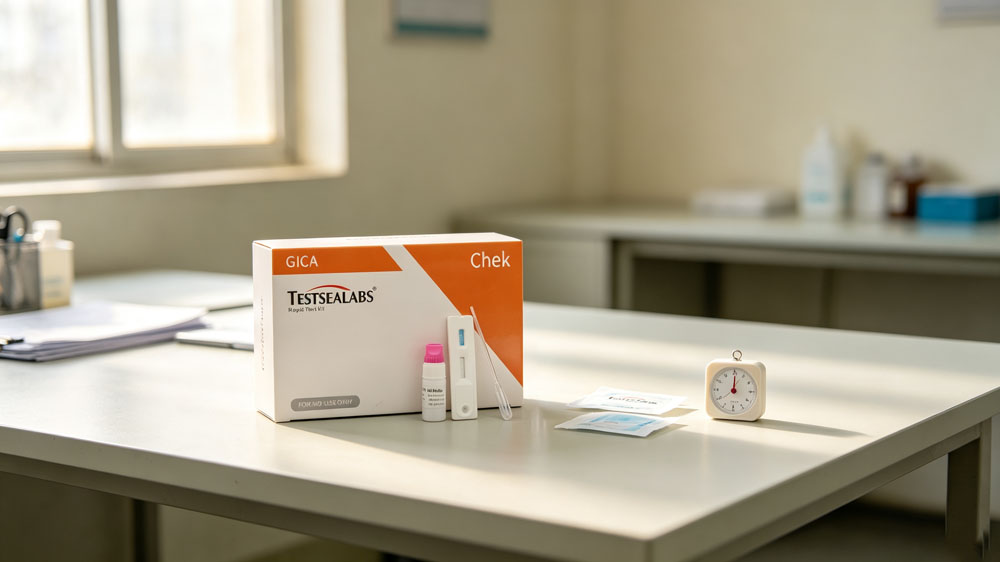
HCV Hepatitis C Virus Ab rapid test kit — chromatographic immunoassay format for whole-blood fingerstick, serum, and plasma specimens. Source: Testsealabs HCV Ab Test product page.
What antibody screening actually measures
An HCV antibody rapid test detects IgG-class antibodies to recombinant hepatitis C virus core, NS3, NS4, and NS5 antigens immobilised on a nitrocellulose strip. A positive line means the patient has mounted an immune response to HCV exposure at some point in life. It does not, on its own, distinguish a current chronic infection from a cleared past infection — that distinction requires a confirmatory HCV RNA test — but for public-health screening purposes the antibody-positive cohort is the cohort that needs to be triaged into RNA confirmation and onward linkage to care.
The operational advantage of the rapid antibody format is that it converts a virology question into a bedside procedure. A drop of capillary whole blood from a fingerstick, fifteen minutes of incubation, and a visual readout that does not require interpretation by a laboratory scientist. The procedure needs no pipettes, no centrifuges, no refrigeration, and no electricity. The Testsealabs HCV Hepatitis C Virus Ab Test product page describes the assay format in chromatographic immunoassay form with a 15-minute reading time and a 24-month shelf life at 4–30°C storage temperature — the room-temperature stability that lets a kit travel from the manufacturer’s loading dock to a rural clinic by motorbike without breaking a cold chain.
The sensitivity and specificity story
Published performance data on WHO-prequalified HCV antibody rapid tests routinely places sensitivity in the high range and specificity also in the high range against a laboratory ELISA reference standard. The exact performance number depends on the population being tested — sensitivity is highest in chronic HCV cohorts with established antibody titres and lower in very recent infections during the seroconversion window — but for the operational purpose of screening at a population level the assay is considered acceptable by WHO, by the U.S. Centers for Disease Control and Prevention, and by the European Association for the Study of the Liver.
The technical limitation worth being honest about is the seroconversion window of approximately 8 to 12 weeks after exposure. A patient tested inside that window can carry HCV RNA and still register antibody-negative on the rapid test. For a screening programme that targets general population prevalence, the window is operationally irrelevant because the prevalence cohort has had time to seroconvert. For an outbreak investigation that targets very recent exposures, an RNA-based test is the appropriate front-line tool. The WHO viral hepatitis health topic page walks this distinction in detail and is the reference most procurement teams use to decide when rapid antibody testing is the appropriate operational choice.
The public-health case for keeping antibody rapid testing as the front line
In a country with limited laboratory infrastructure, the relevant comparison is not antibody sensitivity versus PCR sensitivity in isolation. It is antibody-plus-confirmatory-RNA against PCR-from-the-start. Antibody rapid testing is much cheaper per test, much faster to result, deployable in settings where a PCR machine cannot be operated, and converts a clinic visit into a same-day diagnosis-and-linkage decision when combined with on-site dried-blood-spot RNA confirmation. The total cost per person diagnosed and initiated on direct-acting antiviral therapy is typically lower for the antibody-first pathway than for the PCR-from-the-start pathway, and the number of people who actually do complete the diagnostic pathway is higher — a result that holds even when PCR sensitivity is technically higher.
The WHO hepatitis C fact sheet sets the elimination-of-viral-hepatitis-as-a-public-health-threat target that national programmes are working toward, with a service-delivery target of diagnosing the majority of people living with hepatitis C by 2030. Reaching that target in low- and middle-income countries requires the operational reach of rapid antibody testing — a finding that has driven the inclusion of HCV rapid antibody tests on the WHO prequalification list and on the procurement catalogues of the major global health funders. The procurement implication is that antibody rapid testing is not the technology to substitute away from; it is the technology to scale up.
The format flexibility that matters in field deployment
The HCV rapid antibody test ships in two physical formats — strip and cassette. Strip format is the cheaper option per test and the format most programmes order for high-volume screening campaigns where the budget is the binding constraint. Cassette format costs marginally more and gives the operator a plastic housing around the strip, which reduces the risk of contamination, makes the result easier to read in low-light conditions, and is the preferred format for clinics that need a documented visual record of the test outcome for the patient file. Both formats run on the same fifteen-minute protocol from whole blood, serum, or plasma. The Testsealabs HCV product specification table lists strip and cassette as parallel format options with 25T, 40T, and 50T packaging configurations.
The specimen flexibility is the second operational point. Whole-blood fingerstick sampling eliminates the venepuncture step, which means a healthcare worker with two days of training can run the test in a community setting without the phlebotomy skills that a serum or plasma workflow requires. Serum and plasma remain the laboratory-preferred specimen formats, and the same cassette accommodates either workflow, which lets a clinic run community fingerstick testing in the morning and laboratory-based serum testing in the afternoon on the same product code line. The FIND diagnostic pipeline platform tracks the rapid-test product formats and specimen-type validations that procurement teams compare against incoming supplier offers.
The storage and shelf-life envelope that lets the kit travel
Cold-chain logistics are the single largest operational obstacle to deploying a diagnostic test in a low-resource setting. A product that needs to stay between 2 and 8 °C from the manufacturer’s loading dock to the patient bedside cannot be shipped by the local motorbike courier, cannot be stored in the village health worker’s backpack, and cannot survive a power outage at the clinic refrigerator. The room-temperature envelope between 4 and 30 °C eliminates that entire operational layer. The Testsealabs HCV kit storage envelope of 4–30 °C with 24-month shelf life is the operational specification that lets a national procurement officer order a single annual bulk shipment instead of running a refrigerated distribution network.
The 24-month shelf life is the second logistical enabler. A clinic that orders one kit per quarter can carry the inventory on a shelf rather than in a refrigerator, can use the kit across the full 24-month window without a forced write-off at the expiry date, and can borrow from a neighbouring clinic’s stock during a demand spike rather than waiting on a refrigerated re-supply shipment. The U.S. FDA in vitro diagnostic regulatory assistance page is the regulatory reference that procurement teams use when they need to confirm the room-temperature stability data the supplier submitted aligns with the FDA review framework for Class II rapid IVDs.
The supply-side checklist for sourcing from a Chinese manufacturer
Procurement officers sourcing HCV rapid antibody tests from Chinese manufacturers evaluate five operational dimensions in the order they appear on the supplier’s quality dossier:
ISO 13485 plus MDSAP certification. ISO 13485 is the medical-device quality-management standard required for sale into most regulatory regimes. MDSAP — the Medical Device Single Audit Program — is the audit framework that lets a manufacturer satisfy the regulatory requirements of Australia, Brazil, Canada, Japan, and the United States through a single audit cycle, which materially shortens the time-to-market in the largest English-language regulatory regimes. A supplier with both certifications is the operational baseline; a supplier with neither is not qualified for a national procurement programme.
Documented room-temperature stability. A written statement that the kit is stable at 4–30 °C for 24 months is the entry-level specification; the procurement-grade specification is real-time and accelerated stability data the supplier can produce on request. The Testsealabs HCV product specification lists the stability envelope and the contact-us page is the channel for requesting the full stability dossier.
Format and packaging options. Strip format for high-volume campaigns, cassette format for clinic workflows, and pack sizes of 25T, 40T, and 50T to match the throughput profile of the receiving clinic. A supplier that offers only one format or one pack size is a supplier whose customers have to over-order to cover the unit they actually need.
Specimen compatibility. Whole blood from fingerstick for community testing, plus serum and plasma for laboratory workflows. The same cassette accommodating all three specimen types lets one product code line serve both use cases.
Minimum order quantity and OEM customisation. The standard minimum order quantity for an HCV rapid antibody test kit is in the order of a few thousand units, and the OEM customisation threshold for branded cassette shells, branded instruction leaflets, and branded outer cartons is in the order of tens of thousands of units. A supplier that publishes a transparent minimum order quantity and a transparent OEM threshold is a supplier that can be planned into an annual procurement cycle.
The field-deployment pattern that makes rapid antibody testing work
The field pattern that consistently delivers the highest diagnosis-and-treatment rate is the integrated rapid-test-plus-dry-blood-spot model. A patient presents at a community screening event, receives a fingerstick rapid antibody test, and gets a result in fifteen minutes. If the result is positive, the healthcare worker takes a second fingerstick sample, blots it onto a dried-blood-spot filter paper card, and ships the card to a regional laboratory for HCV RNA confirmation. The patient leaves the screening event with a confirmed antibody-positive status and an appointment date for the RNA result. The confirmatory RNA drops back to the clinic within a week, and the patient starts direct-acting antiviral therapy on the same visit. The total pathway time from screening to treatment initiation is typically under fourteen days — a result that compares favourably with the multi-week pathway of a PCR-from-the-start laboratory workflow.
The same integrated pattern is the operational model for harm-reduction programmes working with people who inject drugs, for antenatal HCV screening integrated into existing HIV antenatal programmes, and for prison-health screening networks. The common element is a rapid antibody test at the front end and a confirmatory RNA test on the back end, with the two connected by a dried-blood-spot logistics chain that does not require the patient to revisit the clinic for the venepuncture. The WHO hepatitis C fact sheet walks the integrated pathway model that public-health programmes apply when scaling up HCV screening in primary-care and community settings.
When an RNA-first pathway is the right operational choice
There are operational cases where a PCR-from-the-start pathway is the better answer. Very recent exposure during an outbreak investigation, where the antibody seroconversion window is operationally relevant, is one. Confirmatory testing of antibody-positive patients who cannot return for a second visit is another — a same-visit PCR plus antibody combination test eliminates the loss-to-follow-up that an antibody-plus-separate-PCR pathway can introduce. Surveillance programmes that need to distinguish active infection from cleared past infection at the population level are a third case, where the antibody prevalence overstates the active-infection prevalence and the RNA-based surveillance number is the operationally correct answer.
For the dominant operational case — population-level screening of adults in low- and middle-income countries — the antibody-first pathway remains the right operational choice. The clinical case for keeping antibody rapid testing as the front line is the total pathway cost per person diagnosed and initiated on treatment, not the per-test sensitivity number. The operational case is the room-temperature envelope and the fifteen-minute result. The supply case is the room-temperature stability, the format flexibility, and the OEM threshold.
The procurement pathway for buyers
A national procurement officer or an NGO field buyer sourcing HCV rapid antibody tests follows a five-step pathway. First, the buyer defines the operational specification — strip or cassette, pack size, specimen type, OEM requirement. Second, the buyer requests the stability dossier and the ISO 13485 plus MDSAP certificates from the supplier shortlist. Fourth, the buyer runs a small-volume field evaluation on the top two or three candidates against the local reference laboratory’s ELISA assay. Fifth, the buyer negotiates the annual supply agreement with the field-evaluation winner and places the bulk procurement order.
The Testsealabs contact-us page is the procurement entry point for buyers requesting the HCV rapid antibody test stability dossier, the ISO 13485 plus MDSAP certificates, the OEM customisation catalogue, and the annual supply agreement quotation. The Testsealabs infectious disease portfolio page lists the parallel product lines — HIV, HBV, syphilis, dengue, malaria, and the multi-analyte combination cassettes — that sit alongside HCV on the same room-temperature stability platform.
Frequently Asked Questions
What specimen types does the HCV rapid antibody test accept?
The HCV rapid antibody test accepts whole blood from a fingerstick, plus venous whole blood, serum, and plasma. The whole-blood fingerstick option is the field-deployed sampling mode that eliminates the venepuncture step; the serum and plasma options are the laboratory-preferred modes for clinic and hospital workflows. The same cassette accommodates all four specimen types.
What is the reading time and how is the result interpreted?
The reading time is 15 minutes from sample application. A positive result shows two coloured lines — one at the control position and one at the test position — and means the patient has mounted an immune response to HCV exposure at some point. A negative result shows one coloured line at the control position only. The control line must appear for the result to be valid; a cassette with no control line is an invalid result that needs to be repeated with a fresh device.
What storage temperature range and shelf life apply to the kit?
The kit is stored at room temperature between 4 and 30 °C with a 24-month shelf life from the date of manufacture. The room-temperature envelope is the operational specification that lets the kit travel through the low-resource distribution chain without breaking a cold chain and lets the receiving clinic store the inventory on a shelf rather than in a refrigerator.
What regulatory certifications does the manufacturer carry?
The manufacturer carries ISO 13485 medical-device quality-management certification plus MDSAP — the Medical Device Single Audit Program that covers Australia, Brazil, Canada, Japan, and the United States. The combination shortens the time-to-market in the largest English-language regulatory regimes and is the entry-level certification baseline for national procurement programmes.
What is the minimum order quantity and the OEM customisation threshold?
The minimum order quantity for an HCV rapid antibody test kit is in the order of a few thousand units, and the OEM customisation threshold for branded cassette shells, branded instruction leaflets, and branded outer cartons is in the order of tens of thousands of units. A supplier that publishes a transparent minimum order quantity and a transparent OEM threshold is a supplier that can be planned into an annual procurement cycle.
How does the rapid antibody test compare with laboratory ELISA and PCR?
The rapid antibody test has high sensitivity and high specificity against a laboratory ELISA reference standard for established chronic HCV infections. PCR detects HCV RNA directly and is the appropriate test for very recent exposures inside the 8-to-12-week seroconversion window, for confirmatory testing of antibody-positive patients, and for surveillance programmes that need to distinguish active from cleared infection. For population-level screening of established chronic infections, the antibody rapid test is the operationally and economically correct front-line tool.
How is a positive rapid antibody result handled in a screening programme?
A positive rapid antibody result flags the patient into the confirmatory testing pathway. The standard integrated model takes a second fingerstick sample, blots it onto a dried-blood-spot filter paper card, and ships the card to a regional laboratory for HCV RNA testing. The patient starts direct-acting antiviral therapy on the visit when the confirmatory RNA result drops back to the clinic, typically within seven to fourteen days of the initial screening visit.
Post time: Sep-23-2026