Testsealabs MDMA Ecstasy Test (Urine)
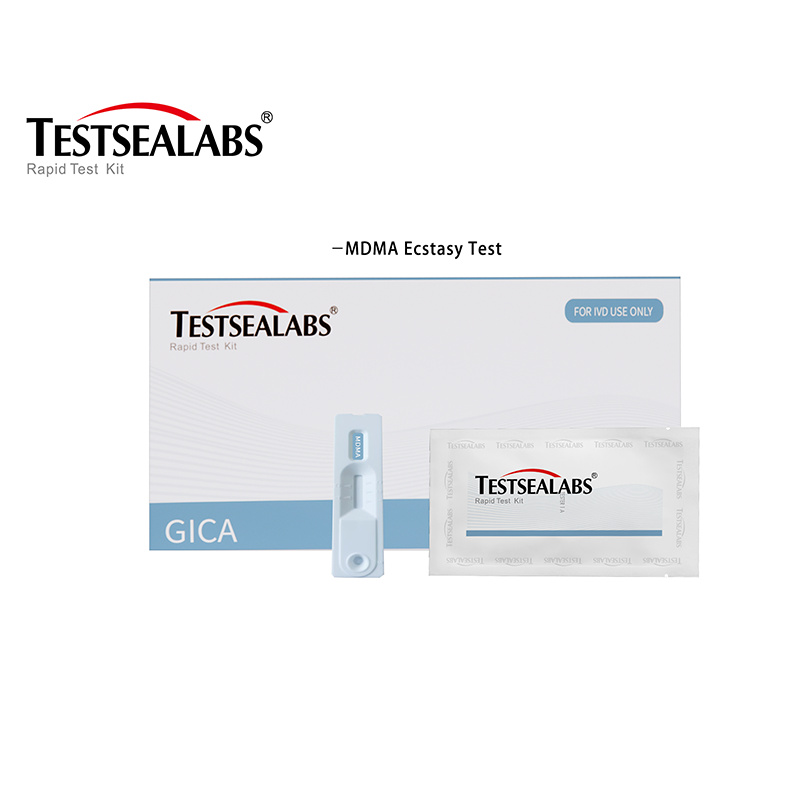
Short Description:
The MDMA Ecstasy Test is a lateral flow chromatographic immunoassay for the qualitative detection of methylenedioxymethamphetamine in urine.
 Fast & Accurate:Achieve reliable results in minutes.
Simple Operation:No complex equipment required.
High Accuracy:Lab-grade precision you can trust.
Clear Visual Readout:Results are easy to read and interpret.
Certified Quality Systems:Compliant with ISO 13485 and MDSAP.
Room-Temperature Stability:No cold chain needed—easy to transport and store.
Product Specification
| Principle | Chromatographic Immunoassay | Specimen | Urine |
| Reading Time | 3-5 minutes | QMS Certification | ISO 13485 and MDSAP |
| Storage Temperature | 4-30°C | Shelf life | 2 years |
| Format | Strip/Cassette | Specification | 25T/40T/50T |
Intended Use
The MDMA Ecstasy Test is a lateral flow chromatographic immunoassay for the qualitative detection of methylenedioxymethamphetamine in urine.
Summary
Methylenedioxymethamphetamine (ecstasy) is a designer drug first synthesized in 1914 by a German drug company for the treatment of obesity. Those who take the drug frequently report adverse effects, such as increased muscle tension and sweating.MDMA is not clearly a stimulant, although it has, in common with amphetamine drugs, a capacity to increase blood pressure and heart rate. MDMA does produce some perceptual changes in the form of increased sensitivity to light, difficulty in focusing, and blurred vision in some users.Its mechanism of action is thought to be via release of the neurotransmitter serotonin. MDMA may also release dopamine, although the general opinion is that this is a secondary effect of the drug (Nichols and Oberlender, 1990).The most pervasive effect of MDMA, occurring in virtually all people who took a reasonable dose of the drug, was to produce a clenching of the jaws.The MDMA Ecstasy Test yields a positive result when the concentration of methylenedioxymethamphetamine in urine exceeds 1000 ng/mL.